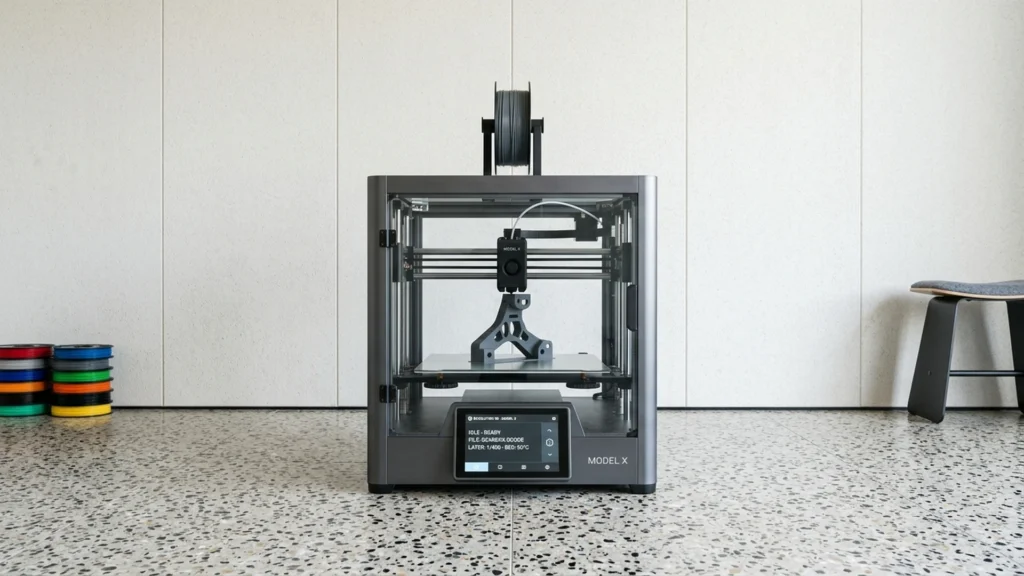
The 3 Best Jumbo Build Volume 3D Printers in 2026

Transparency Note: This post contains affiliate links. As an Amazon Associate, we earn from qualifying purchases at no extra cost to you.

Jumbo build volume 3D printers are for prints that would be too big for standard beds. Buyers in this sub-category care about finishing large parts cleanly, keeping dimensions close to the model, and avoiding failures that waste hours of print time.

Picking one is harder than it sounds. Larger machines often trade faster setup for a bigger calibration surface. They may also need more rigid frames, steadier cooling, and more consistent bed contact to prevent warping and layer shifts on tall or wide parts.

Use the checklist below to match your print size goals with daily usability, then compare the top options ranked for this category. Looking for all types? See our Best 3D Printers.

Quick Overview

FLSUN V400 3D Printer
#1 FLSUN V400 3D Printer
Creality K2 Plus 3D Printer
#2 Creality K2 Plus 3D Printer
Anycubic Kobra 3 Max 3D Printer
#3 Anycubic Kobra 3 Max 3D Printer

Our Top Picks

#1. FLSUN V400 3D Printer

FLSUN V400 3D Printer
Our Score
7.9 / 10
hover for details
Print Quality
8
Reliability
7.6
Ease
8
Features
8.2
Value
7.6
BrandFLSUN
Build Volume500 x 500 x 480 mm
Max Print Speed600 mm/s
Number Of Extruders2
Supported MaterialsPLA, PETG, TPU
  • Sharp layers, accurate dimensions
  • Fast printing speed
  • Large build capacity
  • Firmware update friction
  • Klipper update failures

For jumbo-format printing, the FLSUN V400 stands out with its 500 x 500 x 480 mm build volume, paired with very fast speeds up to 600 mm/s. Big parts stay sharp, with consistent layers and accurate dimensions that reduce rework. When you need large functional prints in PLA, PETG, or TPU, it is built for output rather than slow, small-parameter testing.

The trade-off is software and firmware friction. Some users run into update issues with Klipper, so first-time owners may want to plan for some troubleshooting before long, unattended jobs. This is best for buyers who are comfortable dialing things in and keeping notes, not those who want a fully hands-off experience.

→ Read full review

#2. Creality K2 Plus 3D Printer

Creality K2 Plus 3D Printer
Our Score
7.5 / 10
hover for details
Print Quality
8
Reliability
6.4
Ease
7.5
Features
8
Value
7.7
BrandCreality
Printing TechnologyFDM
Build Volume350 x 350 x 350 mm
Max Print Speed600 mm/s
Max Nozzle Temperature350 °C
Supported MaterialsPLA, PETG, TPU, ABS, ASA, PC, PA
  • Sharp layers, accurate dimensions
  • Smart convenience features, helpful extras
  • Large build capacity
  • Occasional clogs or poor adhesion
  • Assembly inconsistency
  • Firmware version tuning

The Creality K2 Plus stands out in the jumbo build volume FDM group because its 350 x 350 x 350 mm workspace makes large parts practical. Print quality is strong for the category, with sharp layers and accurate dimensions that usually mean less sanding and fewer fit issues. It also supports a wide range of materials, including PLA, PETG, TPU, ABS, ASA, PC, and PA, which helps when you want big functional prints rather than only decorative ones.

The trade-off is that day to day reliability and repeatability can vary. Some users report occasional clogs and poor bed adhesion, and assembly can feel inconsistent from one unit to the next. Firmware tuning may also be part of the learning curve. This is a good choice for buyers who want large-scale printing but do not mind some setup fine tuning, especially for long prints where small adhesion problems become bigger.

#3. Anycubic Kobra 3 Max 3D Printer

Anycubic Kobra 3 Max 3D Printer
Our Score
7.2 / 10
hover for details
Print Quality
7.3
Reliability
6.8
Ease
7.1
Features
7.1
Value
7.8
BrandANYCUBIC
Printing TechnologyFDM
Build Volume420 x 420 x 500 in
Layer Height0.2 mm
Max Print Speed600 mm/s
Max Bed Temperature90 °C
  • Large build capacity
  • Fast printing speed
  • Reliable auto-leveling
  • Firmware instability
  • Unit variability
  • Heated bed failures

This Anycubic Kobra 3 Max stands out for its big print area in the jumbo build volume category, with a 420 x 420 x 500 in build volume. That size helps when you want large cosplay parts, wide functional pieces, or multiple medium items in one job. Fast travel and printing speeds can also cut time on long, bulky models. Auto bed leveling is reliable enough to get you to first prints without heavy setup.

The main trade-off is consistency. Firmware instability, unit variability, and reported heated bed failures can slow projects when you least want interruptions. If you are comfortable troubleshooting and you can verify prints with test runs, the Kobra 3 Max can fit the jumbo workflow well. If you need long prints to finish with minimal attention, plan for extra monitoring early on.

What to Look For

Build Volume That Matches Your Real Parts: Look beyond advertised dimensions. Target machines whose W x D x H gives you enough clearance for your biggest model, plus room for skirts, supports, and brim. If you routinely print large boxes or cosplay shells, prioritize usable footprint over maximum height alone.

Layer Height and Surface Consistency: Jumbo prints amplify small defects. Check whether the printer can hold fine layer height without rough top layers, gaps, or uneven extrusion. You want repeatable dimensional accuracy, not just a best-case print.

Speed That Does Not Destroy Detail: High max print speed often assumes ideal conditions. For large prints, evaluate how well the printer holds quality while moving fast, especially across long perimeters and over bridges. Faster is only helpful if it still looks clean after the first large print.

Reliability for Long Jobs: A jumbo bed increases the chance of adhesion issues. Focus on whether the printer can complete long runs with stable temperature control and dependable feeding. Also consider how often you will need to clean clogs or fix loose motion components after tall prints.

Practical Feature Set for Daily Use: For this category, features matter when prints run for hours. Prioritize basics that reduce friction, like heated bed support and dependable filament handling. Multi-extruder setups only help if you truly need them, since they add tuning time.

How We Picked

Products were identified through broad research across review sites and buyer forums, then filtered to only those that qualify as Jumbo Build Volume 3D Printers. The final shortlist focuses on machines that are realistically used for large parts, not only those with big specs on paper.

Scoring uses the same objective pillar framework as the main 3D Printers post. Print quality, reliability, ease, features, and value are weighted to reflect the daily pain points of large-format printing, then ranked directly within this sub-category for buyers who want the best match for jumbo builds.

Frequently Asked Questions

What build volume sizes should I expect from jumbo build volume printers?

Jumbo build volume printers usually target large parts and bigger workspaces. Look for a build area around 300 mm class up to roughly 350 mm in one direction. Always check all three axes, not just the longest side, because parts need height too.

Do large build volume printers need special bed leveling and calibration more often?

They often need more careful setup because the bed area is bigger. Use auto bed leveling if the model has it, then run a quick first-layer test print. Recheck once after major moves, new nozzles, or when prints start failing.

Are jumbo build volume prints harder to keep stuck to the bed?

Large prints increase the odds of lifting, especially near the edges. Use the right bed temperature for your filament and keep the enclosure steady if there is one. Use a brim for tall or wide parts, and clean the bed before each long job.

How do jumbo build volume printers compare to smaller 3D printers for part size?

Jumbo build volume printers help when you want one-piece models instead of many smaller sections. A larger build area also reduces how often you must reslice and assemble. For small parts, a smaller printer can still be faster and cheaper to run.

When should I choose a different type of 3D printer instead of a jumbo build volume FDM printer?

Consider SLA or MSLA when you need very smooth surface detail and small features. Consider resin for miniatures, dental-style models, and fine text. Choose FDM jumbo printers when you need larger functional parts, durable materials like PETG, and easier maintenance.

See Also

Share:
On Key
You Might Also Like