




Skip to content

The 8 Best Weather Stations in 2026

September 12, 2026-By The Top Zone

Transparency Note: This post contains affiliate links. As an Amazon Associate, we earn from qualifying purchases at no extra cost to you.

Weather stations are home devices that measure outdoor conditions like temperature, humidity, wind, and rain. Many also track pressure and other helpful signals. They sit outside on a post or wall and send data to a console, a phone app, or both.

Picking one is harder than it looks because key details often get buried in specs. A long wireless range can be meaningless if the signal drops through walls. A big screen can distract from the real issue, sensor quality. App and smart home support may sound important, but setup, syncing speed, and reliable alerts matter more.

This guide breaks the decision into practical criteria and matches those criteria to real product behavior. You will learn what to check for accuracy, durability, usability, connectivity, and value, then use a clear selection process to narrow down the right station for your yard and your setup.

Quick Overview

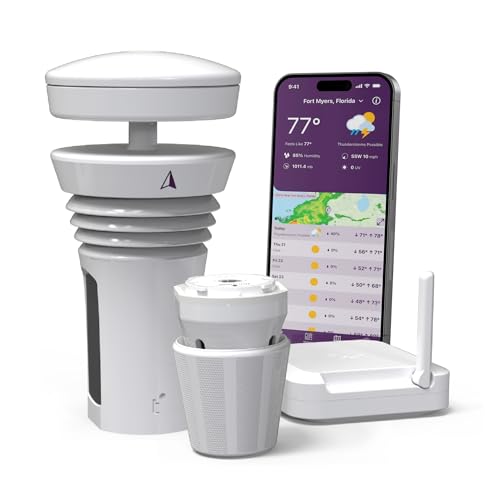
WeatherFlow Tempest Weather Station
Best Overall WeatherFlow Tempest Weather Station
Ambient Weather WS-5000 Weather Station
Best Solar Powered Ambient Weather WS-5000 Weather Station
Davis Vantage Pro2 Plus Weather Station
Best for Pro Monitoring Davis Vantage Pro2 Plus Weather Station
Davis Vantage Pro2 Weather Station
Best for Advanced Tinkerers Davis Vantage Pro2 Weather Station
ECOWITT HP2560 Weather Station
Best Wi-Fi ECOWITT HP2560 Weather Station
Ambient Weather WS-2902 Weather Station
Best with Bluetooth Ambient Weather WS-2902 Weather Station
AcuRite Iris 5-in-1 Weather Station
Best for Compact Lots AcuRite Iris 5-in-1 Weather Station
Newentor Q3 Weather Station
Best Value Newentor Q3 Weather Station

Top Picks

Best Overall

WeatherFlow Tempest Weather Station
Our Score 8.2 / 10 Score details
Accuracy8.1
Durability8
Usability8.6
Connectivity8.1
Value7.9
How we research & score
BrandWeatherFlow
Measurement FunctionsTemperature, Humidity, Barometric Pressure, Wind Speed, Wind Direction, Dew Point, UV Index, Lightning Strikes, Rainfall, Solar Radiation
Wireless Range1000 ft
ConnectivityWi-Fi / Bluetooth
Power SourceSolar Powered
App Smart Home CompatibilityAlexa / Rachio / IFTTT
  • Weatherproof, stays reliable
  • Clear display, easy pairing
  • More measurement types
  • overestimated rainfall total

This WeatherFlow station fits the Best Overall spot because it balances strong day-to-day readings with a setup that does not feel fragile. Its solar-powered design and weatherproof build help it keep running through sun, rain, and cold without frequent babysitting.

Readouts are straightforward, and pairing is simple once you get the initial setup done. It also covers the big weather categories, including temperature, humidity, barometric pressure, wind speed and direction, UV index, rain, and lightning strikes. In daily use, the system tends to stay steady, and the app plus Wi-Fi and Bluetooth links make it easier to check trends without waiting.

The main downside is rainfall totals can come out higher than expected. If you want one station that stays reliable outdoors and you care about multiple sensor types, this is the one to get. If you track rain closely for watering or comparisons, you may want to cross-check with a local gauge.

→ Read full review

Best Solar Powered

Ambient Weather WS-5000 Weather Station
Our Score 8.1 / 10 Score details
Accuracy8.6
Durability7.7
Usability7.9
Connectivity8.3
Value7.8
How we research & score
BrandAmbient Weather
Display TypeColor LCD
Measurement FunctionsTemperature, Humidity, Barometric Pressure, Rainfall
Sensors Included4 Sensors
Wireless Range1000 ft
ConnectivityWi-Fi
Power SourceSolar Powered
App Smart Home CompatibilityIFTTT / Google Assistant / Alexa
  • Consistently matches local sources
  • Reliable wireless and app link
  • Solar or AC powered
  • can be non-trivial

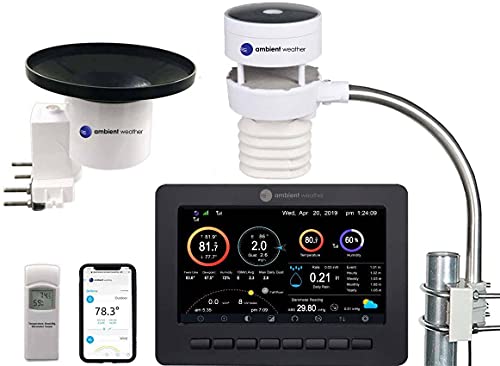
This Ambient Weather WS-5000 fits the Best Solar Powered role because it can run on solar power while still sending a steady stream of data indoors. You get the convenience of a power source that keeps itself topped up outdoors, without losing day-to-day monitoring.

In real use, it holds up well on measurement quality, with readings that consistently match local sources. The station also keeps connections reliable, using Wi-Fi with quick syncing to the app, plus support for IFTTT and voice control via Alexa and Google Assistant. For the basics, it tracks Temperature, Humidity, Barometric Pressure, and Rainfall with four outdoor sensors, using a 1000 ft wireless range.

One catch is setup and setup changes can be non-trivial, especially if you want everything dialed in right away. If you want solar-powered outdoor monitoring with strong wireless reliability and app or smart home integration, this is a good fit, as long as you do not mind taking time during setup.

→ See full ranking

→ Read full review

Best for Pro Monitoring

Davis Vantage Pro2 Plus Weather Station
Our Score 8.1 / 10 Score details
Accuracy8.9
Durability8.5
Usability7.6
Connectivity7.2
Value7.4
How we research & score
BrandDavis Instruments
Display TypeTouchscreen LCD
Measurement FunctionsTemperature, Humidity, Wind Speed, Wind Direction, Rainfall, UV Index, Solar Radiation
Wireless Range1000 ft
Power SourceAC Power / Battery Backup
  • Consistently matches local sources
  • Weatherproof, stays reliable
  • More measurement types
  • Setup troubleshooting required
  • Missing sensor telemetry

This Davis Vantage Pro2 Plus fits the Best for Pro Monitoring role because it tends to stay close to trusted local sources. The station reports a wide set of outdoor readings, including temperature, humidity, wind speed and direction, rainfall, UV index, and solar radiation. That mix helps when you need consistent data for day-to-day decisions, not just a quick glance.

Accuracy and durability stand out in real use. It is weatherproof and designed for long-term outdoor exposure, while the measurements stay stable enough to compare against nearby references. Setup can take some time, though, and the touch LCD interface is not always smooth during initial configuration. Wireless range is rated up to 1000 ft, but the station also has gaps in sensor telemetry.

Expect occasional troubleshooting during setup, and plan for missing sensor telemetry if you want every detail streamed cleanly to another system. If you need dependable, multi-variable outdoor monitoring and can handle a bit of setup work, this is a strong choice.

→ Read full review

Best for Advanced Tinkerers

Davis Vantage Pro2 Weather Station
Our Score 8.1 / 10 Score details
Accuracy8.9
Durability8.3
Usability7.7
Connectivity7.1
Value7.5
How we research & score
BrandDavis Instruments
Display TypeTouchscreen LCD
Measurement FunctionsTemperature, Humidity, Wind Speed, Wind Direction, Rainfall
Wireless Range984 ft
Power SourceAC Power / Battery Backup
  • Consistently matches local sources
  • Weatherproof, stays reliable
  • Touchscreen interface
  • Non plug-and-play setup
  • Publishing endpoint friction
  • Wind dropout occurrences

This fits the Best for Advanced Tinkerers role because it is designed for people who do not mind setting things up carefully. The touchscreen LCD helps you dial in readings, and the system is known for staying close to trusted local sources once it is configured.

Accuracy is a standout, with temperature, humidity, wind speed, wind direction, and rainfall readings that tend to track what you would expect from nearby references. It is also weatherproof in day-to-day use, and the station has an AC power setup with battery backup for resilience. The Davis interface is fairly straightforward for ongoing use, with a touch display that makes it easier to review what is happening.

The main friction is that it is not truly plug-and-play. You may also run into wind data dropouts at times. If you want dependable sensor logging and are comfortable with some setup work, this is a strong match. If you want simple, always-smooth wireless data without tinkering, look elsewhere.

→ Read full review

Best Wi-Fi

ECOWITT HP2560 Weather Station
Our Score 7.6 / 10 Score details
Accuracy7.6
Durability7
Usability8.1
Connectivity7.4
Value8
How we research & score
BrandECOWITT
Display TypeLCD
Display Size7 in
Measurement FunctionsTemperature, Humidity, Barometric Pressure, Wind Speed, Wind Direction, Rainfall
ConnectivityWi-Fi
Power SourceAC Power
App Smart Home CompatibilityWS View Plus / Ecowitt APP
  • More measurement types
  • WiFi + Bluetooth support
  • Solar or AC powered
  • Limited monochrome display

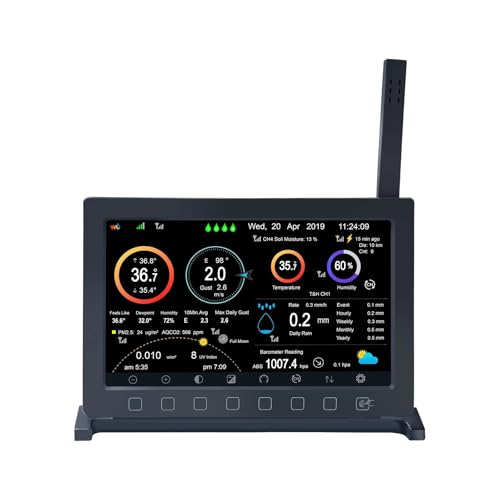
This ECOWITT station fits the Best Wi-Fi spot because it keeps your weather data online. It links through Wi-Fi and pairs with the WS View Plus and Ecowitt app ecosystem. For most households, that means fewer steps than stations that rely only on local screens.

Setup and daily use feel practical. The display is a 7-inch monochrome LCD, and it reports a wide set of readings, including temperature, humidity, barometric pressure, wind speed and direction, and rainfall. On the connectivity side, the station supports both Wi-Fi and Bluetooth, which helps with smoother setup and syncing.

The main drawback is the limited monochrome display, so it is not as easy to scan at a glance as color screens. If you want a Wi-Fi connected weather station with solid, multi-sensor outdoor data and you do not mind a simpler display, this is a good match.

→ See full ranking

→ Read full review

Best with Bluetooth

Ambient Weather WS-2902 Weather Station
Our Score 7.5 / 10 Score details
Accuracy7.9
Durability6.4
Usability8.3
Connectivity6.8
Value7.9
How we research & score
BrandAmbient Weather
Display TypeColor LCD
Measurement FunctionsTemperature, Humidity, Wind Speed, Wind Direction, Rainfall, UV Index, Solar Radiation, Barometric Pressure, Dew Point
Wireless Range500 ft
ConnectivityWi-Fi
Power SourceSolar Powered
App Smart Home CompatibilityIFTTT / Google Assistant / Alexa
  • Clear display, easy pairing
  • Wi‑Fi + Bluetooth support
  • More measurement types
  • Intermittent connection hiccups
  • Short wireless reach
  • Long outage lockup

This station fits the Best with Bluetooth role because it mixes local control with flexible data sharing. With both Wi-Fi and Bluetooth support, you can pair and set up nearby, then rely on network updates for day-to-day tracking.

Readability and day-to-day use are strong. The color LCD is easy to read, and pairing is straightforward. It also covers a wide set of measurements, including wind speed and direction, rainfall, UV index, solar radiation, barometric pressure, and dew point.

The main drawback is connectivity stability. Users may see intermittent hiccups, and the wireless reach is limited to about 500 ft. If you want a sensor-rich station with Bluetooth for easy setup and Wi-Fi for ongoing updates, this is a solid choice, as long as you plan for possible range and sync delays.

→ Read full review

Best for Compact Lots

AcuRite Iris 5-in-1 Weather Station
Our Score 7.5 / 10 Score details
Accuracy7.7
Durability6.6
Usability8
Connectivity7
Value8.1
How we research & score
BrandAcuRite
Display TypeColor LCD
Measurement FunctionsTemperature, Humidity, Wind Speed, Wind Direction, Barometric Pressure, Rainfall
Sensors Included5 Sensors
Wireless Range330 ft
ConnectivityWi-Fi
Power SourceSolar Powered
App Smart Home CompatibilityAlexa / Google Assistant
  • Wi‑Fi + Bluetooth support
  • More measurement types
  • Clear display, easy pairing
  • Short wireless reach
  • Connectivity dropouts
  • 2.4GHz account dependency

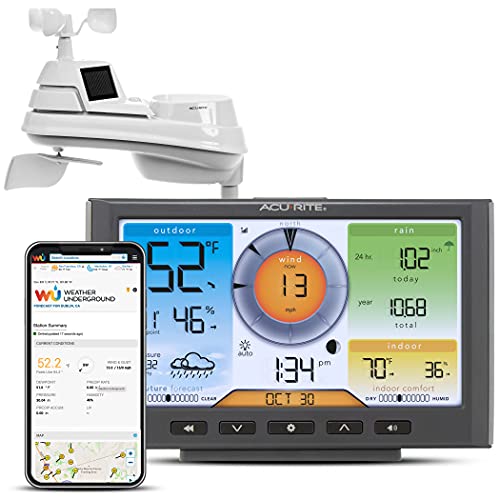
For smaller yards and tight installation spots, the AcuRite Iris 5-in-1 is a strong fit because it combines a clear color LCD with multi-sensor coverage, without needing a lot of space to place separate stations. The Wi-Fi link and Bluetooth support make it easier to set up and check readings from more than one device.

Day to day use feels straightforward. Pairing is simple, and the display is easy to read at a glance. It also tracks a broader set of conditions than many compact models, including temperature, humidity, wind speed and wind direction, barometric pressure, and rainfall, with solar power helping keep maintenance low. Accuracy scores are solid in real use, and the station is generally stable with responsive sensor updates.

The main drawback is connectivity. Its wireless reach is shorter than some options, and there can be dropouts, plus performance can depend on a 2.4GHz Wi-Fi account. If you want a compact, multi-sensor station that is easy to use and ready for voice assistants, choose this one, but make sure your Wi-Fi signal is strong where the station will live.

→ Read full review

Best Value

Newentor Q3 Weather Station
Our Score 7.1 / 10 Score details
Accuracy7.3
Durability6.5
Usability7.2
Connectivity6.1
Value8.6
How we research & score
BrandNewentor
Display TypeColor LCD
Display Size7.5 in
Measurement FunctionsTemperature, Humidity, Barometric Pressure
Sensors Included1 Sensor
Power SourceAC Power / Battery Backup
  • Solar or AC powered
  • Touchscreen interface
  • Atomic timekeeping
  • Minimal sensor package
  • Intermittent connection hiccups
  • Some long-term wear risk

This Newentor Q3 fits the Best Value slot because it is a simple, everyday weather station with atomic timekeeping and a bright 7.5-inch color LCD touchscreen. It aims at steady local readings, without pushing you into a complex setup.

In day-to-day use, the station scores well for Accuracy, covering Temperature, Humidity, and Barometric Pressure. It also handles power in a practical way with AC power plus battery backup, which helps it stay on during outages. Touchscreen operation makes it easy to view the data, and atomic timekeeping helps keep the clock aligned for timestamped trends.

The main trade-off is a limited sensor package, since it includes only 1 outdoor sensor. It can also have intermittent connection hiccups, which may annoy you if you rely on smooth syncing. If you want clear local measurements and a straightforward display, this is a good pick for small setups and casual monitoring, not for large multi-sensor coverage.

→ Read full review

What to Look For

Accuracy: Choose stations that report readings consistently, not just fast updates. Look for sensors that respond quickly to changes and do not drift noticeably over time. If the station supports user calibration, confirm it is meant for the included sensors.

Durability: Verify the outdoor sensor package is built for sun, rain, and wind. Pay attention to weather resistance and how sensors are mounted. If battery life is weak in cold weather, expect more gaps in data during winter.

Usability: A good display should be easy to read at a glance. Favor stations with simple setup, clear menus, and straightforward sensor pairing. If you plan to check conditions often, prioritize screen clarity and quick access to key readings.

Connectivity: Wireless link stability matters more than headline range. Check whether the station uses Wi-Fi, Bluetooth, or RF, and how it behaves when you are not standing next to it. For phone use, confirm the app is consistently responsive and that syncing is not slow after power changes.

Value: Compare what you get for the price, not just how many features are listed. A higher price makes sense only if it improves sensing reliability, outdoor robustness, or ongoing connectivity. Watch for bundles that add reporting features you will not use.

Measurement Functions: Pick the readings you will actually track. Temperature and humidity are common. If you care about storms and microclimates, look for Rainfall, Wind Speed, and Barometric Pressure. If you want UV or dew-related signals, confirm those categories are supported on the station.

Sensors Included: Count the included sensors and check what they cover. More sensors are useful only if they measure the areas you care about. For example, wind and rain often come from dedicated outdoor sensors, while indoor comfort metrics may require extra setup.

For practical advice, see Weather Station Placement: Mount Sensors for Better Readings.

How We Selected These Products

Products were found through broad web searches across review sites, buyer forums, and best-of lists, so the shortlist did not depend on a single brand narrative. We cross-checked each candidate against multiple discussions to see which problems showed up repeatedly.

Next, we read a large volume of real customer reviews to separate short-term setup issues from long-term failures. We paid close attention to sensor dropouts, drifting readings, battery or power problems, and app sync behavior when the network or weather changes.

Finally, we verified availability and key specs directly against Amazon listings. Each station was scored with the same objective framework across Accuracy, Durability, Usability, Connectivity, and Value. The final picks focus on strong performance in distinct roles, not on a single top score that ignores different user needs.

Frequently Asked Questions

What is the best weather station for overall performance?

The WeatherFlow Tempest Weather Station ranks highest in this guide. Users and reviews often praise its fast updates and strong home level forecasting. It also does well in durability and app based use. It is a great choice if you want a single, polished system.

Which weather station is best if I want solar power?

Choose the Ambient Weather WS-5000 Weather Station for the solar powered category. Reviews rate it highly for accuracy, especially for wind. It also focuses on fewer moving parts, which can help with long term wear. If you live where winters are harsh, solar plus stable sensor design can be a big advantage.

Do I need to do more maintenance on pro grade stations?

Yes, plan for more setup care on pro style systems. Many higher end stations rely on proper sensor siting for the best results. You may also need periodic checks on cables and outdoor parts after storms. Still, they often last for many years when installed correctly.

Is a higher price always better for weather station accuracy?

Not always. Some midrange stations can be very accurate for home use, especially for temperature and humidity. The biggest accuracy differences often come from sensor design and good placement. Paying more helps most when you want research level results and long term stability.

Why do some weather stations score lower on connectivity?

Connectivity can break when Wi-Fi drops, syncing fails, or apps do not handle outages well. Some stations also rely on an app or cloud service for day to day viewing. Others work better with smart home tools, but still need correct setup. In real life, placement and setup choices can affect how stable links stay.

What separates budget and premium weather stations?

Premium stations usually deliver more stable measurements and better outdoor reliability. They also tend to offer faster updates and more useful integrations. Budget stations can be a great start, but you may see limits in sensor consistency or forecast reliability. You often trade off long term confidence for lower cost.