




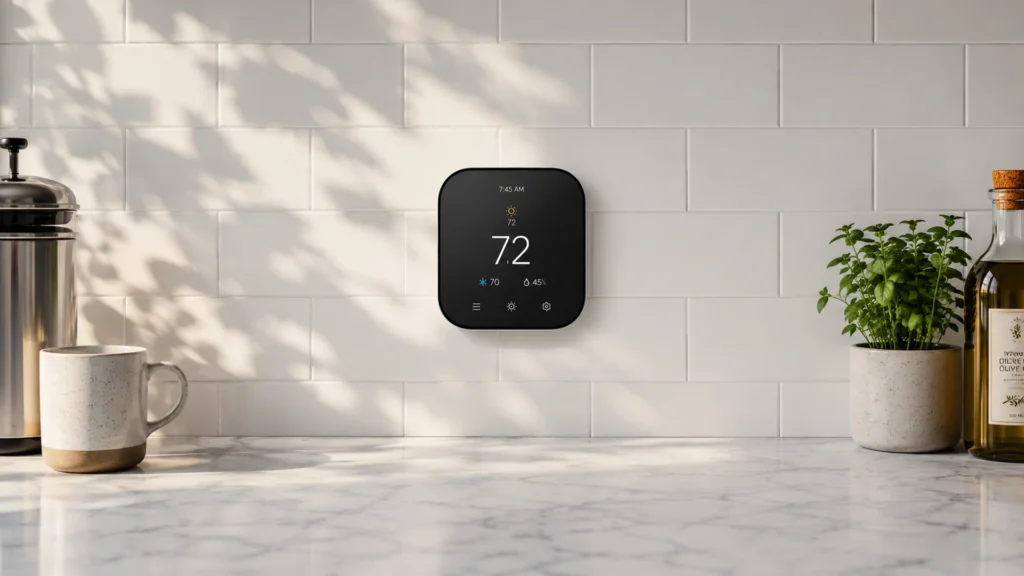
Touchscreen smart thermostats put the main controls on a screen at the wall. For buyers, that means you should care about how quickly the thermostat responds, how clear the interface is up close, and how smoothly the schedule changes in the app. You also need dependable comfort control that does not swing around your target.
Choosing one is hard because the touchscreen is only part of the story. Some models need a C-wire to avoid battery drain. Others have limits around HVAC types or stage support. Even when the screen looks good, comfort can suffer if the sensor setup or control logic does not run stable schedules.
Looking for all types? See our Best Smart Thermostats.
Quick Overview
Our Top Picks
#1. Sensi Touch 2 Smart Thermostat

Specifications
| Brand | Sensi |
|---|---|
| Connectivity | Wi-Fi |
| Voice Assistant Compatibility | Amazon Alexa |
| Power Requirement | C-wire Required |
| Display Type | Color Touchscreen |
| Dimensions | 0.8 x 5.6 x 3.2 in |
Pros
- Tight, steady control
- Automation stays on track
- Strong features, fair price
Cons
- Single/limited voice support
- Dual-fuel edge issues
The Sensi Touch 2 stands out in touchscreen smart thermostats because it focuses on steady comfort control rather than flashy extras. The control feels tight and stable, with scheduling and automation staying consistent over time. In day to day use, that means fewer noticeable temperature swings as the HVAC cycles, and the thermostat generally tracks your setpoints without feeling laggy.
Its main trade off is in home control reach. Voice support is limited, and dual fuel setups can be a bit touchier than simpler systems. If you want a clear color touchscreen and reliable everyday temperature management, this is a strong choice. If you need broader voice options or you run a complex dual fuel arrangement, you will want to double check compatibility before installing.
#2. Sensi Touch Smart Thermostat ST75

Specifications
| Brand | Sensi |
|---|---|
| Hvac Compatibility | Forced Air, Heat Pump, Boiler |
| Connectivity | Wi-Fi |
| Voice Assistant Compatibility | Amazon Alexa |
| Power Requirement | C-wire Required |
| Display Type | Color Touchscreen |
Pros
- Tight, steady control
- Automation stays on track
- Strong features, fair price
Cons
- HomeKit hard resets
- C-wire power sensitivity
- Single/limited voice support
With its color touchscreen and steady comfort control, the Sensi Touch ST75 fits well in the touchscreen smart thermostat crowd. The day-to-day behavior feels smooth, with tight temperature stability and automation that stays on track rather than drifting over time. If you like managing schedules on a wall screen, it is a strong match for people who want simple, dependable HVAC control without constant tweaks.
The main trade-off is setup power and platform fit. It requires a C-wire and can be sensitive to that wiring, which may add work for some homes. It also has limits on smart home compatibility, including HomeKit hard resets and only single voice support, so it is best for households that use Amazon Alexa and can handle the wiring requirements.
#3. Honeywell Home Smart Thermostat X8S

Specifications
| Brand | Honeywell Home |
|---|---|
| Hvac Compatibility | Heat Pump, Forced Air, Boiler |
| Connectivity | Wi-Fi |
| Voice Assistant Compatibility | Amazon Alexa, Google Assistant, Apple HomeKit |
| Power Requirement | C-wire Required |
| Heat Cool Stages | 3 Heat / 2 Cool |
| Temperature Range | 40°F to 90°F (Heating) |
| Display Type | Touchscreen |
| Dimensions | 3.5 x 1 x 5.2 in |
Pros
- Schedules are simple
- Works with most setups
Cons
- C-wire install dependency
- Limited performance metrics
The Honeywell Home Smart Thermostat X8S stands out in touchscreen smart thermostats because it keeps day-to-day control simple while still fitting common HVAC setups. The touchscreen interface makes it easy to change modes and adjust temperatures without digging through confusing screens. Scheduling is also straightforward, so most households can set routines quickly and move on.
The main trade-off is installation. It requires a C-wire, which can be a deal-breaker if you do not already have one. It also has more limited energy feedback, so you may not get deep performance metrics beyond the basics. This is a good pick if you want a clear touchscreen experience and broad system support, and you are ready for the wiring requirement.
#4. Honeywell Home Smart Thermostat T9

Specifications
| Brand | Honeywell Home |
|---|---|
| Hvac Compatibility | Forced Air, Heat Pump, Boiler |
| Connectivity | Wi-Fi |
| Voice Assistant Compatibility | Amazon Alexa, Apple HomeKit, Google Assistant |
| Power Requirement | C-wire Required |
| Heat Cool Stages | 3 Heat / 2 Cool |
| Display Type | Touchscreen |
Pros
- Broad system support
- Multiple voice assistants
- Touchscreen display
Cons
- Runaway heating failure
- Settings ignored behavior
- Some temperature drift
The Honeywell Home Smart Thermostat T9 stands out in touchscreen smart thermostats for its broad HVAC and home platform reach. It supports forced air, heat pumps, and boilers, and it works with Amazon Alexa, Apple HomeKit, and Google Assistant. The touchscreen makes day-to-day changes easy, without digging through menus in the app. For many homes, that kind of compatibility reduces the guesswork before install.
The main trade-off is control consistency. Some users report runaway heating failure and instances where settings do not follow as expected, plus reports of some temperature drift over time. It can still be a solid pick if you want a touchscreen experience and multiple smart home connections, but it is worth monitoring behavior closely after setup and updates.
What to Look For
Comfort control performance: Pick a model that holds your set temperature without overshooting. Look for stable response when you adjust the target and when the schedule switches between heating and cooling.
Daily usability of the wall touchscreen: The best screens make common tasks quick. Check how fast you can change modes, edit setpoints, and confirm current status without digging through menus.
HVAC compatibility by system type: Verify your setup before you buy. Check for support for your system type, such as Forced Air, Heat Pump, Boiler, Dual Fuel, or Electric Baseboard, and confirm it matches your wiring and configuration.
Connection stability and app control: Touchscreen thermostats still depend on Wi-Fi for remote control and updates. Favor models known for consistent connections and smooth command delivery, especially if you rely on schedules or geofencing.
Value versus control features: Stay within the typical category price and compare what you get for it. If key comfort features require add-ons or if the model struggles with control stability, it costs more than the sticker price.
How We Picked
Products were identified through broad research across review sites and buyer forums, then filtered to only those that qualify as Touchscreen Smart Thermostats.
Scoring used the same objective pillar framework as the main Smart Thermostats post, allowing direct comparison of products within this sub-category.
Frequently Asked Questions
Do touchscreen smart thermostats work better than basic dial thermostats for daily use?
Usually, yes. Touchscreen models let you change modes, set schedules, and view status in seconds. They also make it easier for guests to adjust the temperature without guessing. The best ones keep the screen bright and readable at night.
Will a touchscreen smart thermostat still work if my HVAC has only limited system support?
It depends on your heating and cooling setup. Many touchscreen models support common systems like forced air and heat pumps, but fewer cover boilers or dual fuel well. Before you buy, check the supported HVAC system types and stage counts in the product specs. Also confirm what wiring is required for your home.
Do touchscreen smart thermostats need a C-wire?
Many touchscreen thermostats need a C-wire for stable power. Some models let you skip the C-wire, but they may use battery power and could need charging or replacements. A stable power setup usually improves reliability and reduces random restarts. If you are unsure, check your current thermostat wiring before installing.
When should I choose a non-touchscreen smart thermostat instead of a touchscreen model?
Pick a non-touchscreen model if you want the simplest interface and fewer steps for quick changes. Also choose it if you prefer physical buttons that work well when gloves or poor screen visibility are an issue. If your home has older wiring and power options are limited, a simpler model may be easier to power correctly. Compare reliability and power requirements before deciding.
How do touchscreen smart thermostats compare to other smart thermostats for app and smart home control?
Touchscreen models usually offer the same core smart features through an app. You can often manage them with Alexa or Google Assistant, plus remote access. The main difference is how you interact with the thermostat on the wall. Touchscreen units tend to feel faster for schedule edits and status checks.


