




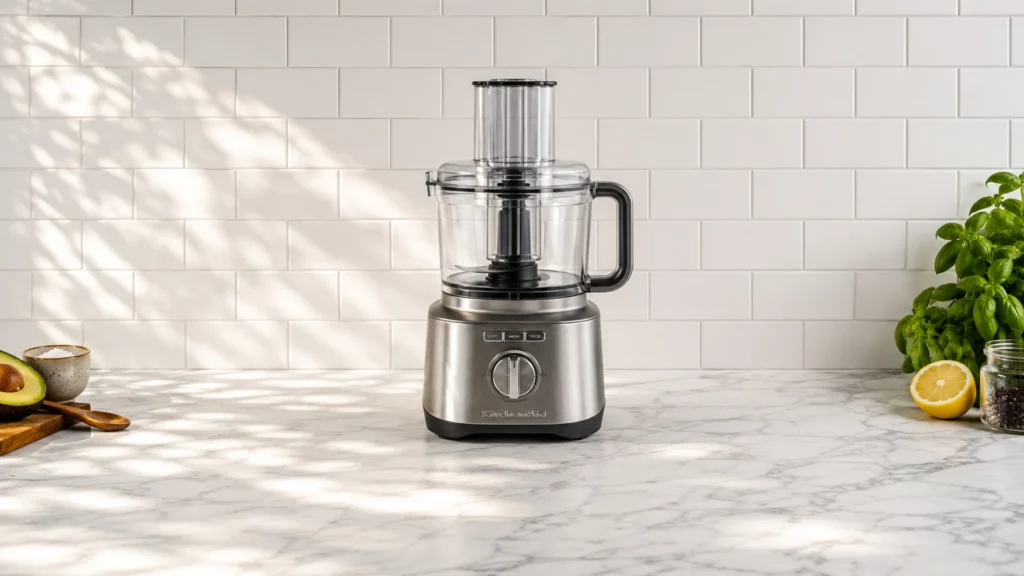
Food processors are counter appliances that do a lot of prep work fast. They chop onions, slice vegetables, shred cheese, puree soups, and mix dough for quick bakes. They sit between a blender and a stand mixer, but they are built for batch prep and repeatable cuts.
Picking one is harder than it looks. Many listings focus on specs that do not translate well to your results. A higher watt rating does not guarantee steady speed under load. A bigger claimed capacity can still lead to uneven chopping if the bowl shape and blade design do not move food efficiently. Extra “features” like extra speeds or more small attachments may help on paper, but they can also mean more parts to store and clean.
This guide compares food processors using the parts of the job that matter in daily cooking. You will see what to prioritize, what to avoid, and how each model fits different prep styles. You will also get a clear shortlist with roles like best overall, best for dicing, best for storage, and best value.
Quick Overview
Top Picks
Best Overall

Specifications
| Brand | Magimix |
|---|---|
| Capacity Cups | 14 |
| Power Watts | 950 W |
| Bowl Material | Tritan |
| Dimensions In | 16.7 x 10.2 x 8.3 in |
| Weight Lb | 24.3 lb |
Pros
- Reliable slicing and pureeing
- Secure locking, no wobble
- Useful discs and smart speeds
Cons
- Heavy countertop unit
The Magimix 4200XL fits the Best Overall spot because it focuses on steady, repeatable results, especially for slicing and smooth purees. Its secure locking system helps keep the bowl stable, so you get consistent cuts instead of changing angles mid-task.
In daily use, it turns out reliable slices and even purees, with minimal need to stop and scrape. The build quality feels solid, with a Tritan bowl and a setup that stays put without wobble. It also comes with useful discs and smart speed choices, which makes switching between prep jobs easier.
The main trade-off is size and weight. At 24.3 lb, it is a heavy countertop unit, so storage and moving it out of the way take planning. If you want dependable slicing and pureeing for regular home cooking, and you do not mind a bigger footprint, this is the one to get.
Best Easy Storage

Specifications
| Brand | Magimix |
|---|---|
| Capacity Cups | 12 cups |
| Power Watts | 650 W |
| Dimensions In | 8.07 x 9.37 x 14.17 in |
| Weight Lb | 14.8 |
Pros
- Reliable slicing and pureeing
- Secure locking, no wobble
- Simple controls, effortless storage
Cons
- Heavy countertop unit
This Magimix 3200XL fits the Best Easy Storage role because it is built for everyday handling, not a constant setup routine. The most distinctive trait is how straightforward it is to go from use to stowing, helped by its simple controls and tidy accessory management.
On the counter, it feels stable. The locking system sits firmly with no wobble, and the motor keeps results consistent for tasks like slicing and pureeing. Cleaning is also less of a hassle than many processors, since daily parts are easier to manage and store once detached.
The trade-off is weight, at 14.8 lb, so moving it in and out of a cupboard takes planning. If you want smooth, reliable prep with easy day-to-day storage and you do not mind a heavier unit, this is a strong match.
Best for Dicing

Specifications
| Brand | Breville |
|---|---|
| Power Watts | 625 W |
| Bowl Material | Stainless Steel |
| Feed Tube Size In | 4.7 in |
| Dimensions In | 7.7 x 11.8 x 17.5 in |
| Weight Lb | 15.5 lb |
Pros
- Reliable slicing and pureeing
- Secure locking, no wobble
- Useful discs and smart speeds
Cons
- Underpowered for tough tasks
- Heavy countertop unit
This 9-cup food processor fits the Best for Dicing role because it turns whole ingredients into even, bite-size pieces with less fuss. Its stainless-steel bowl and stable design help keep slices and shreds consistent, which makes it easier to dice from the start.
You see that in daily prep. It delivers reliable slicing and pureeing, with a smooth, predictable result when you run the discs. The locking system feels secure, so the unit does not wobble on the counter. Breville also includes useful discs and smart speed choices, which helps you match the cut to the ingredient.
The main trade-off is that it can feel underpowered for tougher tasks, especially denser mixes or big loads. It is also heavy, so you will not want to move it around often. If you want dependable slicing-to-dicing prep with solid stability, this is a good fit for regular meal prep, especially for vegetables and everyday sauces.
Best for Vitamix Owners

Specifications
| Brand | Vitamix |
|---|---|
| Capacity Cups | 12 cups |
| Power Watts | 1200 W |
| Dimensions In | 12.8 x 11.8 x 8.5 in |
| Weight Lb | 6.2 lb |
Pros
- Secure locking, no wobble
- Reliable slicing and pureeing
- More batch capacity
Cons
- Compatibility confusion risk
This 12-cup Vitamix food processor attachment is a great fit for Vitamix owners who want to expand beyond blending, and its standout trait is the secure locking system that keeps everything steady. With no wobble in place, it feels built for day to day prep, whether you are doing quick weekday cooking or bigger batch days.
In real tasks, it stays consistent for slicing and pureeing, which matters when you want even results without stopping to scrape. The extra batch capacity also helps when you are processing more than one meal worth of ingredients. Build quality feels solid, with a fit and finish that stays aligned instead of shifting mid-cycle.
The main catch is compatibility confusion risk, especially if you are not sure which Vitamix base models and setups it matches. If you are already committed to the Vitamix system and want a stable 12-cup option for slicing and smooth purees, this is the right attachment to look at.
Best Value

Specifications
| Brand | Cuisinart |
|---|---|
| Capacity Cups | 4 cups |
| Control Type | Buttons |
| Bowl Material | Tritan |
| Dimensions In | 7.2 x 9.3 x 5.6 in |
| Weight Lb | 3.7 lb |
Pros
- Reliable slicing and pureeing
- Secure locking, no wobble
- Strong power, fair cost
Cons
- Limited accessories, narrow range
- Small batch size
This 4-cup mini chopper fits the Best Value role by focusing on everyday prep tasks, not a long list of add-ons. It is a compact workhorse with a secure locking system that stays stable on the counter.
In use, it delivers steady chopping and consistent pureeing, with reliable slicing results. The core parts feel well built, and the lid locks in firmly, which helps prevent wobble during processing. Buttons make it simple to run in short bursts, and cleanup is generally straightforward for a small unit.
The main trade-off is the narrow setup, with limited accessories and a smaller batch size. If you mainly want quick chopping, slicing, and smooth purees for small meals, this is the one to get.
Also ranked #1 in: Dishwasher-Safe Food Processors
Best 13-Cup

Specifications
| Brand | Cuisinart |
|---|---|
| Capacity Cups | 13 |
| Power Watts | 650 W |
| Number Of Speeds | 3 Speeds |
| Control Type | Buttons |
| Bowl Material | Tritan |
| Dimensions In | 15 x 11 x 7.5 in |
| Weight Lb | 16.6 lb |
Pros
- Reliable slicing and pureeing
- Secure locking, no wobble
- More batch capacity
Cons
- Limited speed control
- Heavy countertop unit
- Cleaning pain
This 13-cup Cuisinart fits the Best 13-Cup slot thanks to a dependable, workhorse performance style. It is built for everyday batches, from everyday chopping to smooth pureeing, without getting fussy or falling over mid-task.
In real use, it turns out consistent results. Slicing and pureeing are the standouts, helped by secure locking that keeps the bowl stable, with no wobble on the counter. The larger batch size also helps when you are doing bigger prep runs, so you spend less time reloading ingredients.
The main downside is day-to-day practicality. It can be a heavy countertop unit, and cleaning feels like a chore once discs and parts get into the corners. If you want a stable, reliable 13-cup processor for frequent chopping and pureeing, this is a strong match, especially if you do not mind a less nimble, more hands-on cleanup routine.
Best 16-Cup

Specifications
| Brand | Breville |
|---|---|
| Capacity Cups | 16 |
| Power Watts | 1450 W |
| Bowl Material | Stainless Steel |
| Feed Tube Size In | 5.5 in |
| Dimensions In | 9.2 x 11.3 x 17.7 in |
| Weight Lb | 16.9 lb |
Pros
- Reliable slicing and pureeing
- Secure locking, no wobble
Cons
- Button/control failures
- Pulse malfunction
This 16-cup Breville fits the Best 16-Cup role for one big reason, it stays steady while you do real prep jobs. The secure locking design and no-wobble feel make it easier to keep food cuts consistent in larger batches.
On the performance side, it is reliable for both slicing and pureeing. The 1450 W motor helps it maintain speed under typical loads, so you get cleaner results for everyday mixes and sauces. Build quality also shines, with a stainless steel bowl and a locking system that feels solid on the counter.
The main downside is control reliability, some users report button or control failures, and there can be pulse malfunction. If you want a large-capacity processor that focuses on consistent slicing and pureeing, and you are comfortable taking care of electronics, this is the one to get.
Best Dial Control

Specifications
| Brand | GE |
|---|---|
| Capacity Cups | 12 cups |
| Power Watts | 550 W |
| Number Of Speeds | 3 Speeds |
| Control Type | Dial |
| Dimensions In | 16 x 10.3 x 12.2 in |
| Weight Lb | 10 lb |
Pros
- Secure locking, no wobble
- Strong power, fair cost
- More batch capacity
Cons
- Limited speed control
- Disc size limitations
- Texture inconsistency
This GE 12-Cup food processor fits the Best Dial Control role because its dial setup is simple and gives you steady control while you work. The locking feels secure, with no wobble on the counter, so you can keep your rhythm when you are chopping, slicing, or pureeing.
On day-to-day prep, the 550 W motor brings solid power, and it handles larger batches without stalling. Build quality also feels confident, with a lid that locks down firmly and stays in place during use. Cleanup and day-to-day handling are fairly easy, helped by controls that are quick to understand and a design that does not feel overly fussy.
The main trade-off is that speed control is limited, and some users may notice texture inconsistency when processing mixed ingredients. If you want reliable dial control for everyday chopping and purees, without overthinking settings, this is a good pick.
Best Auto IQ

Specifications
| Brand | Ninja |
|---|---|
| Capacity Cups | 9 cups |
| Power Watts | 1000 W |
| Control Type | Buttons |
| Weight Lb | 7.7 lb |
Pros
- Strong power, fair cost
- Auto-iQ convenience
- Versatile meal-prep utility
Cons
- Ingredient trapping
This Ninja Professional Plus is a strong pick for the Best Auto IQ role because it leans on Auto-iQ presets to handle common prep tasks with less guesswork. When you want steady results without constant manual control, the built-in automation helps you get there faster.
On real kitchen work, the 1000 W motor and 9-cup bowl make quick work of chopping, slicing, and shredding, with solid power under load. It also scores well for build and overall usefulness, thanks to a practical attachment lineup and straightforward button controls that keep day-to-day use manageable. Auto-iQ convenience is the standout, especially for repeat tasks like batches of veggies or dips.
The main downside is ingredient trapping, where bits can cling around parts and require a bit more attention during cleanup. If you want an easy-to-run processor with Auto-iQ guidance for everyday meal prep, and you do not mind giving the bowl and blade area a quick check, this one fits well.
What to Look For
Capacity: Match the bowl capacity to your usual batch size. If you often work with small amounts like salsa or pesto, a 4 to 9 cup unit can be easier to handle. If you meal prep for a family, look closer to 12 to 16 cups so you do not need multiple runs.
Power: Use wattage as a quick filter, especially for dense tasks like kneading dough or processing harder vegetables. Higher wattage usually supports better performance under load, but it should not replace good blade and disc design.
Number of Speeds: Pick a processor with enough speed control for your tasks. More speeds can help, but you care more about having a practical low speed for gentle mixing and a higher speed for consistent chopping. Pulse is useful for preventing over-processing.
Control Type: Dial controls often make it faster to fine-tune while you work. Buttons can also be fine, especially if they are simple and clearly labeled. Whatever you choose, prioritize controls that you can operate one-handed and that feel easy to reach.
Bowl Material: Choose based on how you use and care for it. Stainless steel bowls tend to feel more rigid and can handle frequent use well. Plastic bowls are typically lighter and may be easier to move, while still working for most countertop cooking.
Feed Tube Size: A wider feed tube reduces prep time because you can fit larger pieces. If you slice and shred often, bigger is usually better. Also confirm that the tube works well with the discs you plan to use.
Dimensions and Weight: Measure your space before you buy. Wider bases can be hard to fit behind cabinet doors, and heavy units are annoying to pull out for daily use. If you store on the counter, prioritize manageable weight and a footprint you can live with.
How We Selected These Products
We started with broad web searches across review sites, buyer forums, and best-of lists. That helped us find the models people actually discuss, not just the ones with the most polished product pages.
Next, we read a large volume of real customer reviews to identify the problems buyers repeatedly reported. We focused on issues that show up during everyday prep, like uneven cuts, jamming, weak results on dense foods, and frustrating cleanup or storage.
We then verified availability and key specs directly against Amazon listings. Each model was scored across the same pillar set, Performance, Build Quality, Ease of Use, Features, and Value, using an objective rubric. Final picks favored processors that perform strongly in distinct roles, rather than ranking everything by a single overall score.
Frequently Asked Questions
Which food processor is best for dicing consistently?
Look for a model that gets strong feedback specifically for cube work. In this lineup, Breville Paradice 9-Cup Food Processor earns the Best for Dicing badge. Its dicing kit is the main reason it stands out, while some bigger units still disappoint when cube consistency matters. If dicing is your top job, prioritize user reports on dicing first.
What are the main differences between budget, midrange, and premium food processors?
Budget models often focus on basic chopping and shredding, with fewer speed options and smaller accessory sets. Midrange units usually improve on motor power, bowl capacity, and disc quality. Premium models tend to feel sturdier, process more evenly under load, and include more useful accessories. The tradeoff is higher price and, sometimes, a more complex attachment ecosystem.
How should I clean and maintain a food processor to keep it working well?
Rinse parts soon after use, especially blades and discs. Most processors clean best when you remove the bowl and take out the blade carefully. Dry everything before reassembly to prevent odor and residue buildup. Avoid running the motor base under water, and wipe it with a damp cloth only.
Is a higher price always better for food processors?
Not always. Some budget and value models score well on day-to-day tasks, like reliable chopping and shredding. Higher prices usually buy better build quality, more consistent results, and smoother handling under load. But you can still get uneven dicing, tricky attachments, or small-batch issues in higher-priced units too.
Why do many food processors struggle with fine texture or small batches?
Small amounts can sit too high in a bowl, so the blade does not pull them down well. That leads to uneven cuts and more scraping. Lower-powered units also may lose consistency when ingredients get denser. If you often process small amounts, choose designs known for good small-batch handling and easier scraping.


