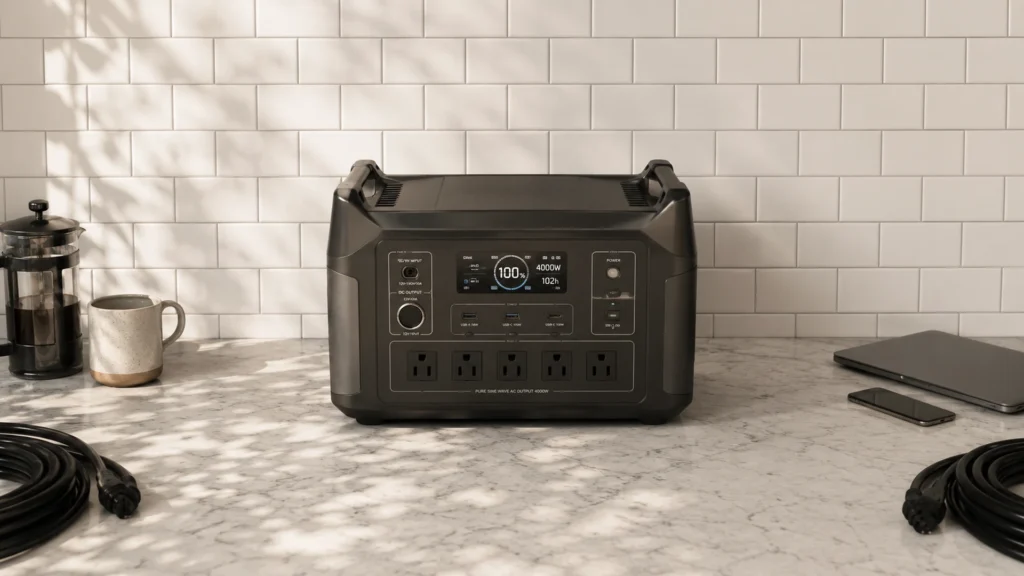
A 4000W continuous portable power station targets high, steady loads, not short bursts. In this sub-category, you should expect an inverter rated for around 4000W continuous output, with enough battery capacity to power appliances long enough to matter. Buyers usually want reliable AC output for refrigerators, tools, window AC, and home backup circuits.
The hard part is the trade-off between output size, runtime, and charging speed. Bigger inverters draw more power from the battery, which cuts usable runtime fast. Faster recharge usually needs higher wall input power, and solar recharge depends on available panel size and weather. Weight and size also rise quickly at this power level, so storage and daily movement become part of the decision.
Looking for all types? See our Best Portable Power Stations end-to-end buying guide that covers other watt classes.
Quick Overview
Our Top Picks
#1. EcoFlow DELTA Pro 3 Portable Power Station

Specifications
| Brand | EF ECOFLOW |
|---|---|
| Battery Capacity Wh | 4096 Wh |
| Ac Output Power W | 4000 W continuous / 6000 W surge |
| Battery Chemistry | LiFePO4 |
| Weight Lb | 115 lb |
Pros
- UPS-ready, versatile ports
- Reliable ports and cooling
- Rated watts delivered
Cons
- Manageable weight, bulky bulk
- Setup friction
- EcoFlow support friction
If you need a true 4000W continuous-class portable power station, the EcoFlow DELTA Pro 3 stands out for how reliably it backs up that rating in real use. It pairs a 4096 Wh LiFePO4 battery with a 4000 W continuous / 6000 W surge inverter, so it is a solid match for demanding jobs like jobsite tools, event gear, or running home backup loads when the grid goes down. In this class, stable power matters more than peak numbers, and this unit is built around UPS-ready operation and dependable cooling to keep output steady under load.
The main trade-off is practical, not technical. It is around 115 lb, so it is better suited to car staging, a fixed outdoor setup, or rolling between nearby locations than frequent carry. There is also some friction with setup and getting service support, which can slow things down if you expect a plug-and-play experience every time. This is a strong pick for buyers who plan to keep it in one place and use it like a long-run power source.
#2. Anker SOLIX F3000 Portable Power Station

Specifications
| Brand | Anker SOLIX |
|---|---|
| Battery Capacity Wh | 3072 Wh |
| Ac Output Power W | 6000 W |
| Ac Charging Input W | 3600 W |
| Solar Input W | 2400 W |
| Battery Chemistry | LiFePO4 |
| Weight Lb | 91.5 lb |
| Dimensions In | 14.8 x 25.6 x 11.8 in |
Pros
- Stable inverter under load
- Reliable ports and cooling
- UPS-ready, versatile ports
Cons
- Manageable weight, bulky bulk
- Regional cable availability
- Solar setup dependency
For a 4000W continuous portable power station job, this Anker SOLIX F3000 stands out for stable power under load. Its inverter is rated for 6000 W output and it stays steady when you run demanding appliances like jobsite tools or RV-style loads. You also get 3072 Wh of LiFePO4 capacity, which is a practical base for longer sessions, and it supports UPS-ready use so power can bridge during short outages.
The main trade-off is handling. At 91.5 lb and a fairly bulky footprint, it is more “move it once” than “grab and go.” Solar can work up to 2400 W, but real results depend on setup and sun, and cable options can vary by region. If you want dependable high-draw power for backup or off-grid use and can manage the weight, it is a strong fit.
#3. Pecron E3800 LFP Portable Power Station

Specifications
| Brand | pecron |
|---|---|
| Battery Capacity Wh | 3840 Wh |
| Ac Output Power W | 4200 W |
| Ac Outlet Count | 5 Outlets |
| Ac Charging Input W | 3200 W |
| Solar Input W | 3000 W |
| Battery Chemistry | LiFePO4 |
| Weight Lb | 87.3 lb |
| Dimensions In | 14.7 x 17.5 x 12.1 in |
Pros
- Stable inverter under load
- High capacity
- More AC ports
Cons
- Heavy and hard-carry
- UI polish lacking
- Model naming confusion
In the 4000W continuous portable power station tier, the Pecron E3800 stands out for its inverter stability. With 4200 W continuous output and 3840 Wh of LiFePO4 capacity, it is a strong match for running heavier home backup loads rather than just small gadgets. It also keeps things practical outdoors thanks to five AC outlets, so you can spread loads across devices without constant unplugging.
The main trade-off is portability. At 87.3 lb, it is not a grab-and-go unit, and the UI polish is not as smooth as some competitors. It is best for people who plan to roll it between a garage and a job site, or use it as a stationary backup, and want reliable high-draw performance with an LFP battery.
#4. Anker SOLIX F3800 Portable Power Station

Specifications
| Brand | Anker |
|---|---|
| Battery Capacity Wh | 3840 Wh |
| Ac Output Power W | 6000 W |
| Solar Input W | 400 W |
| Battery Chemistry | LiFePO4 |
| Weight Lb | 132.3 lb |
| Dimensions In | 15.3 x 27.6 x 15.6 in |
Pros
- Stable inverter under load
- High capacity
- LiFePO4 reliability
Cons
- Heavy and hard-carry
- Accessory dependency
- Charging-time unverified
In the 4000W continuous portable power station category, the Anker SOLIX F3800 stands out for its stable inverter behavior under real load, backed by a large 3840 Wh LiFePO4 battery. For users running demanding gear during outages or off grid setups, that steadier output matters more than peak numbers. The 6000 W continuous rating also makes it a strong fit for heavier appliances, while the 400 W solar input keeps recharging realistic from roof or panel arrays.
The trade-off is portability. At 132.3 lb, it is more like a move-once backup unit than a quick campsite carry. Also note that key items like charging time from AC and exact accessory needs are not fully verified here, so plan to confirm what you will use to refill it before you commit.
What to Look For
Continuous inverter rating you can trust: Confirm the model lists around 4000W continuous AC output. If a unit only targets surge power, it will struggle with steady loads like refrigerators or running power tools for long stretches.
Battery capacity for meaningful runtime: Choose based on watt-hours (Wh), not just the AC watt rating. Higher Wh lets the station run high-draw devices longer before you need a recharge. For 4000W-class systems, capacity matters more than it does for smaller stations.
Charging speed that matches your downtime: Check the AC charging input wattage. Higher AC input reduces wall recharge time, which matters when you will run near the inverter limit. If you plan to recharge with solar, ensure the max solar input wattage fits realistic panel setups.
Port selection for real loads: Look for enough AC outlets for how you plan to use it. Also check USB and DC ports for smaller devices so you do not have to dedicate AC outlets to phones, routers, and lights.
Battery chemistry and build for repeated heavy use: Most buyers in this class prefer LiFePO4 (LFP) because it holds up well over many cycles. Also consider cooling behavior and overall build quality since a 4000W continuous unit runs hot under load.
How We Picked
Products were identified through broad research across review sites and buyer forums, then filtered to only those that qualify as 4000W Continuous Portable Power Stations. We focused on real output behavior under sustained loads, not just advertised peak specs.
Scoring used the same objective pillar framework as the main Portable Power Stations post: Performance, Portability, Build Quality, Features, and Value. That approach lets us compare these higher-output models fairly within this sub-category, using the same standards across different brands.
Frequently Asked Questions
What does 4000W continuous really mean for daily use?
It means the inverter can run at up to about 4000W for long periods. Real draw varies by device, so check each appliance label. Some power tools and motors need extra start-up power, even if they run below 4000W.
Can I run a fridge, microwave, and electric kettle at the same time?
You might, but you must add up the wattage for every device. Microwaves and kettles pull high watts, often close to the inverter limit. If the total stays under 4000W, it should run steadily, but start-up surges can still trip weaker setups.
How do I choose the right battery size for my runtime?
Use the battery capacity in Wh to estimate runtime. Higher Wh usually means longer runtime, but high-watt loads drain it faster. For planning, divide Wh by your target watts, then reduce the result for real-world losses.
Do I need LiFePO4 batteries for a 4000W continuous station?
Most buyers choose LiFePO4 because it supports many cycles and stable power. It also tends to handle heat better during heavy use. Still, the inverter rating and cooling matter as much as the battery chemistry.
When should I choose a lower watt portable power station instead of 4000W continuous?
Choose lower wattage if you only power lights, a laptop, a fan, or a small fridge. It is usually lighter and costs less. You can avoid wasted capacity by matching the inverter to your typical loads.
How do 4000W continuous stations compare to other portable stations for storage space and weight?
They are usually bigger and heavier because they need a larger inverter and battery. You should plan for a large carry case or a car trunk setup. If you need frequent travel on foot, a smaller unit may be more practical.


