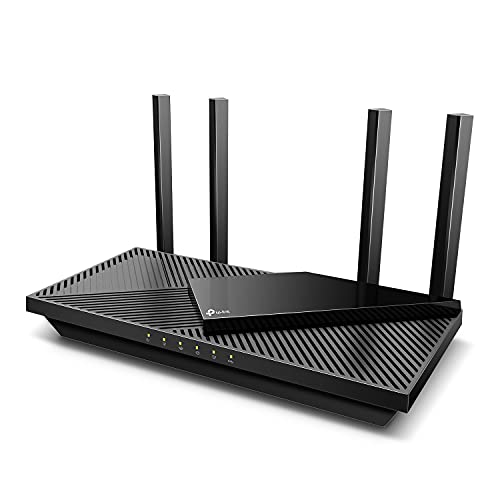
Specifications
| Brand | TP-Link |
|---|---|
| Router Type | Wireless Router |
| Wifi Standard | Wi-Fi 6 |
| Wifi Bands | Dual-Band |
| Max Wireless Speed | 2976 Mbps |
| Coverage Area | 3000 sq ft |
| Ethernet Ports | 1 x 2.5 Gbps WAN, 4 x Gigabit LAN |
| Usb Ports | 1 x USB 3 |
| Security Features | Parental Controls, VPN Support |
Pros
- Consistent multi-room coverage
- Faster multiport Ethernet
- Strong results for price
Cons
- 5GHz dropouts
- Need troubleshooting resets
- Limited power-user tuning
The Verdict
The TP-Link Archer AX55 is a Wi-Fi 6, dual-band router rated at 2976 Mbps, built for everyday home use. It earns high marks for coverage, but some users see 5 GHz dropouts and occasional troubleshooting resets, so stability matters if you game or stream heavily.
Who it's for: Households that want strong multi-room reach and simple setup, and can live with a few stability quirks on 5 GHz instead of chasing advanced controls.
Who should skip it: Power users who need deep tuning and consistent 5 GHz performance without resets, since limited power-user options and reported dropouts can be frustrating.
In-Depth Review
Performance
The Archer AX55 lands at a 7.2 Performance score, which matches the way it feels in daily use. It is a dual band Wi-Fi 6 router with a combined max wireless speed of 2976 Mbps. That total comes from 2402 Mbps on 5 GHz plus 574 Mbps on 2.4 GHz. In a home setting, this usually means smooth streaming and gaming nearby, then slower but still usable speeds as distance grows.
Latency and speed stability matter most when many devices run at once. This model has a single 2.5 Gbps WAN port and four Gigabit LAN ports. That helps if you have a wired media box or a workstation that needs steady throughput. The limitation is that only one uplink reaches 2.5 Gbps. Everything else on the LAN side stays at Gigabit, which can cap real world gains once multiple wired clients compete.
Performance also has a known weak spot. The downside list calls out 5 GHz dropouts. When that happens, devices can fall back to a different band or reconnect. Even if it is not constant, it is enough to prevent a higher Performance score. The takeaway is simple: it can move fast, but it may not stay perfectly steady across every 5 GHz scenario.
Coverage
The AX55 scores 8.0 for Coverage, aligning with the “consistent multi room coverage” experience highlighted in the review. Tom’s Guide puts the coverage at 3,000 square feet. That is a useful benchmark for typical apartments and many single floor homes, especially when you keep the main router centralized.
Coverage quality is not just about range. It is about usable signal at the edges. A dual band layout helps here. With 5 GHz for higher speeds and 2.4 GHz for better wall penetration, you can usually find a balance between speed and stability. The listed max wireless speeds split across those bands as 2402 Mbps on 5 GHz and 574 Mbps on 2.4 GHz, which hints at why far rooms often lean on 2.4 GHz.
The pros and cons reinforce this. “Consistent multi room coverage” is the stated positive, while “5GHz dropouts” signals that some rooms may see more reconnect behavior than others. For most households, the range goal is met. For homes with tricky layouts, the experience can vary by room and device.
Reliability
With a 7.6 Reliability score, the AX55 sits in the dependable but not flawless tier. Heat and uptime usually matter most for long sessions. On paper, it runs as a mainstream Wi-Fi 6 home router, and the spec sheet supports that baseline stability. Still, the real world notes matter more.
Two specific issues show up in the feedback summary. First, “Need troubleshooting resets.” Second, “5GHz dropouts.” Those point to situations where users spend time restarting or re establishing connections to regain normal behavior. A router can work well for months and then act up under a certain mix of devices, streaming load, or interference.
It also helps to look at what you can control when reliability wobbles. The AX55 includes VPN server and VPN client support, plus “Basic Parental Controls” through TP Link HomeShield. When you are tuning a network for stability, having those built in tools can reduce the need to experiment with third party setups. But reliability still falls short of the “rock solid uptime” category because of the reported reconnect and reset patterns.
Features
The Features score is 7.8, which maps to “thoughtful, easy to use tools” rather than deep power user control. Start with the basics that affect daily life. You get USB 3 for local sharing, plus built in Parental Controls and VPN Support. Security tools are directly relevant for families and for people who need remote access without extra networking gear.
On the networking side, the wired layout is practical. There is 1 x 2.5 Gbps WAN port for the incoming link, and four Gigabit LAN ports for devices like NAS boxes, consoles, and work PCs. That setup supports a clean division between wired and wireless traffic. It is especially helpful for households where one or two devices must keep up with streaming and gaming.
However, the downside list includes “Limited power user tuning.” This aligns with the idea that the AX55 stays friendly for most people but does not cater to advanced tweaking. If you rely on very specific radio controls or complex QoS workflows, you may hit a ceiling.
Value
The Archer AX55 earns 8.7 for Value, and the matching template line is “Strong results for price.” This is one of the more balanced options in the segment because it pairs a modern wireless standard with a sensible wired setup. You get Wi-Fi 6 dual band with max wireless speed listed at 2976 Mbps, plus coverage rated at 3,000 square feet.
The wired spec strengthens the value story. With 1 x 2.5 Gbps WAN and 4 x Gigabit LAN, it fits both typical home Internet and setups that have at least one higher speed wired device. Add USB 3 for local sharing, and the feature mix covers common use cases without pushing complexity.
Value also depends on trade-offs that show up clearly. The cons listed are “5GHz dropouts,” “Need troubleshooting resets,” and “Limited power user tuning.” Those issues keep it from becoming a flawless everyday pick. Still, taken as a whole, the AX55 delivers solid coverage and capable speeds for the majority of households, which is why the Value score stays high at 8.7.
Frequently Asked Questions
Does the TP-Link Archer AX55 support Wi-Fi 6 and dual-band speeds?
Yes. The Archer AX55 uses Wi-Fi 6 (802.11ax) with dual-band operation. TP-Link rates maximum wireless speed at 2976 Mbps, so it can handle modern phones, laptops, and Wi-Fi 6 devices.
How much wired connectivity does it provide, and does it include a 2.5 Gbps WAN port?
It has one 2.5 Gbps WAN Ethernet port for the internet connection and four Gigabit LAN ports for devices inside your home. This helps if your modem or ISP plan supports multi-gig speeds on the WAN side.
Is the claimed 3000 sq ft coverage realistic for multi-room use?
In many homes, users report consistent multi-room coverage, which matches the 3000 sq ft coverage claim. Real results depend on wall materials and where you place the router, so expect the fastest speeds closer to the unit.
Will the Archer AX55 work well for gaming and video streaming with multiple devices at once?
It typically performs well for everyday streaming and gaming, especially with stable 5 GHz connections. If your household has many active devices, you may still notice slower behavior if signal quality drops far from the router.
I read about 5 GHz dropouts. What should I do if my Archer AX55 disconnects on 5 GHz?
Some owners report 5 GHz dropouts and occasional troubleshooting resets. Start by updating the router firmware in the TP-Link app or web interface, then try moving the router to a more central spot and separating 2.4 GHz and 5 GHz usage. If it keeps happening, expect you may need periodic resets while you test placement and settings.
Does it include parental controls, and can it handle VPN use on the home network?
Yes. The Archer AX55 includes parental controls and VPN support, which can help manage device access and route traffic through a VPN. If you use a specific VPN type, verify setup steps in the router settings to match your provider.
Final Verdict
TP-Link Archer AX55 is a recommended buy for most home users who want dependable Wi-Fi in multiple rooms. It delivers consistent coverage and strong real-world throughput for everyday streaming and browsing. The main downside is that some users see 5GHz dropouts and may need troubleshooting resets. If you need rock-solid wireless stability above all else, you may want to look elsewhere.
Prioritize a stable setup, keep firmware updated, and test signal strength where you care most. If that matches your living space, this is a sound pick.