




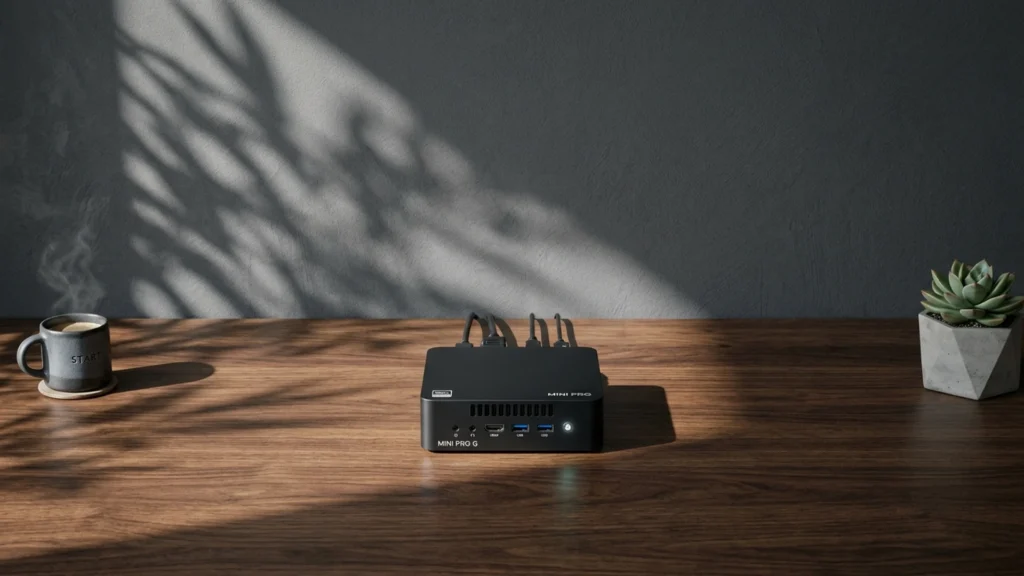
Business mini computers are small desktops built for stable daily use. Buyers in this category focus on fast office tasks like email, spreadsheets, and web apps. They also need dependable ports for monitors, docking, printers, and simple device sharing in a workplace.
Choosing one is harder than it looks. You trade compact size for fewer ports, and thin cooling designs can throttle under long workloads. Wireless quality matters more than casual users expect, since Wi-Fi drops can break video calls and cloud syncing. Value also depends on the exact CPU and memory you get out of the box.
If you want options beyond the business office lane, see our Best Mini Computers.
Quick Overview
Our Top Picks
#1. GEEKOM IT12 Mini Computer

Specifications
| Brand | GEEKOM |
|---|---|
| Processor | Intel Core i5-12450H |
| Memory | 16 GB |
| Storage | 512 GB SSD |
| Graphics | Intel Quick Sync UHD graphics |
| Wireless | Wi-Fi 6E, Bluetooth 5.2 |
Pros
- Smooth multitasking performance
- Reliable Wi-Fi and Bluetooth
- Feature-rich and fairly priced
Cons
- Graphics-limited
The GEEKOM IT12 is a strong pick for business use because it feels smooth under everyday multitasking. The Intel Core i5-12450H with 16 GB of RAM handles web apps, office work, and light media tasks without a lot of slowdowns. It also pairs well with a work-from-home setup thanks to Wi-Fi 6E and Bluetooth 5.2, which tend to stay stable for calls and wireless peripherals.
The main trade-off is graphics limits. For office productivity and video playback, the Intel Quick Sync UHD graphics are fine, but you should not expect it to be a good choice for heavier creative work or demanding workloads. If your goal is a compact, dependable work computer for documents, browsing, and meetings, this model fits that job well.
#2. GEEKOM Air12 Mini Computer

Specifications
| Brand | GEEKOM |
|---|---|
| Processor | Intel Pentium 7505 |
| Memory | 8 GB |
| Storage | 1 TB SSD |
| Wireless | Wi-Fi 6 |
| Usb Ports | 6 Ports |
| Dimensions | 5.3 x 8.9 x 6.9 in |
Pros
- Spacious fast SSD
- More connection options
- Feature-rich and fairly priced
Cons
- Underpowered CPU
- RAM bottleneck risk
- HDMI version ambiguity
GEEKOM Air12 stands out in business mini computers because it pairs a roomy 1 TB SSD with solid everyday connectivity in a small chassis. With 6 USB ports and Wi-Fi 6, it is easier to run real office setups without constant dongles or swapping cables. The build also feels practical for desk or behind-monitor use, which matters when you want a clean workspace for email, spreadsheets, video calls, and shared file access.
The main trade-off is its Intel Pentium 7505 and the 8 GB of RAM. For light multitasking and typical office browsing, it can feel fine, but heavy browser tabs, large documents, or many apps at once can make the system feel tight. If you plan to keep this machine as a long-term work hub, double-check whether you can upgrade RAM later, and be careful with HDMI expectations since the HDMI version is not clearly stated.
#3. Lenovo ThinkCentre neo 50q Mini Computer

Specifications
| Brand | Lenovo |
|---|---|
| Processor | Intel Core i5-13420H |
| Memory | 16 GB |
| Storage | 512 GB SSD |
| Graphics | Intel UHD Graphics |
| Wireless | Wi-Fi 6, Bluetooth 5.2 |
| Usb Ports | 8 Ports |
| Dimensions | 7 x 7 x 1.4 in |
| Weight | 6.3 lb |
Pros
- Fast modern CPU
- Spacious fast SSD
- Reliable Wi-Fi and Bluetooth
Cons
- Weak graphics performance
- Cooling evidence missing
The Lenovo ThinkCentre neo 50q stands out as a practical business mini PC thanks to its modern Intel Core i5-13420H, roomy 16 GB of RAM, and a 512 GB SSD. In office use, it feels responsive for web work, multitasking, and everyday apps, with quick waking and fast loading from the SSD. Wi-Fi 6 and Bluetooth 5.2 are also a strong fit for a shared workspace, where stable wireless matters for headsets, phones, and peripherals.
The main trade-off is graphics. Intel UHD Graphics limits heavier creative work and makes casual gaming or GPU-heavy tasks less smooth. Cooling performance is harder to judge from available info, so if you plan long, sustained workloads, expect to manage the workload mix and airflow like you would with any compact PC.
What to Look For
CPU that stays responsive: Office work needs a CPU that handles multitasking without lag. Prioritize models with strong real world performance for web browsing, office suites, and light media work. Look for configurations that avoid slowdowns during sustained use.
Enough RAM for everyday multitasking: Business users typically run multiple tabs and apps at once. Aim for 16 GB if you expect heavier browsing, larger spreadsheets, or frequent document switching. 8 GB can work for lighter usage, but it leaves less room to breathe.
SSD capacity that matches your workflow: Choose a primary SSD size that fits your files and tools. If you store documents locally, pick more than the minimum. For mostly cloud based work, smaller storage can still be practical, but updates and caches still consume space.
Wi-Fi and Bluetooth that do not disrupt meetings: Use the stated wireless standards to gauge reliability. Wi-Fi 6 and Bluetooth 5.2 or higher usually serve business setups better for stable conferencing and smoother peripheral use. This matters for headsets, mice, and keyboard dongles.
Port count you can live with: Verify the number and placement of USB ports for your day to day devices. Business buyers often connect external drives, adapters, and peripherals. If the port selection is thin, you will spend more on hubs and cables than you planned.
How We Picked
Products were identified through broad research across review sites and buyer forums, then filtered to only those that qualify as Business Mini Computers. That filter prioritizes office friendly performance, dependable daily behavior, practical connectivity, and business appropriate build and thermals.
Scoring used the same objective pillar framework as the main Mini Computers post, allowing direct comparison of products within this sub category. Performance, connectivity, cooling, compactness, build quality, and value were weighted to reflect what business buyers feel first during real work, not lab benchmarks.
Frequently Asked Questions
What makes a mini PC good for business use?
Look for fast daily performance, reliable Wi-Fi, and enough ports for your desk setup. Many business models also run cooler and stay stable during long work sessions. Good storage and enough RAM help with web browsing, office apps, and multitasking.
How do I choose between better performance and better value for work?
Start with your heaviest tasks. If you do lots of multitasking, choose a configuration with stronger CPU speed and at least 16 GB RAM. If your work is mostly email, spreadsheets, and browsing, you can often save money with a balanced model and still feel smooth.
What ports do I need for a typical business desk setup?
Plan for monitors, keyboards, mice, and any network or storage needs. Most business mini PCs are meant to support everyday USB use, plus easy video output for screens. If you use many peripherals, check the total number of USB ports before you buy.
Do business mini PCs need special cooling or maintenance?
They should handle office workloads without frequent fan issues, but airflow still matters. Keep the vents clear and place the unit where air can move. If you notice louder fan noise, dust buildup may be the cause, so clean it carefully.
When should I choose a different mini PC type instead of a business mini PC?
Choose another mini PC type if you need heavy creative work, high-end gaming, or major GPU tasks. Business mini PCs focus on steadier office performance, basic media, and dependable daily use. If your software needs a stronger graphics card, you may want a more performance focused option.
How do business mini PCs compare to other mini PCs for everyday size and setup?
Business mini PCs usually focus on being easy to place near a monitor or under a desk. They also tend to prioritize practical I O for office gear. If space is tight or you want a simple, clean setup, this segment often fits better.


