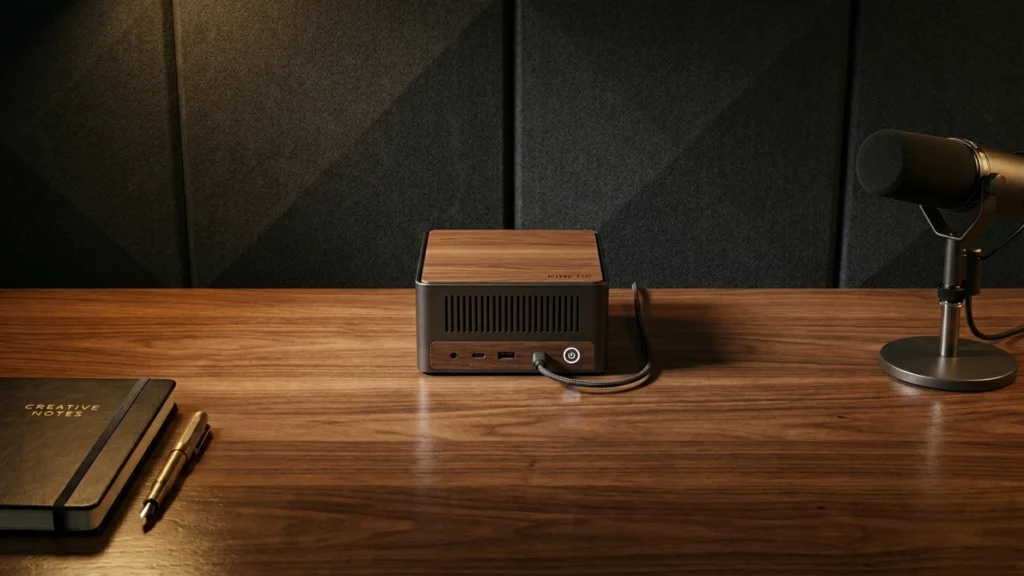
Gaming mini computers are small desktop PCs meant for low-profile setups. Buyers in this sub-category care about smooth frame rates, quick loading, and stable performance during longer play sessions.
This category is hard because the smallest boxes limit thermals and power. You also trade off GPU strength, upgrade paths, and the number of usable ports for controllers, headsets, and fast storage.
After you narrow your target games and resolution, use the criteria below to pick the right balance for your desk. Looking for all types? See our Best Mini Computers.
Quick Overview
Our Top Picks
#1. ASUS ROG NUC Mini Computer

Specifications
| Brand | ASUS |
|---|---|
| Processor | Intel Core Ultra 9 (Series 2) ARL-HX |
| Memory | 32 GB |
| Storage | 1 TB SSD |
| Graphics | NVIDIA GeForce RTX 5070 Mobile |
| Wireless | Wi-Fi 6E, Bluetooth 5.3 |
| Usb Ports | 6 Ports |
Pros
- Smooth multitasking performance
- Stable thermals under load
- Compact footprint, practical layout
Cons
- High price premium
- Limited user wireless proof
The ASUS ROG NUC Mini Computer stands out for gaming mini PC buyers who want desktop-class responsiveness in a small box. With an Intel Core Ultra 9 (Series 2) ARL-HX, 32 GB of RAM, 1 TB SSD, and an NVIDIA GeForce RTX 5070 Mobile, it handles demanding multitasking and game sessions without feeling cramped or laggy. The thermals stay stable under load, so performance does not noticeably wobble during longer play or heavier tasks.
The main trade-off is how it fits real setups. Connectivity is good, but with only 6 USB Ports, you may end up planning around adapters for extra controllers, storage, or peripherals. This makes it best for gamers who already have a streamlined desk setup and want a compact system that stays consistent when things get busy.
#2. MINISFORUM AtomMan G7 PT Mini Computer

Specifications
| Brand | MINISFORUM |
|---|---|
| Processor | Intel Core i9-14900HX |
| Memory | 32 GB |
| Storage | 1 TB SSD |
| Wireless | Wi-Fi 7, Bluetooth 5.4 |
Pros
- Smooth multitasking performance
- Reliable Wi-Fi and Bluetooth
- Stable thermals under load
Cons
- Rear-port inconvenience
The MINISFORUM AtomMan G7 PT stands out in the Gaming Mini Computers lane because it brings desktop-class Intel i9-14900HX power into a small box, and it stays responsive when you multitask. In real use, it handles heavy browser tabs, game launchers, and background apps without feeling sluggish. It also keeps Wi-Fi and Bluetooth stable enough for gaming where dropping connections is the difference between smooth play and frustration. Cooling holds up under sustained load, which matters when a game or emulator runs for a long session.
The main trade-off is rear-port inconvenience. If you expect to plug controllers, headsets, and storage into the back during regular play, you may need a longer cable or a hub to avoid awkward reach. This makes it a better fit for setups where most cables stay put behind your monitor or where you do not frequently reshuffle peripherals.
#3. TOPGRO T1-Pro Mini Computer

Specifications
| Brand | TOPGRO |
|---|---|
| Processor | Intel Core i9-13900HK |
| Memory | 64 GB |
| Storage | 2 TB SSD |
| Graphics | NVIDIA GeForce RTX 4060 |
| Wireless | Wi-Fi 6E, Bluetooth 5.3 |
| Dimensions | 1.6 x 11.8 x 10.2 in |
| Weight | 3.1 lb |
Pros
- Smooth multitasking performance
- Fast modern CPU
- Compact footprint, practical layout
Cons
- Early failure reported
- Warranty support limited
- Bulky and heavy
The TOPGRO T1-Pro stands out in Gaming Mini Computers because it pairs a high-end Intel Core i9-13900HK with an NVIDIA GeForce RTX 4060 in a small form. In everyday game use, that combo supports smooth multitasking alongside gaming, with quick app launches and responsive desktop behavior. With Wi-Fi 6E and Bluetooth 5.3, it also stays practical for online play and wireless peripherals when you do not want to run cables.
The main trade-off is reliability and support. There are early failure reports, and warranty help seems limited. It is also bulky and heavy for the category, so it may not feel as easy to hide behind a monitor as lighter mini PCs. This one fits best if you want a compact gaming setup and can tolerate the risk while you test it early.
What to Look For
Game performance you can feel: Prioritize a CPU and GPU combo that handles your real playstyle, not just benchmark peaks. Look for configurations with enough memory and SSD speed so game launches, level streaming, and multitasking stay smooth.
RAM and storage for modern games: Aim for at least 16 GB RAM for gaming and background apps like Discord. Choose an SSD sized for your library, since storage bottlenecks can show up as stutter when you load new areas.
Graphics output that matches your monitor: Confirm the integrated GPU or included graphics model can drive your target resolution and settings. If you play at 1080p, you still want enough graphics headroom to avoid constant frame drops.
Port planning for controllers and headsets: Count the USB ports you need for mouse, keyboard, controller, and any accessories. Also check wireless support for stable Wi-Fi and reliable Bluetooth for headsets and controllers, especially in shared spaces.
Cooling that prevents slowdown: Gaming mini computers should stay consistent under repeated loads. Look for reviews that mention stable thermals and acceptable fan noise, since throttling can cut performance right when you need it.
How We Picked
Products were identified through broad research across review sites and buyer forums, then filtered to only those that qualify as Gaming Mini Computers.
Scoring used the same objective pillar framework as the main Mini Computers post, allowing direct comparison of products within this sub-category.
Frequently Asked Questions
What makes a mini PC better for gaming than a basic mini computer?
Gaming mini PCs focus on faster CPUs, enough RAM, and storage that loads games quickly. They also need stronger graphics, either a capable integrated GPU or a dedicated option. Cooling matters too, because games keep the system busy for longer.
How much RAM do I need for gaming on a mini PC?
Most people should start with 16 GB for smooth multitasking and modern game launchers. 32 GB helps if you stream, edit video, or run lots of browser tabs while gaming. If a model ships with 8 GB, plan to upgrade quickly.
Do gaming mini PCs need special cooling or extra maintenance?
They usually do more work than office mini PCs, so airflow is critical. Keep the intake vents clear and clean them gently with compressed air. If the fan noise bothers you, check reviews for sustained load temperatures and throttling.
Why do some gaming mini PCs feel faster in daily use even with similar specs?
Storage speed and memory configuration can make a big difference in real life. A fast SSD helps games launch and loads levels faster. Cooling also affects speed, since good cooling keeps performance steady during long sessions.
When should I choose a different kind of mini PC instead of a gaming mini PC?
Choose an office or media-focused mini PC if you only browse, use Microsoft Office, and stream video. Those models often cost less and stay quieter. Gaming mini PCs help most when you play games, test software, or do heavier creative work.
How do gaming mini PCs compare to other mini computers for ports and setup?
Gaming models often include more useful ports for controllers, headsets, and external drives. You still may want extra USB for monitors and accessories. If you use multiple peripherals, compare USB port count and check that Wi-Fi and Bluetooth match your needs.