




45-Slope Robotic Lawn Mowers are built for properties where the yard tilts steeply. For this sub-category, your main need is traction and safe hill climbing while keeping a steady cutting pattern. You also need reliable boundary handling so the mower does not miss zones on the uphill side.
Picking the right model is hard because high-slope mowing creates trade-offs. Some mowers support steep inclines but have smaller coverage for their cutting width. Others cover your area but route less efficiently, which increases overlap on hills. Even “smart” navigation can fail if your boundary setup leaves tight uphill sections or blocked approaches.
To compare across all yard sizes and boundary types, use our top list for the full set of options: Looking for all types? See our Best Robotic Lawn Mowers.
Quick Overview
Our Top Picks
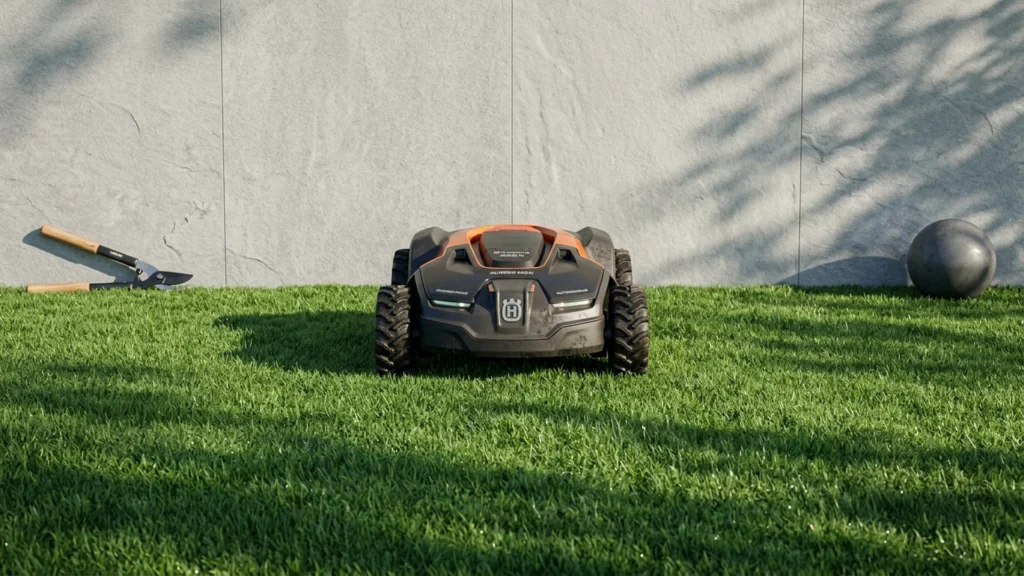
#1. Husqvarna 520H EPOS Robotic Lawn Mower

Specifications
| Brand | Husqvarna |
|---|---|
| Max Lawn Area | 1.25 acre |
| Cutting Height | 0.8-2.4 in |
| Max Slope | 45% |
| Navigation Boundary System | Wire-Free |
| Connectivity Smart Control | App Control |
Pros
- Reliable, consistent mowing
- Smart mapping, minimal repeats
- App control feels intuitive
Cons
- Hardscape transition issues
- Layout sensitivity
This Husqvarna model stands out for buyers shopping specifically for 45-slope robotic mowing. Its wire-free boundary approach pairs with smart mapping, so it cuts with steady, repeatable coverage across the yard. In practice, it tends to avoid those long re-traversals that waste time, and the app makes it easy to monitor and keep schedules on track. Cut height control also stays consistent, which matters when your yard has uneven growth along the edges.
The main trade-off is layout sensitivity. Hardscape transitions can interrupt the flow, like when mowing near patios, edging stones, or tight borders. If your property has many tricky shape changes or narrow passages, expect a bit more tweaking than with simpler lawns. It is best for homeowners who want reliable day-to-day mowing and can invest time up front to get the yard layout dialed in.
#2. ECOVACS Goat O1000 1/4-Acre Robotic Lawn Mower

Specifications
| Brand | ECOVACS |
|---|---|
| Max Lawn Area | 0.25 acre |
| Max Slope | 45% |
| Navigation Boundary System | Wire-Free |
| Connectivity Smart Control | App Control |
Pros
- Reliable, consistent mowing
- Smart mapping, minimal repeats
- Feature-rich for the price
Cons
- Small coverage limit
- Less dependable mapping
- Thick-grass struggles
For 45-slope robotic mowing, this ECOVACS model stands out because it is designed to run on steep ground up to 45%. In real use, it keeps cuts fairly even and stays consistent over the yard. It also maps the space well for a wire-free setup, with fewer repeat passes than many random-path models.
The main trade-off is coverage. Its max area is limited to 0.25 acre, so it fits smaller lawns best. It can also struggle when grass gets thick or slightly overgrown, and mapping is sometimes less dependable than the mowing results, so you may need a quick check after initial setup in tricky areas.
#3. Mova LiDAX Ultra 1000 1/4-Acre Robotic Lawn Mower

Specifications
| Brand | Mova |
|---|---|
| Max Lawn Area | 0.25 acre |
| Cutting Width | 15.75 in |
| Cutting Height | 1.2-3.9 in |
| Max Slope | 45% |
| Navigation Boundary System | Wire-Free |
Pros
- Reliable, consistent mowing
- Smart mapping, minimal repeats
- App control feels intuitive
Cons
- Small coverage limit
- Setup learning curve
- Battery/charging opacity
The Mova LiDAX Ultra 1000 stands out for yards that need dependable mowing on moderate to steep areas, up to a 45% slope. In the same class as wire-free boundary robots, it keeps the cut fairly even and shows steady results across the lawn. Mapping seems smart and it tends to avoid constant back and forth in the same spots, so you spend less time watching it redo missed areas. App control is also straightforward, which helps if you want to adjust schedules without getting pulled into constant troubleshooting.
The main trade-off is coverage. At a 0.25 acre limit, it fits smaller lots best, especially if you want it to run often enough to prevent tall grass from building up. Setup takes some learning, so first weeks may feel a bit hands on. Also, battery and charging details are not clear up front, which can make it harder to predict how often it will need attention during long mowing windows.
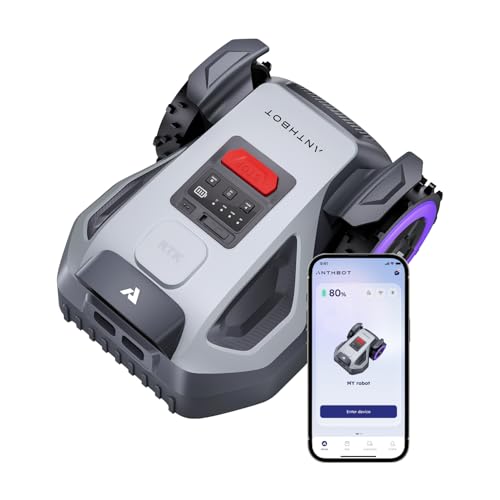
#4. ANTHBOT M9 0.3-Acre Robotic Lawn Mower

Specifications
| Brand | ANTHBOT |
|---|---|
| Max Lawn Area | 0.3 acre |
| Cutting Width | 7.9 in |
| Cutting Height | 1.2-2.8 in |
| Charge Time | 90 min |
| Max Slope | 45% |
| Navigation Boundary System | Wire-Free |
| Connectivity Smart Control | Cellular + Wi-Fi + Bluetooth |
Pros
- Smart mapping, minimal repeats
- App control feels intuitive
- Handles steeper slopes
Cons
- Small coverage limit
- Narrow cutting swath
- Condition-dependent navigation
This mower stands out for the 45-slope use case thanks to its max 45% incline rating. For yards that feel too steep for many robotic mowers, the ANTBOT M9 is designed to keep working where others struggle. It also uses wire-free boundary navigation and smart mapping, which helps it cover the lawn with fewer repeated passes.
The trade-off is simple: its cutting width is narrow at 7.9 in, and its coverage limit is only 0.3 acre. If your yard is larger or has lots of tight turns, expect slower overall coverage and more setup time. Navigation also seems more condition-dependent, so uneven growth or tricky obstacles can lead to less consistent pathing.
What to Look For
Max Slope Rating: Confirm the mower’s maximum slope is 45% or higher for real-world use. If the spec is close to your steepest spot, leave extra margin for wet grass and tire slip.
Navigation / Boundary Fit for Hills: Choose a navigation method that stays consistent on inclines. In practice, this means fewer missed patches on uphill zones and less repeated back-and-forth where paths narrow.
Cutting Width vs. Coverage Area: Match cutting width to the total lawn size you actually want maintained. A wider deck can reduce mowing time, but only if the mower can keep its route reliable on slopes without frequent stops.
Battery Runtime and Recharge Behavior: For steep lawns, shorter runtime can turn into more interruptions because the mower works harder. Check runtime and charging time so the mower can return and resume without long gaps.
App Control and Setup Limits: Prioritize models with clear scheduling and straightforward zone control. On a 45% slope, you want fewer setup surprises, like zones that slice uphill awkwardly or schedules that increase full-battery starts on heavy growth.
How We Picked
Products were identified through broad research across review sites and buyer forums, then filtered to only those that qualify as 45-Slope Robotic Lawn Mowers.
Scoring used the same objective pillar framework as the main Robotic Lawn Mowers post, allowing direct comparison of products within this sub-category.
Frequently Asked Questions
What does a 45-slope robotic mower mean in real yard use?
It means the mower can work on steep hills of up to 45 percent grade, if conditions are right. Wet grass, loose soil, and tight turns can reduce traction. Plan for slower mowing on hills and keep the area reasonably clear.
Do all 45-slope robotic lawn mowers use the same boundary setup?
No. Some models use a boundary wire, while others use wire-free positioning like GPS or camera based guidance. Your setup choice affects installation time and how well the mower handles odd edges. Check the navigation type before buying.
How should I place the charging dock when my yard has steep slopes?
Place the dock in a spot with safe access from both the flat and the hill areas. Avoid steep side paths that could trap the mower during docking. Test a short run on a clear day, then adjust the layout if the mower struggles.
How do I choose between a 45-slope mower and a standard robotic lawn mower?
Choose a 45-slope model if you have hills near the mower’s typical routes. A standard unit may slip, stop, or fail to finish mowing on steep sections. If your yard is mostly flat, a standard model can be easier to set up and less expensive.
How do 45-slope robotic mowers compare in mowing area and cut width?
Many 45-slope models are sized for small to mid yards, often around a quarter acre. Cutting widths often land in the 7 to 10 inch range. The right choice depends on your lawn area and how often the mower must start back up for charging.


