




Weather-Based Rain Delay Smart Irrigation Systems use local forecasts and rain delay logic to stop or shorten watering. This matters when sprinklers run on fixed schedules but the sky does not. For buyers, the core need is simple: automatic rain shutoff that reduces wasted water without skipping needed irrigation.
Choosing one is harder than it looks because the trade-offs are real. You must balance how smart the delay decisions are against zone capacity, app usability, and the system’s ability to run day-to-day without resets. You also need to check whether the controller supports your sprinkler wiring and whether weather features work well in your area.
To narrow the options without overbuying, compare only controllers that handle weather-based rain delay consistently and let you control zones clearly. Looking for all types? See our Best Smart Irrigation Systems.
Quick Overview
Our Top Picks
#1. Rachio 3 16-Zone Smart Irrigation System

Specifications
| Brand | Rachio |
|---|---|
| Installation Type | Indoor/Outdoor |
| Zones Supported | 16 Zones |
| Connectivity | Wi-Fi |
| Weather Adjustments | Weather-Based |
| Sensor Compatibility | Rain Sensor / Soil Moisture Sensor / Flow Sensor |
| Smart Home Integration | Alexa / Google Assistant / HomeKit |
| Power Source | AC Power |
Pros
- Accurate rain-delay handling
- Reliable alerts, minimal drops
- Intuitive zone scheduling
Cons
- Zone calibration sensitivity
- Wi‑Fi setup friction
- Warranty coverage limitations
The Rachio 3 16-Zone system is a top pick for weather-based rain delay watering because it handles rain events in a practical, low-effort way. The controller combines weather-based scheduling with strong rain delay logic, so zones pause when rain is likely and avoid the common problem of runoff and mushy lawns from missed rain-off signals. In day to day use, you can still plan zone runtimes clearly, then let the system adjust decisions as conditions change.
The main trade-off is setup and tuning. Calibrating and fine adjusting zone behavior can be a bit sensitive, especially if your sprinkler coverage varies across zones. Wi-Fi setup can also feel a little fiddly at first, and warranty coverage has limitations to be aware of before install. This is best for homeowners with multiple sprinkler zones who want weather-driven rain delays but are willing to spend a little time dialing in their system.
#2. Rachio 3 8-Zone Smart Irrigation System

Specifications
| Brand | Rachio |
|---|---|
| Zones Supported | 8 Zones |
| Connectivity | Wi-Fi |
| Weather Adjustments | Weather-Based |
| Smart Home Integration | Alexa |
| Power Source | AC Power |
Pros
- Accurate rain-delay handling
- Reliable alerts, minimal drops
- Stable firmware updates
Cons
- otherwise predictions may be off
- Zone calibration required
- Wi-Fi pairing resets
The Rachio 3 8-Zone Smart Irrigation System stands out in weather-based rain delay smart irrigation because it handles rain interruptions in a way that feels consistent and practical. When rain delays kick in, the controller makes zone-by-zone scheduling changes without you needing to babysit the forecast. It also works with steady Wi-Fi app alerts, and firmware updates tend to stay stable, so the system is less likely to act unpredictable on rainy days.
The main trade-off is that predictions and timing still depend on your setup. You will need zone calibration, and early Wi-Fi pairing can be a little fussy, sometimes requiring a reset. This controller is best for homeowners who want weather-driven rain delay automation and are willing to spend a bit of time dialing in each zone, rather than expecting a fully set-and-forget experience.
#3. Eve Aqua Smart Irrigation System

Specifications
| Brand | Eve |
|---|---|
| Installation Type | Outdoor |
| Connectivity | Bluetooth / Thread |
| Weather Adjustments | Weather-Based / Rain Delay |
| Sensor Compatibility | Soil Moisture Sensor |
| Smart Home Integration | HomeKit |
| Power Source | Battery |
Pros
- Accurate rain-delay handling
- Reliable alerts, minimal drops
- Intuitive zone scheduling
Cons
- No Wifi control
- Pump control limitations
- Battery-only upkeep
Eve Aqua stands out for weather-based rain delay control that fits naturally into an everyday watering routine. Instead of only relying on fixed schedules, it can pause or adjust watering based on rain-related logic and keep zones from running during wet periods. Setup is straightforward, and the zone scheduling makes it easier to avoid overwatering when forecasts look rainy. Alerts also tend to show up reliably, so you are not guessing whether the controller acted on the weather.
The main trade-off is connectivity and control style. It uses Bluetooth and Thread with HomeKit, so you will not get Wi-Fi based remote control like many rival systems. It also has pump control limitations and runs on battery power, so plan for periodic upkeep. This makes it a better fit for smaller, HomeKit-centered sprinkler setups where rain delay accuracy matters more than full-time cellular or Wi-Fi control.
#4. Hunter PRO-HC 12-Zone Smart Irrigation System

Specifications
| Brand | Hunter |
|---|---|
| Installation Type | Outdoor |
| Zones Supported | 12 Zones |
| Connectivity | Wi-Fi |
| Weather Adjustments | Weather-Based / Rain Delay |
| Sensor Compatibility | Rain Sensor / Soil Moisture Sensor |
Pros
- Reliable alerts, minimal drops
- Intuitive zone scheduling
- ET and forecast aware
Cons
- Rain-skip delay concern
- Subscription value doubt
- Reset touchscreen glitches
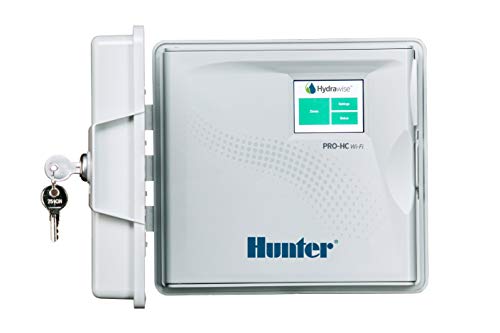
This 12-zone controller stands out for weather-based rain delay behavior that feels steady in day-to-day use. With forecast and ET aware scheduling, it can pause or reduce watering when conditions look wet enough, which helps prevent the common problem of watering too soon after rain. In practice, the system also supports rain sensor and soil moisture sensor inputs, so the controller can make adjustments based on both outside conditions and what the ground is actually doing.
The main trade-off is the rain-skip delay behavior. Some homeowners may find that the skip timing sometimes feels overly cautious, especially if storms pass quickly and lawns dry faster than expected. There are also occasional touchscreen reset glitches, and if you rely heavily on a subscription layer for the best rain-delay results, that part can feel less compelling.
#5. Hunter PRO-HC 12-Station Smart Irrigation System

Specifications
| Brand | Hunter |
|---|---|
| Installation Type | Outdoor |
| Zones Supported | 12 Zones |
| Connectivity | Wi-Fi |
| Weather Adjustments | Weather-Based / Rain Delay |
Pros
- Accurate rain-delay handling
- Reliable alerts, minimal drops
- Intuitive zone scheduling
Cons
- Touchscreen unresponsive
- Low review satisfaction
For weather-based rain delay watering, the Hunter PRO-HC 12-Station stands out for how it handles skipped days. It uses weather-based rain delay logic to reduce the odds of running sprinklers right before or during rain. For homes with multiple lawn areas, the 12-zone setup also makes it easier to keep each zone on its own schedule while still letting the weather adjustment nudge watering decisions when conditions change.
The main trade-off is day-to-day control through the unit itself. Some reviewers report that the touchscreen can be unresponsive, so you may rely more on the app for setup and tweaks. This controller is a good fit if you want dependable weather-based rain delay behavior and zone-by-zone scheduling, but you can tolerate occasional friction on the physical interface.
#6. Gardena Smart Water Control Smart Irrigation System

Specifications
| Brand | Gardena |
|---|---|
| Installation Type | Outdoor |
| Zones Supported | 6 Zones |
| Connectivity | Bluetooth |
| Weather Adjustments | Weather-Based / Rain Delay |
| Smart Home Integration | Alexa / Google Assistant / HomeKit |
Pros
- Accurate rain-delay handling
- Intuitive zone scheduling
- Stable firmware updates
Cons
- No WiffFi control
- Cloud dependency uncertainty
- Gateway package variance
This 6-zone Gardena controller stands out for weather-based rain-delay control that helps prevent watering on days when rain is likely. In this sub-category, that kind of automatic skip is the difference between a schedule that ignores storms and one that reacts to them. It also keeps day-to-day planning simple with intuitive zone scheduling, so each zone stays aligned even when the system pauses or shortens runs.
The main trade-off is connectivity. It relies on Bluetooth, not Wi-Fi, so you may not get the same kind of steady remote control as Wi-Fi-based models. If you prefer local app control near the controller and you want reliable rain-delay behavior, this is a strong fit. If you rely on always-on cloud access, you may find the cloud dependency less predictable than Wi-Fi options.
What to Look For
Weather-Based Rain Delay Controls: Prioritize controllers that can automatically pause watering when rain is likely, not just display weather info. Look for clear rain delay behavior in the app, so you can confirm that skipped runs match the forecast.
Zone Coverage and Scheduling Fit: Pick a model that matches your number of zones with room to grow. Weather-based rain delay works best when the controller can manage zones individually, because different areas dry out at different rates.
Reliable App and Wireless Connection: Choose a system with dependable Wi-Fi connectivity and stable remote access. If alerts or scheduling updates fail often, rain delay may not apply when you need it most.
Sensor Compatibility for Smarter Skips: If you have or plan to add sensors, confirm support for rain sensors and, where offered, soil moisture and flow sensors. Sensor-ready setups can reduce needless watering when conditions change between forecasts.
Installation and Daily Usability: Favor controllers with straightforward setup and easy overrides. You want quick ways to adjust schedules after a rain delay, plus clear instructions for indoor or outdoor installation, depending on where you mount the controller.
How We Picked
Products were identified through broad research across review sites and buyer forums, then filtered to only those that qualify as Weather-Based Rain Delay Smart Irrigation Systems.
Scoring used the same objective pillar framework as the main Smart Irrigation Systems post, allowing direct comparison of products within this sub-category.
Frequently Asked Questions
What does rain delay actually do in a weather-based smart irrigation system?
It pauses scheduled watering when rain is likely or when recent rain is detected. The controller then resumes watering when the lawn needs it again. This helps prevent runoff and wasted water.
How is weather-based rain delay different from using only a rain sensor?
A weather-based feature uses forecast or local weather data to decide ahead of time. A rain sensor reacts to what happens right now, like raindrops on a sensor. Both can work together, but they help in different ways.
Do I need to run the system in ET mode too, or is rain delay enough?
Rain delay only handles wet weather. ET based or weather adjusted schedules estimate how much water plants need based on heat and conditions. Using both often gives the best balance between avoiding overwatering and preventing dry spots.
Which is easier to manage: weather-based rain delay, soil moisture sensing, or flow sensing?
Weather-based rain delay usually needs the least extra hardware. Soil moisture sensing can reduce watering when the ground stays wet, but it requires sensor placement and occasional checks. Flow sensing helps catch leaks, but it is more about detecting problems than optimizing routine schedules.
When should I choose a different type of smart irrigation instead of weather-based rain delay?
Choose a different type if you have very specific watering issues. For example, pick leak detection if you suspect underground line breaks. Pick soil moisture control if your soil types vary a lot across zones.
How do these systems compare to basic timer controllers?
Basic timers run on set schedules and do not react to weather changes. Weather-based rain delay systems adjust or pause watering based on forecasts and conditions. That usually means fewer missed storms and less wasted water between seasons.


