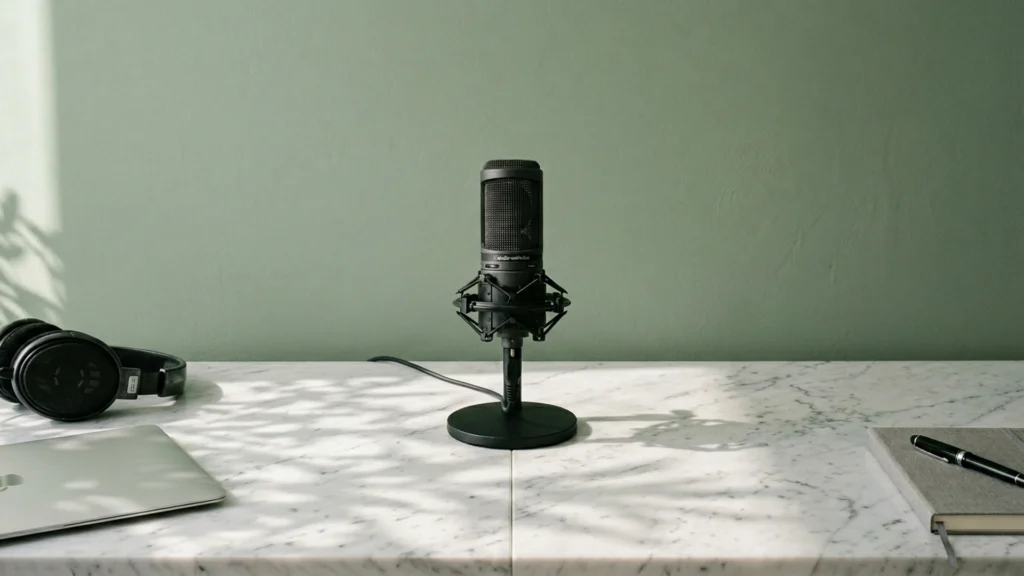
USB condenser microphones use a built-in audio interface. That means you plug them into your computer and record right away. This sub-category is for buyers who want studio-style detail for voice, streaming, and home recording without an external mixer or interface.
Picking the right one gets tricky because USB convenience can come with trade-offs. Many models sound bright and expose room noise. Others include useful monitoring, but their gain control can be less precise. You also have to match the mic to your source and space, since pickup pattern and placement change how boomy or hissy your recording will sound.
If you want guidance across the full microphone lineup, not just USB condensers, use the same buying logic from here: Looking for all types? See our Best Microphones.
Quick Overview
Our Top Picks
#1. RØDE NT-USB+ USB Condenser Microphone

Specifications
| Brand | Rode |
|---|---|
| Microphone Type | Condenser |
| Form Factor | Desktop |
| Polar Pattern | Cardioid |
| Connector Type | USB-C |
| Power Source | USB Bus Power |
| Frequency Response | 20 Hz - 20000 Hz |
| Max Spl | 118 dB SPL |
Pros
- Balanced, detailed and clean
- Plug-and-play with stable mounting
- Broad frequency response
Cons
- Struggles with loud sources
- Room-noise pickup
The RØDE NT-USB+ stands out in USB condenser microphones because it stays clear and balanced even when your room is less than perfect. With a cardioid pickup and a 20 Hz to 20000 Hz response range, it delivers detailed vocals and speech that sound natural and easy to listen to. Setup is simple and consistent for everyday recording, since it runs on USB-C bus power and mounts firmly for stable mic placement. The result is a direct, clean voice sound that works well for streaming, podcasts, and home studio use.
The main trade-off is that it can struggle with loud sources and needs careful distance and level control. It also picks up room noise more than you might want in echoey spaces, so closer speaking and basic sound treatment help a lot. If you mainly record vocals and spoken audio on a desk, and you want a straightforward USB setup with a clean tone, this is a strong top pick for most users.
#2. SE Electronics Neom USB Microphone

Specifications
| Brand | SE ELECTRONICS |
|---|---|
| Microphone Type | Condenser |
| Form Factor | Desktop |
| Polar Pattern | Cardioid |
| Connector Type | USB-C |
| Power Source | USB Bus Power |
| Frequency Response | 20 Hz - 20000 Hz |
Pros
- Balanced, detailed and clean
- Sturdy metal and secure cable
- Plug-and-play with stable mounting
Cons
- Windows ASIO dependency
- Monitoring sounds better
SE Electronics Neom is notable in the USB condenser mic crowd because it sounds balanced and detailed without feeling harsh. The cardioid design helps keep your voice front and center, even when there is some room noise. It also captures quiet nuance well, while staying controlled when you speak a bit louder. In day to day podcasting and streaming setups, that cleaner top end and clear midrange make it easier to get a finished sound without heavy editing.
The main trade-off is software and monitoring. It is plug and play for capture, but Windows users may run into ASIO dependency. Also, what you hear during monitoring is not as satisfying as the final recording, so you may need to rely on playback. Best fit is for creators who want a more natural condenser sound for vocals and speech, and who are comfortable setting levels once and then recording consistently.
#3. AKG Lyra Ultra-HD USB-C Microphone

Specifications
| Brand | AKG |
|---|---|
| Microphone Type | Condenser |
| Form Factor | Desktop |
| Polar Pattern | Cardioid / Omnidirectional |
| Connector Type | USB-C |
| Power Source | External Power Supply (not included) |
| Frequency Response | 20 Hz - 22000 Hz |
| Max Spl | 129 dB SPL |
Pros
- Balanced, detailed and clean
- Plug-and-play with stable mounting
- Strong bundle, worth every dollar
Cons
- Struggles with loud sources
- External power ambiguity
- Room noise leakage
In the USB condenser microphone category, the AKG Lyra stands out for sounding balanced and detailed without feeling overly edgy for everyday voice work. It keeps tonal color in check and captures speech and vocals with a clean, natural presentation that typical bus-powered USB mics often miss. Setup is also straightforward, and the included mounting helps it stay put on a desk for steady results during long recording sessions.
The trade-off is how it handles louder talk or high-energy sources. It can struggle when you get too close to the mic or push volume hard, so you may need more distance or a softer speaking level. Also, like many desktop USB condensers, it can leak a bit of room noise, so quieter spaces or some basic acoustic treatment will help. Power is another small point to watch because it relies on an external power supply rather than fully relying on bus power.
#4. RØDE NT-USB Mini USB Condenser Microphone

Specifications
| Brand | Rode |
|---|---|
| Microphone Type | Condenser |
| Form Factor | Desktop |
| Polar Pattern | Cardioid |
| Connector Type | USB |
| Frequency Response | 20 Hz - 20000 Hz |
| Max Spl | 110 dB SPL |
Pros
- Plug-and-play with stable mounting
- Sturdy metal and secure cable
- Studio-like clarity
Cons
- Struggles with loud sources
- Overly gain-heavy output
- No on-mic gain control
In the USB condenser microphone space, the RØDE NT-USB Mini stands out for its straightforward setup and studio-like clarity. It is a cardioid desktop mic that works quickly over USB, with a solid metal build and a stable mount that helps keep your voice sounding consistent. The result is clear speech capture and detailed vocals, with a sound that feels polished for streaming, podcasting, and home recording.
The main trade-off is how it handles louder voices. It can struggle when the source gets too intense, and the output can feel gain-heavy, which may push you toward safer levels and closer monitoring. It also lacks on-mic gain control, so you will likely rely on software or your computer settings to dial it in.
#5. Mackie EM-91CU+ USB Condenser Microphone

Specifications
| Brand | Mackie |
|---|---|
| Microphone Type | Condenser |
| Form Factor | Desktop |
| Polar Pattern | Cardioid |
| Connector Type | USB |
| Power Source | USB Bus Power |
| Frequency Response | 20 Hz - 17000 Hz |
| Max Spl | 132 dB SPL |
Pros
- Sturdy metal and secure cable
- Plug-and-play with stable mounting
- Strong bundle, worth every dollar
Cons
- Single cardioid limitation
- Accessory compatibility friction
The Mackie EM-91CU+ stands out in the USB condenser mic set because it feels built for daily desk use. The metal body and secure cable help it survive bumps, and it stays stable when you mount it for calls, streaming, or podcasting. In typical home setups, the cardioid pickup pattern keeps things focused on your voice, and the 20 Hz to 17000 Hz range is broad enough to capture speech detail without needing extra signal chains.
The trade-off is simple: you only get cardioid. That means you will need to control room noise and mic distance more carefully than multi-pattern USB mics. If you are recording mostly one person and want plug-and-play behavior with solid hardware, this is a strong fit. If you often record in lively rooms or need more pickup flexibility, the single-pattern setup and accessory compatibility friction can be limiting.
#6. Elgato Wave:3 USB Condenser Microphone

Specifications
| Brand | Elgato |
|---|---|
| Microphone Type | Condenser |
| Polar Pattern | Cardioid |
| Connector Type | USB |
| Power Source | USB Bus Power |
| Frequency Response | 70 Hz - 20000 Hz |
| Max Spl | 120 dB SPL |
Pros
- Balanced, detailed and clean
- Plug-and-play with stable mounting
- Sturdy metal and secure cable
Cons
- Struggles with loud sources
- Narrow pickup flexibility
- Limited instrument use
Elgato Wave:3 stands out in the USB condenser market for its clean, balanced sound that stays detailed without getting harsh. With its cardioid pickup and 70 Hz - 20000 Hz range, it is a strong match for clear voice recording in a home studio, streaming setup, or podcast environment. Setup is also refreshingly simple. Plug it into USB bus power, position it on the included stable mount, and you are ready to record with minimal fuss.
The main trade-off is that the mic is not built for very loud sources. If you push it with high-volume singing, loud instruments, or close mic placement, it can start to struggle. It also has more limited flexibility than multi-pattern mics, since cardioid pickup favors a consistent speaking or singing position. This makes it best for straightforward voice work where you can control distance and volume.
#8. Joby WAVO POD USB Condenser Microphone

Specifications
| Brand | Joby |
|---|---|
| Microphone Type | Condenser |
| Form Factor | Desktop |
| Polar Pattern | Cardioid / Omnidirectional |
| Connector Type | USB-C / 3.5 mm |
| Power Source | USB Bus Power |
| Frequency Response | 20 Hz - 20000 Hz |
Pros
- Plug-and-play with stable mounting
- Strong bundle, worth every dollar
- Broad frequency response
Cons
- Noise pickup variability
- Plastic durability limit
- Omni mode mismatch
The Joby WAVO POD stands out in the USB condenser mic group because it is simple and quick to get recording. It works with plug-and-play use, and the included desktop setup stays stable enough for home voice work. In practice, the sound is clear across a broad range, so spoken voice and vocals come through with good detail. It also leans into a natural presentation rather than sounding overly bright.
The main trade-off is consistency. Some users may notice noise pickup variability, especially in quieter rooms. The plastic durability ceiling also makes it less ideal for frequent travel or rough handling, and the omnidirectional mode can sound a bit mismatched compared to the cardioid position. Best fit is someone who wants an easy USB condenser for podcasts, streaming, and everyday recording, but who can control room noise and speak close to the mic.
What to Look For
Sound clarity and self-noise: Focus on how clean the mic sounds at normal speaking levels. Good USB condensers keep hiss low and preserve vowel shape so vocals and speech stay readable, not brittle or thin.
Frequency balance for your voice: Condenser mics can boost presence and air. If a mic sounds harsh on S and T sounds, you will hear it right away. Choose a model that keeps highs smooth and mids natural for your speaking style.
Max SPL and plosive control: Check how well the mic handles louder moments. Even when you sound fairly controlled, close-up plosives and sudden volume jumps can clip. A higher max SPL rating helps you stay under distortion during takes.
USB compatibility and power behavior: Look for stable USB operation on your computer. In this sub-category, that usually means USB bus power with no extra power adapter. If the mic needs special software or drivers, confirm they work with your operating system before buying.
Polar pattern and off-axis rejection: Use the pickup pattern to match your room. Cardioid style mics tend to reduce side and rear noise, which helps if your room is untreated. If you record with more people or from farther away, choose a pattern that fits that spacing.
How We Picked
Products were identified through broad research across review sites and buyer forums, then filtered to only those that qualify as USB Condenser Microphones.
Scoring used the same objective pillar framework as the main Microphones post, allowing direct comparison of products within this sub-category.
Frequently Asked Questions
Do USB condenser microphones need any extra audio interface or drivers?
Most USB condenser microphones work right away with a computer. You plug them in and pick them as the input in your system settings. Some models still include a driver or app for extra controls, but basic recording usually works without fuss.
What polar pattern should I look for in a USB condenser microphone?
For most home voice and podcast use, Cardioid is the safe choice. It focuses on sound from the front and reduces pickup from the sides and back. If you record with more room noise or multiple people, you may prefer a more open pattern, like Omnidirectional, but you will also capture more background.
Why does my USB condenser mic sound distorted or harsh?
Distortion usually means you are clipping the mic gain or software level. Lower the input volume in your computer settings or in the mic controls. Also try keeping your mouth a bit farther away and speak slightly across the mic to reduce plosives and sibilance.
How do USB condenser microphones compare to XLR condenser microphones?
USB condenser microphones are simpler. They combine the preamp and analog to digital conversion in one plug. XLR condenser mics give you more upgrade paths and can be quieter when paired with higher end preamps, but you need an audio interface.
When should I choose a dynamic microphone instead of a USB condenser?
Choose a dynamic microphone if your room is noisy or echoey. Dynamics handle loud sound well and they often reject background better than many condensers. USB dynamics also avoid the hiss that some condensers show in very quiet settings.