




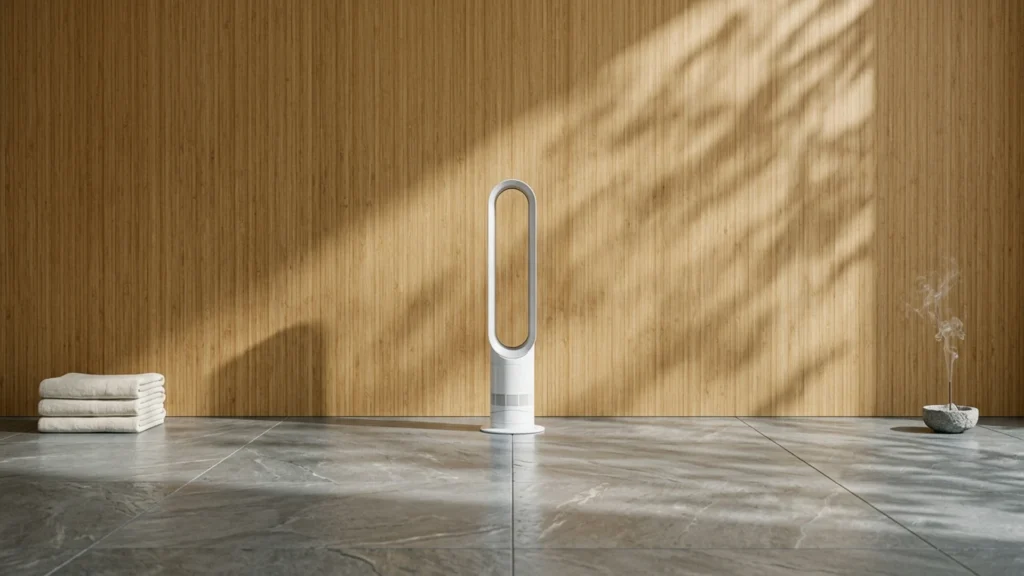
Bladeless household fans use an air channel and a circular intake to push air forward without exposed blades. Buyers in this category usually want safer use around kids, fewer snag hazards, and an airflow that feels more even than many standard fans.
The hard part is trade-offs. Bladeless models can cost more for similar room coverage. Some units move less air at higher speeds, or they get louder as you raise the setting. Others also mix in added functions, like heating or tower airflow design, which can change both noise and day to day comfort.
If you also want guidance across non-bladeless options, use the same room first approach, then compare airflow and noise head to head. Looking for all types? See our Best Household Fans.
Quick Overview
Our Top Picks
#1. Dyson Pure Cool Purifier Fan TP4A Fan

Specifications
| Brand | Dyson |
|---|---|
| Fan Type | Bladeless Fan |
| Oscillation Angle | 350° |
| Noise Level | 42.3 dB |
| Dimensions | 8.8 x 8.8 x 41.5 in |
Pros
- Consistent airflow
- Low noise output
- Wide oscillation coverage
Cons
- Limited CADR validation
- Model-specific evidence lacking
- Price value mismatch
This Dyson bladeless purifier fan stands out for how smoothly it moves air without exposed blades. In everyday use, airflow feels consistent across speeds, and the oscillation reaches a full 350 degrees, so the breeze can reach more of the room. Noise stays in check at about 42.3 dB, which makes it easier to run during work, reading, or sleep.
The main trade-off is proof. Its cooling impact depends on how the unit performs in your space, and there is limited CADR-style validation and model-specific evidence. It also tends to fit best for people who want bladeless safety and whole-room circulation more than shoppers focused on purely documented air-moving numbers.
#2. Seville Classics UltraSlimline 40” Tower Fan

Specifications
| Brand | Seville Classics |
|---|---|
| Fan Type | Tower Fan |
| Fan Size | 40 in |
| Speed Settings | 5 Settings |
| Oscillation Angle | 75° |
| Noise Level | 50 dB |
| Power Consumption | 60 W |
| Dimensions | 11 x 11 x 39.25 in |
Pros
- Quiet at low speed
- Worth the price
- Useful oscillation options
Cons
- Remote responsiveness issues
The Seville Classics UltraSlimline 40 inch tower stands out in bladeless household cooling because it feels easy to live with. It is very quiet at low speed, which matters when you want gentle air circulation in a bedroom or living room. The airflow is steady across its 5 speed settings, and the 75 degree oscillation helps spread that breeze across more of the room without the strong, direct blast you get from many traditional fans.
A small trade-off is the remote. Some users may notice slow or inconsistent responses, so you may end up using the controls on the unit more often than expected. This is a good pick if quiet operation and room-wide, bladeless-style comfort are your main goals, and you can tolerate a slightly finicky remote.
#3. Lasko Quiet Bladeless Tower Fan & Heater Fan

Specifications
| Brand | Lasko |
|---|---|
| Fan Type | Bladeless Fan |
| Speed Settings | 4 Settings |
| Noise Level | 45 dB |
| Dimensions | 12.5 x 12.5 x 41.8 in |
Pros
- Bedroom-friendly quietness
- Useful oscillation options
- Effective year-round comfort
Cons
- Intermittent rattling noise
Lasko Quiet Bladeless Tower Fan & Heater stands out in bladeless household fans because it aims for comfort without the “blade” feel. The airflow is steady across 4 speed settings, and the unit is quiet enough for bedroom use, rated at 45 dB. Oscillation helps spread air around a space, which matters when you want coverage without repositioning the fan often.
The main trade-off is sound quality. Some users notice intermittent rattling during operation, which can be distracting at lower speeds or in quiet rooms. This model fits best for households that want bladeless safety and year-round use from a fan plus heater, and it is less ideal for people who are very sensitive to small noises.
#4. KIDEE 360° Airflow Neck Fan

Specifications
| Brand | KIDEE |
|---|---|
| Fan Type | Bladeless Fan |
| Speed Settings | 3 Settings |
| Noise Level | 20 dB |
| Dimensions | 2.2 x 8.7 x 5.9 in |
Pros
- Worth the price
- Low noise output
- Bladeless safety
Cons
- Middling circulation
- Flimsy feel
- Airflow drying
The KIDEE 360° Airflow Neck Fan stands out in bladeless household cooling because it targets personal comfort rather than whole-room circulation. Its bladeless design keeps things safer around kids and pets, while the 360° airflow style makes it easy to aim air where you feel warm. The noise level is also low enough for everyday use, with quiet operation that does not feel disruptive in shared spaces.
The main trade-off is cooling reach. Circulation feels only middling, so it works best at close range, not as a substitute for a stronger room fan. The airflow can also feel a bit drying if you run it for long periods, and the body has a somewhat flimsy feel. If you want quiet, bladeless comfort for your desk, couch, or neck area, this is a practical pick, but you will want a more powerful fan for bigger rooms.
#5. Costway Oscillating Tower Fan 47.5” Fan

Specifications
| Brand | COSTWAY |
|---|---|
| Fan Type | Bladeless Fan |
| Fan Size | 47.5 in |
| Speed Settings | 3 Settings |
| Oscillation Angle | 80° |
| Noise Level | 53 dB |
| Power Consumption | 60 W |
| Dimensions | 13.5 x 13.5 x 47.5 in |
Pros
- Sleep-mode positioning
- Remote convenience
Cons
- Flimsy feel
- Middling circulation
- Limited speed options
This Costway 47.5 in bladeless tower fan stands out for everyday comfort and safer handling. It pairs quiet sleep-mode positioning with an 80° oscillation pattern, so air movement feels more even than a fixed fan. The remote control also makes it easier to adjust without getting up, which matters for bedtime or long stretches of work.
The trade-off is that airflow and build feel more basic. Circulation is only middling, so you get better results in a smaller space or when you are relatively close. It also limits you to 3 speed settings, and the overall feel can seem a bit flimsy during use. This one fits best for people who want simple, bladeless airflow and easy nighttime control, not high-power cooling.
What to Look For
Airflow strength for your room: Prioritize airflow CFM and real-world coverage over brand name. A bladeless fan can feel strong up close but underperform farther away, so match the fan to the space you plan to cool.
Noise at the speeds you will use: Check dB ratings and how the fan behaves at low and medium. Many bladeless fans stay tolerable at night, while others add motor hum or rushing sound as you increase speed.
Oscillation range and consistency: For moving air across seating or a bed area, look for a clear oscillation angle. Make sure the oscillation actually covers the width you need, not just a small center-to-side sweep.
Build and control reliability: Focus on stability for the base and how solid the control panel feels. Bladeless models often include more enclosed parts, so you want a design that does not wobble and uses buttons or a remote that works every day.
Power use and added functions: Compare wattage W with the airflow you get. If a model adds heater support or other modes, confirm you still get the airflow you want in fan only use, and that the added features do not drive noise up when you are not heating.
How We Picked
Products were identified through broad research across review sites and buyer forums, then filtered to only those that qualify as Bladeless Household Fans. That means the model must use bladeless airflow design for home use, not a wearable neck fan or a non-bladeless household style.
Scoring used the same objective pillar framework as the main Household Fans post, allowing direct comparison of products within this sub-category. We weighed Performance most, then Noise and Build Quality, followed by Features and Value, so buyers can pick based on how the fan behaves in daily use, not just specs.
Frequently Asked Questions
Are bladeless household fans actually safer for kids and pets?
Yes, bladeless fans reduce the risk of getting fingers near spinning blades. The airflow comes through an enclosed airflow ring, not exposed propeller blades. Still, keep the unit out of reach when possible, especially for very young children.
How do bladeless fans create airflow without visible blades?
They use a motor and fan inside a sealed base or column. The airflow then moves through a smooth opening that sends air across the room. You may notice the feel is slightly different than a traditional fan, but it can still be strong.
How often should I clean a bladeless fan?
Clean it about once a month during heavy use, or more if you live in a dusty area. Use a soft cloth for the outer parts and a vacuum with a brush for vents. For deeper cleaning, follow the manual and make sure the unit is fully dry before turning it on.
What should I look for in oscillation and controls when comparing bladeless fans?
Check the oscillation angle and whether it has a true remote or easy on unit controls. Wider oscillation can cool more of a room at once. Also compare how many speed settings you get, since quiet sleep use often needs lower speeds.
When should I choose a bladeless fan instead of a regular tower or box fan?
Choose bladeless if you want safer access, a sleek look, and easy cleaning with fewer exposed parts. Choose a regular fan if you want the strongest airflow per dollar and lower upfront cost. For very large rooms, you may also need more airflow than a compact bladeless model can deliver.
How loud are bladeless fans compared to other household fans?
Many bladeless models run quietly at low and medium speeds, which helps for sleep or work. The loudest modes can still get noticeable, especially at the highest settings. If noise matters most, compare the lowest and mid speed noise level in decibels and how smoothly it sounds.


