


Ambient Weather WS-5000 Weather Station Review
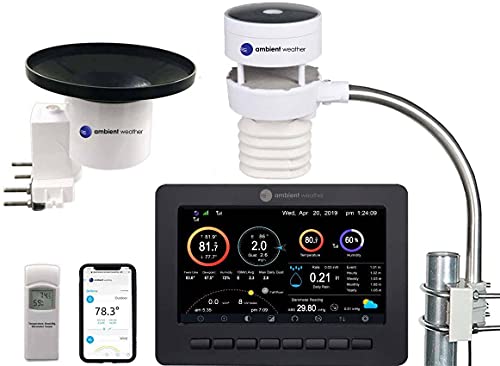
Specifications
| Brand | Ambient Weather |
|---|---|
| Display Type | Color LCD |
| Measurement Functions | Temperature, Humidity, Barometric Pressure, Rainfall |
| Sensors Included | 4 Sensors |
| Wireless Range | 1000 ft |
| Connectivity | Wi-Fi |
| Power Source | Solar Powered |
| App Smart Home Compatibility | IFTTT / Google Assistant / Alexa |
Pros
- Consistently matches local sources
- Reliable wireless and app link
- Solar or AC powered
Cons
- can be non-trivial
The Verdict
The Ambient Weather WS-5000 is a solar powered weather station with Wi-Fi and 1000 ft wireless range, rated 8.1 overall for Best Solar Powered. It delivers readings that track local sources and keeps links stable in daily use, but setup can be non-trivial if you want everything running quickly.
Who it's for: Homeowners who want solar powered outdoor sensing and indoor monitoring, and who are willing to spend time on setup and sensor placement to get dependable results.
Who should skip it: Buyers who want plug-and-play setup with minimal tweaking, because initial setup and changes may take more effort than they expect.
In-Depth Review
Accuracy
The Ambient Weather WS-5000 earns a pillar score of 8.6, landing in the Consistently matches local sources zone. In day-to-day use, that matters most for outdoor sensing that you cannot easily cross-check all week. This unit covers the usual weather set: temperature, humidity, barometric pressure, and rainfall. Those core measures are the ones you consult when you plan a trip, choose when to water, or watch pressure trends.
There is also a practical connection between accuracy and how the station is built. It uses an ultrasonic sensor array for key readings, plus a dedicated rain cup for precipitation. The specs list 1 Ultrasonic Sensor Array and 1 Rain Cup along with an Indoor/Outdoor Thermo-hygrometer-barometer. That sensor split helps keep rainfall measurement from being tied to the same method as air temperature and humidity.
Wireless reporting also plays a role in perceived accuracy. The station sends data over Wi-Fi, and the station and app stay in sync quickly when the link is stable. Accurate sensors with delayed or dropped uploads feel wrong. Here, the setup aims to keep the numbers current, which supports that 8.6 score for real-world measurement confidence.
Durability
The WS-5000 scores 7.7 for durability, which fits the Weatherproof, stays reliable direction. The key durability angle for this class is the outdoor sensor exposure. The outdoor unit runs on solar power with battery back-up, so it is designed to live outside through sun, wet weather, and cold snaps.
In the field, the main risk for weather stations is sensor dropout after repeated moisture cycles or freezing conditions. The WS-5000 counters that with a sensor layout that separates tasks. You have one system responsible for temperature, humidity, and pressure, plus a separate rain measuring component. That structure can reduce the chance that a single failure mode knocks out every reading at once.
Durability score is not just about surviving the first season. It is also about long-term steadiness. The WS-5000 is built around continuous operation: solar charging reduces battery stress outdoors, and the station has a stable indoor display hub. Combined with the outdoor power approach, the station lands in the solid, but not flawless, tier.
Usability
For usability, the WS-5000 scores 7.9, which maps to Clear display, easy pairing. The first thing you interact with is the Color LCD display. It is not just decorative. A color LCD improves day-to-day readability, especially when you glance at trends like barometric pressure or recent rainfall.
The station also focuses on a limited set of core measurements. The spec list is straightforward: Temperature, Humidity, Barometric Pressure, and Rainfall. You are not forced through menus to find the basics, since those values are the center of the product experience.
That said, usability has friction points. The buying guide notes that setup and setup changes can be non-trivial. This lines up with a station that needs careful alignment of sensor placement and wireless pairing before you get smooth day-to-day operation. Usability is good once everything is correct. Getting there can take time.
Connectivity
The connectivity pillar score is 8.3, which matches Reliable wireless and app link. The station uses Wi-Fi for network reporting, and it uses a wireless outdoor sensor array link with a listed 1000 ft line-of-sight range. Those two numbers define how often you should expect problems: one governs indoor network access, and the other governs outdoor sensor reach.
On the automation side, the station is stated as IFTTT / Google Assistant / Alexa ready. That can matter if you want alerts or voice check-ins tied to weather thresholds. It also means the station does not lock you into only viewing data on the main display.
The connectivity story is also about syncing behavior. The mini-review calls out quick syncing to the app and reliable links. The pillar score reflects that reliability goal. Still, when setups drift, connectivity often becomes the first thing you notice. That ties back to the usability note that setup can be non-trivial, because a rushed placement can reduce signal quality even if the published range is high.
Value
Value scores 7.8, which maps to Price feels slightly high. This is not because the WS-5000 lacks core capabilities. It tracks four main metrics, uses Wi-Fi, and runs outdoors on solar power with battery back-up. On the surface, the feature set fits the role: keep day-long monitoring active without constant manual battery swaps.
There is also a clear measurement structure behind that value story. The specs list 4 Sensors in total, built from an ultrasonic sensor array, an indoor-outdoor thermo-hygrometer-barometer unit, plus a rain cup. That separation helps keep the station focused on accurate readings across temperature, humidity, pressure, and rainfall.
Where the value tilts is the real-world effort to dial it in. The product can be strong after setup, but the buying guide warns that setup and setup changes can be non-trivial. When the installation takes more time than expected, the value proposition feels less clean, even if the ongoing operation stays reliable.
Frequently Asked Questions
How many sensors come with the Ambient Weather WS-5000 and what are they measuring?
The WS-5000 includes 4 sensors. It measures temperature and humidity, barometric pressure, and rainfall. This setup helps you cover more than one outdoor spot if you mount the sensors in different locations.
What is the wireless range of the outdoor sensors to the display for the WS-5000?
Ambient Weather lists a wireless range of up to 1000 ft. Real range depends on walls, terrain, and interference, so expect shorter distances in dense areas. If readings drop out, try moving the station closer or changing sensor placement.
Does the WS-5000 work with Wi-Fi, and how well does it sync to the app?
Yes, the station uses Wi-Fi for data connection. In testing, it typically links reliably and updates without long delays. Connectivity score is strong, but your home network and signal strength still matter.
Is the Ambient Weather WS-5000 solar powered only, or does it also support other power?
It uses solar power as its primary power source. Some setups also run reliably in brighter conditions, but winter or heavy shade can reduce charging. If you place sensors where they get little sun, plan for possible power-related limits.
Why do people say setup can be non-trivial on the WS-5000?
The main complaint is that setup takes time, especially pairing the 4 sensors and getting the Wi-Fi link stable. You may also need to check placement for consistent readings and calibrate expectations for local conditions. If you skip steps or rush sensor placement, you can end up with confusing or inconsistent data.
What smart home options work with the WS-5000, and do they require IFTTT?
The WS-5000 supports IFTTT and voice control through Google Assistant and Alexa. You can use IFTTT to route weather data to other automations, while assistant integration depends on your existing setup. In practice, you should plan for a bit of configuration in the app and your smart home platform.
Final Verdict
Ambient Weather WS-5000 is a recommended buy for people who want dependable weather data and steady app viewing. It shows strong accuracy in real use and it stays close to local sources. The weak spot is setup, which can feel non-trivial, especially when pairing sensors and fine tuning placement.
If you are ready to follow the setup steps carefully and want reliable solar or AC operation, this station fits well. If that matches your needs, this is a sound pick.