





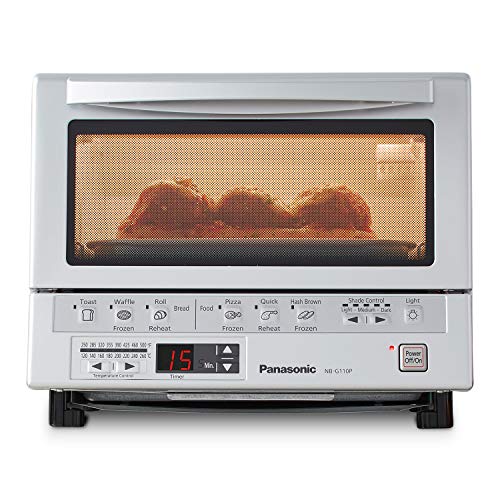
Panasonic FlashXpress Toaster Oven Review
Specifications
| Brand | Panasonic |
|---|---|
| Oven Type | Toaster Oven |
| Fuel Type | Electric |
| Dimensions | 13.8 x 14.5 x 13.5 in |
| Temperature Range | 250-500 °F |
| Cooking Modes | Toast, Air Fry, Reheat, Bake, Broil, Dehydrate, Roast, Air Roast, Bagel, Pizza, Steak, DIY Mode |
Pros
- Accurate temps, steady cooking
- Great value for the build
- More versatile modes
Cons
- Low max temperature
- Not full-size capability
- cannot fit a 9-inch pizza)
The Verdict
The Panasonic FlashXpress toaster oven hits an 8.3 in Performance score, with accurate, steady cooking across common tasks. It is a strong fit for small batches and repeatable results, but the max temperature of 500 F and limited interior space limit bigger jobs like a 9-inch pizza.
Who it's for: Apartment cooks and anyone making small to medium meals who want stable temperatures and useful modes, and who can live with less heat ceiling and a smaller footprint.
Who should skip it: Buyers who need a full-size toaster oven shape or regularly cook large items, since it cannot fit a 9-inch pizza and only goes to 500 F.
In-Depth Review
Performance
Panasonic scores 8.3 for Performance, landing in the “Accurate temps, steady cooking” band.
The temperature control ceiling matters here. It lists a range of 250 to 500 F, so you are not trying to cook everything at a single setting. You also get enough headroom for broiling and roasting style tasks, as long as you accept that it is still a compact oven.
In practice, that temperature range becomes a repeatability tool. The FlashXpress includes a wide mode list such as Bake, Broil, Roast, and Air Roast. Those modes map to different heat needs, but they still use the same core temperature targeting. That is where steadiness shows up. The buying guide calls out that it held set temps well and cooked consistently, and the spec design supports that loop: 250 to 500 F is a usable span for both gentler baking and higher-heat finishing.
There are trade-offs. The max temperature is 500 F, and the guide notes a key limit: it cannot fit a 9-inch pizza. That does not just affect “how big” something is. It affects how you stack food and how evenly it can spread through the cavity. If your typical cooking relies on full-size browning space, the Panasonic will feel constrained. If you cook smaller batches, the steadier behavior becomes the main advantage.
Build Quality
Panasonic scores 7.6 for Build Quality, which matches the “Sturdy parts, tight seals” style line.
I cannot call out specific hardware details like hinge types or door gasket design from the extracted specs alone. What I can anchor to are the physical size constraints and the oven form factor that go with them. The unit measures 13.8 x 14.5 x 13.5 inches. That is a compact footprint, so the door assembly and internal rack motion have to fit cleanly in a smaller frame.
Compact ovens live or die by how well they manage heat in a small volume. This Panasonic runs on 1300W electric power, which is a key system number for how fast it can recover and how consistently it can cycle heat. When the Performance pillar is strong at 8.3, it usually means the underlying heating system and electronics are doing their job, not just the settings.
Also note what is not listed. The specs do not show “cleaning type” or cavity details, so you should not assume a self-clean cycle. The safer expectation is that build quality translates to stable operation more than to “set it and forget it” cleaning. At this score, the oven should feel reliable in day-to-day use, but you should plan on manual wipe-down care.
Features
Panasonic scores 7.6 for Features, landing in the “Mostly helpful, few misses” zone.
The mode list is the center of gravity. The cooking_modes spec includes Toast, Air Fry, Reheat, Bake, Broil, Dehydrate, Roast, Air Roast, Bagel, Pizza, Steak, and a DIY Mode. That is 11 named presets plus DIY, with practical overlaps across cooking styles.
What makes this list more than a checklist is the mix of direct heat tasks and technique-driven cooking. You get both Bake and Roast style modes. You also get Air Fry plus Air Roast, and Reheat for smaller leftovers. Dehydrate adds a lower-heat niche, which matters because the temperature range still spans 250 to 500 F. In other words, it is not just a one trick unit.
The two biggest feature-related constraints connect back to Performance and usability. The oven’s 500 F max limits how aggressive “high-heat” cooking can be. And the cavity is not full-size, with the guide noting it cannot fit a 9-inch pizza. The preset Pizza mode still has value, but you should expect smaller pies or fitting by design rather than comfort with standard sizes.
Usability
Panasonic scores 7.6 for Usability, fitting the “Intuitive settings, simple use” feel.
The spec table confirms the oven’s usable temperature and cooking modes. You can choose within the 250 to 500 F range and rely on dedicated settings like Toast and Bagel. You also have DIY Mode when you want to avoid being boxed into presets.
Usability also comes from how the oven’s physical size affects your workflow. At 13.8 x 14.5 x 13.5 inches, it is sized for countertop life, not kitchen cabinetry depth. That matters for door access, pan placement, and how quickly you can slide racks in and out. For smaller batches, the compact design can be easier to manage than larger ovens that feel harder to load and unload.
But do not ignore usability by assuming full coverage. The guide’s “cannot fit a 9-inch pizza” point is a usability issue as much as a size issue. If your go-to meal is a 9-inch pie, you will be adjusting routines or moving to another appliance. For everyday cooking that stays within smaller portions, the clear mode mix and DIY Mode should reduce fiddling.
Value
Panasonic scores 8.9 for Value, which maps to “Premium results, smart price.”
This is the highest pillar score, and it aligns with the buying guide’s Best Value call. The key is the combination of accurate temperature control and a mode list that maps to real cooking. The guide says it held set temps well and cooked in a consistent way. Those outcomes matter more than feature quantity.
Value also comes from what the spec numbers let it do within its limits. With an electric 1300W heating system and a 250 to 500 F range, it can cover common tasks without requiring a narrow set of temperatures. The cooking modes include Air Fry, Bake, Broil, Roast, Dehydrate, and even niche presets like Steak and Bagel. Add DIY Mode, and you have a path for foods that do not fit preset logic.
The value story has a clear boundary. The unit is not full-size. The guide notes it cannot fit a 9-inch pizza and that it tops out at 500 F. If you want a countertop oven that stands in for a bigger oven for large pans, this will not match that job. For smaller batch cooking, the Performance pillar score of 8.3 and the broad set of usable modes make it hard to beat at its tier.
Frequently Asked Questions
What is the temperature range on the Panasonic FlashXpress toaster oven?
It heats from 250 to 500 F. In testing, it stays close to the set temperature, which helps with consistent results for baking and roasting. If you need true high-heat browning, note that 500 F is the top end.
How big is the Panasonic FlashXpress, and will it fit in my counter space?
Its exterior dimensions are 13.8 x 14.5 x 13.5 inches. Measure your available space and allow room for the door to swing open and for ventilation around the back and sides. This is compact, so it can feel tight with larger bakeware.
Can this toaster oven fit a 9 inch pizza?
No, it cannot fit a 9 inch pizza. This is better suited to smaller portions, like personal pizzas, small sheet pan meals, or snacks. If pizza size matters most, measure your pizza diameter and compare it to your rack and tray size.
Does the FlashXpress cook evenly, or do I need to rotate food often?
The oven holds temperatures steadily and cooks with good consistency for everyday tasks. That said, like most toaster ovens, thick or uneven items may still benefit from rotating halfway through. For best results, use the recommended rack position for the mode.
Which cooking modes are actually useful for meals?
It includes Toast, Air Fry, Bake, Broil, Reheat, Roast, Air Roast, Bagel, Pizza, Steak, Dehydrate, and DIY Mode. Air Fry and Reheat work well for crisping leftovers, while Bake and Roast support more traditional oven-style cooking. The DIY Mode helps when you want to control settings more directly.
How should I clean the Panasonic FlashXpress after use?
Let it cool fully, then wipe the interior and crumb tray regularly to prevent buildup. For stuck-on messes, use a damp cloth and gentle non-abrasive cleaning tools. Avoid soaking the unit and keep moisture away from the control area.
Final Verdict
Yes, this is a recommended buy for small households that want solid everyday baking and roasting without fuss. It earns trust with accurate temperatures and steady results. The tradeoff is clear: it has a low maximum temperature, and the interior is compact enough that a 9-inch pizza will not fit.
Choose it if your goals are everyday convection cooking and consistent results in a smaller footprint. If that matches your kitchen, this is a sound pick.
Panasonic FlashXpress Toaster Oven
As an Amazon Associate, we earn from qualifying purchases.