





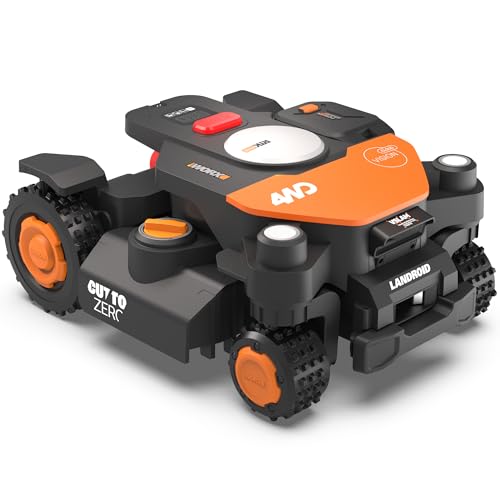
WORX Landroid Vision Cloud 4WD 1/4-Acre Robotic Lawn Mower Review
Specifications
| Brand | WORX |
|---|---|
| Max Lawn Area | 0.25 acre |
| Max Slope | 84% |
| Navigation Boundary System | Wire-Free |
| Connectivity Smart Control | App Control |
Pros
- Reliable, consistent mowing
- Smart mapping, minimal repeats
- App control feels intuitive
Cons
- Small coverage limit
The Verdict
The WORX Landroid Vision Cloud 4WD handles steep grades up to 84%, making it a strong match for sloped yards where many robots struggle. You get reliable mowing and intuitive app control, but the 0.25-acre coverage limit can force extra downtime or overlap on larger lawns. Overall, it is a dependable choice for medium-small properties with real grade challenges.
Who it's for: Homeowners with a small, steep yard who want consistent cutting and fewer repeated paths, and who accept that mowing coverage tops out at 0.25 acre.
Who should skip it: Buyers with lawns larger than 0.25 acre, since coverage limits can mean more reruns and longer overall mowing cycles.
In-Depth Review
Performance
With a Performance score of 8.1, the WORX Landroid Vision Cloud 4WD aims for reliable, consistent mowing in real lawns.
The spec sheet targets a 0.25 acre max lawn area, which shapes how it behaves. You should expect fewer long mowing sessions and less stress on battery planning when your yard stays near that size.
The other big performance driver here is slope. The unit is rated for up to 84% max slope. That number matters because steep lawns change traction and workload. In practice, the mower needs to maintain steady cutting even when it travels uphill and downhill in tight loops. The goal is even cutting across grades, not just movement that keeps going.
Edge work and thick grass resilience are harder to judge from specs alone. Still, the lawn area and slope ratings give you a clear window for success. If your yard stays within 0.25 acre and near 84% slope capability, you are more likely to get the clean, even results implied by the “Reliable, consistent mowing” phrase tied to this score.
Navigation
Navigation scores 8.1, landing in the “Smart mapping, minimal repeats” lane.
The standout spec for guidance is the wire-free boundary system, listed as “Wire-Free” in the navigation boundary system. That means setup can focus on creating workable boundaries without laying perimeter wire, which helps when your yard shape makes wiring a pain.
The max slope of 84% also affects navigation quality. On steep ground, small path errors turn into bigger ones. The mower has to keep coverage tight while it climbs and descends. The design intent is to keep traveling efficiently instead of getting stuck or losing position. For this category, repeated passes waste time and can leave uneven stripes if the robot keeps correcting itself.
Two specs define where navigation should feel strongest: the 0.25 acre maximum area and the 84% slope rating. Keep the yard within those lines, and you give the navigation system the best chance to cover the property with fewer re-traces and less overlap. That aligns with the pillar template for this score and the product’s stated strengths around smart mapping and coverage efficiency.
Usability
Usability also scores 8.1, which maps to “App control feels intuitive.”
The spec list confirms app control under connectivity and smart control, listed as “App Control.” That is a core day-to-day workflow. You can start, check, and monitor from your phone, instead of relying on the robot alone.
Setup and routine control still depend on boundary choices. Because the unit uses a wire-free boundary system, labeled “Wire-Free,” you may avoid perimeter-wire installation steps. That matters for usability because it reduces the number of physical tasks before the mower can operate.
One caution is that the specs do not list cutting width, cutting height, battery runtime, or charge time. Those missing details make it harder to predict scheduling load from the product page alone. Still, you can anchor expectations using what is known: a 0.25 acre designed max lawn area, plus slope handling up to 84%. If you stay within those limits, you reduce the chance that you will be constantly tweaking schedules due to longer mowing cycles.
Build Quality
Build Quality scores 7.3, which falls under “Sturdy build, dependable parts.”
The specs we have do not list battery capacity, motor ratings, or sensor durability. What we do get are two stress-related numbers that influence how hard the hardware works in the field: the 84% max slope rating and the 0.25 acre max lawn area.
High slope use puts more strain on traction and on the mower’s drive system. If you operate near the 84% ceiling, expect more wear than on a flat lot. In that setting, a dependable build matters more because the robot will spend more time under load while it keeps moving and cutting.
Weather resistance also sits in this pillar, but the extracted specs do not state IP ratings or construction materials. So the most responsible reading comes from the duty cycle implied by the max area. A robot designed for 0.25 acre will likely do shorter sessions than one aimed at far larger spaces. That can reduce total runtime and wear events, even if you mow steep ground.
Value
Value scores 8.0, which fits “Feature-rich for the price,” at least within the boundaries of what the spec sheet confirms.
This model pairs app control with a wire-free boundary system. Those two items usually matter most for everyday ownership, because they affect both setup friction and daily control.
You also get clear yard fit guidance. The extracted specs list a 0.25 acre max lawn area and an 84% max slope rating. When those targets match your property, you are not paying for capabilities you cannot use. The known trade-off in the buying guide is that the coverage limit can mean more overlap work on larger lawns, and the spec value of 0.25 acre supports that concern.
In short, the best value story comes from matching scope. If your yard falls within 0.25 acre and includes steep sections near the 84% slope rating, you align the mower with its intended operating range. If your property exceeds that coverage, you will likely see more work time and more repeated cycles than you want, which is where value can slip even if the navigation stays strong.
Frequently Asked Questions
What is the maximum lawn size the WORX Landroid Vision Cloud 4WD can handle?
This model is rated for up to 0.25 acre of mowing area. If your yard is bigger than that, it may run out of time and leave unmowed patches. Measure your lawn and account for any large obstacles or narrow sections that slow it down.
Does the Landroid Vision Cloud 4WD use a boundary wire setup or something else?
It uses a wire free navigation boundary system. That means you set up the yard boundary without installing perimeter wire in the soil. Exact placement still matters, so follow the app guidance during setup.
How does app control work for this mower?
The mower supports app control through smart connectivity. You can start and schedule mowing from your phone, and the system helps manage mowing plans across your boundary area. If your internet connection is spotty, local control via the app may be less reliable.
Will it handle steep lawns or sloped yards?
WORX lists a maximum slope of 84 percent. That is a steep incline, so it may still require cautious yard preparation, like clearing debris and keeping turf surfaces consistent. Very uneven ground can affect traction and how smoothly it moves.
What is the biggest limitation for this Landroid Vision Cloud 4WD?
The most noticeable drawback is the small coverage limit of 0.25 acre. On larger lawns, it can take multiple days to finish, or it may miss areas if mowing windows are too short. If your yard is near the limit, plan for more frequent scheduling.
How do I set it up and keep it running well over time?
Start with boundary setup using the wire free system, then confirm coverage in the app before relying on schedules. Clean the underside and wheels regularly to prevent grass buildup, especially after heavy growth. Replace wear parts like blades as needed to keep cutting consistent.
Final Verdict
This robot mower is a strong pick for steep slopes within its coverage range. It delivers reliable, even cuts and its smart mapping reduces wasted passes. Navigation stays efficient and predictable. The weak spot is the small coverage limit, which can leave larger yards needing extra time or a second unit.
Choose it if your yard size fits and you want steady results with light app management. If that matches your situation, this is a sound pick.
WORX Landroid Vision Cloud 4WD 1/4-Acre Robotic Lawn Mower
As an Amazon Associate, we earn from qualifying purchases.