





Emtec Click Secure B120 32GB USB Flash Drive Review
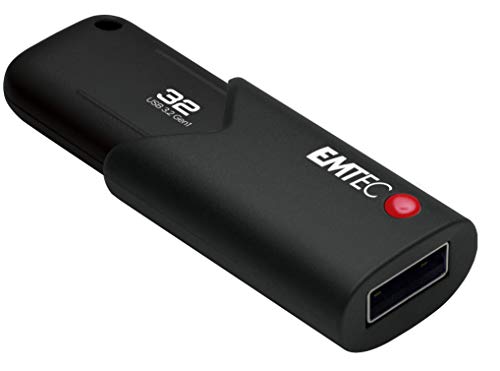
Specifications
| Brand | Emtec |
|---|---|
| Storage Capacity | 32 GB |
| Usb Standard | USB 3.2 Gen 1 |
| Read Speed | 100 MB/s |
| Write Speed | 20 MB/s |
| Form Factor | Slide |
| Security Features | Hardware Encryption |
Pros
- Fair price, solid day-to-day performance
Cons
- Security features are buggy
- Slow write speed
The Verdict
The Emtec Click Secure B120 is a 32GB USB flash drive with USB 3.2 Gen 1 speeds listed at 100MB/s read. It fits the Best Value lane for everyday moving of documents and media, but the trade-off is uneven write performance and security that some users report as buggy, which can make longer transfers and encrypted use less dependable.
Who it's for: People who want a straightforward slide drive for school files and quick backups, and who can accept 20MB/s class writes and occasional hiccups with encrypted access.
Who should skip it: Anyone who needs consistently fast transfers during writes or who depends on reliable hardware encryption every time, since reports point to buggy security behavior.
In-Depth Review
Performance
Emtec’s B120 sits at a 6.7 Performance score, which maps to the template idea that the drive does not stay uniformly strong. The published numbers set the expectation: 100 MB/s read and 20 MB/s write. In practice, that write number matters more for backups, batch photos, and any transfer you cannot pause or resume easily.
The core issue is that 20 MB/s class writing tends to be sensitive to file type and transfer length. When a USB stick starts slower and then drains its buffer, sustained transfers can feel slower than the marketing read rate suggests. This aligns with the listed concern: Slow write speed. If your workflow is mostly large files, you will notice the gap between the read figure and the write figure fast.
For lighter tasks, the balance can still feel workable. Reading a folder of documents is one thing. Writing tens of gigabytes is another. With only USB 3.2 Gen 1 listed, the drive does not aim for the top end of sustained throughput. It aims for “good enough” for everyday moves.
Capacity
The B120 earns a 7.9 Capacity score, which lines up with the template phrase “Plenty of usable space delivered” (assuming the label matches what you get). The spec table stays simple here: it is a 32 GB drive. That is the most important number because it anchors expectations for documents, slides, and photo batches.
In day-to-day use, 32 GB typically means you can keep a reasonable “grab and go” set of files. You can also plan around it for backups, but with an eye on how much of that storage is actually usable after formatting. The listing does not provide extra capacity details beyond the 32 GB label, so you should treat 32 GB as your starting point and budget for overhead.
Capacity also interacts with the performance story. When write speed sits at 20 MB/s, longer transfers can fill up more time. Higher capacity can still be useful, but you feel the drag more when you are trying to push bigger backups in one go.
Build Quality
With a 7.3 Build Quality score, the B120 lands in the “Frequent plugging, no wobble” zone. The biggest build clue comes from the form factor choice: a slide design. The spec notes a “capless design” with a mechanical slider with spring system. That matters because caps get lost. Sliders are also easier to keep clean and intact because there is no small piece to misplace.
The physical durability story is still mixed, though. The product is meant for people who plug in often, and the slide mechanism has more moving parts than a simple capless push-in. The specs do not list drop ratings or material details, so you have to judge based on design choices and reported reliability, which in this case falls short on security stability rather than shell cracking claims.
Practically, the drive’s design helps with day-to-day handling. It also pairs with a mainstream interface: USB 3.2 Gen 1. That combination can be fine for frequent use, as long as you treat it like a convenience drive and not a high duty-cycle archival device.
Design
The design scores high at 7.9 Design score, which maps to “Easy to insert and remove.” The B120 uses a slide form, specifically described as a mechanical slider with a spring system. That is a practical solution for people who want something pocketable but hate exposed connectors.
This design also helps with port management. A slide design keeps the connector protected when not in use. It reduces the risk of lint and contact wear that can happen with uncovered metal tips. In terms of workflow, you do not need to juggle a cap, and that keeps the drive “ready” when you need it for school files, work docs, or quick photo saves.
It is also aligned with the security setup. The model is called “Click Secure B120,” and the listing frames security as part of the drive experience. That puts more importance on reliable physical access, since unlocking has to happen without fuss. A simple slide helps keep the physical steps short, even when the security steps might not be smooth.
Security
Security is the weak point, with a 5.8 Security score, which corresponds to the “Security setup feels clunky” template, or at least unreliable enough to be a deal-breaker for some users. The drive includes hardware encryption, listed as “Encryption software AES 256.” On paper, that is strong: AES-256 is a solid choice for protecting data.
But the real question is whether the protection works cleanly. The cons list says: Security features are buggy. That is the key detail. Buggy security tools can harm trust more than missing security can. Even if encryption is present at a technical level, failures in setup, unlocking, or access can force workarounds and slow down transfers.
The drive’s security story also has to fit into the speed story. When write speed is 20 MB/s, any extra overhead from encryption and access checks can make transfers feel even slower. If you need dependable security for day-to-day backups, this is the area where you should be cautious and test your exact use case early.
Frequently Asked Questions
Is the Emtec Click Secure B120 32GB USB drive fast enough for large file transfers?
It lists read speeds up to 100 MB/s, but write speeds are up to 20 MB/s. In real use, the low write rate can make backups and large video copies take noticeably longer than drives with higher sustained writes. If you mostly read from the drive, it should feel smoother than heavy write workloads.
Will the 32GB Emtec Click Secure B120 work with USB 3.2 Gen 1 ports?
Yes. It uses USB 3.2 Gen 1, so it will run in that speed class when you plug it into a compatible port. It also works in standard USB ports, but transfer speeds may drop on slower connectors.
Does the slide design help with portability or does it feel easy to break?
The drive uses a slide form factor, which keeps the connector covered when not in use. That said, slide mechanisms can wear if you open and close it very roughly. Handle it gently and avoid forcing the cover when it resists.
How does hardware encryption work on the Emtec Click Secure B120 32GB?
This model includes hardware encryption, so the data stays protected when the drive is locked. Some users report that the security features can be buggy, so expect occasional setup quirks or unlocking issues. Use it with a plan to test access before storing important files.
Is the write speed limitation a big problem for backups to the Emtec Click Secure B120?
It can be, because the listed write speed is only 20 MB/s. For routine backups of smaller documents, it should be fine, but large archives will take longer. If time matters, consider a faster-writing USB drive for frequent full backups.
What should I do if the security encryption on the Emtec drive will not unlock reliably?
First, make sure you follow the encryption setup steps exactly for your operating system. If it still fails, try a different USB port and avoid hubs. If you see repeated failures, treat it as a red flag and back up the data using another device.
Final Verdict
This Emtec drive earns a Best Value badge for everyday use. It delivers solid day to day performance and a practical design that is easy to carry. The tradeoff is clear: write speeds lag, and the included security features can be buggy. I recommend it for general files, backups, and sneaker net transfers where speed and security do not have to be perfect.
If you need dependable storage for documents, photos, and casual backups, and you do not rely on the security tools, it fits well. If that matches your workflow, this is a sound pick.