





Culligan MaxClear Countertop Gravity Water Filtration System Review
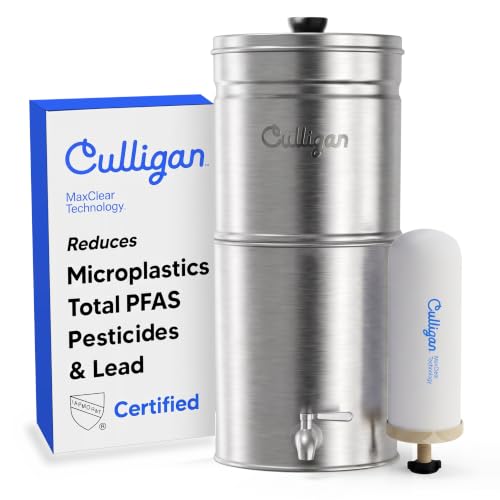
Specifications
| Brand | Culligan |
|---|---|
| System Type | Countertop |
| Filtration Technology | Ceramic + Activated Carbon |
| Contaminants Removed | Microplastics;Lead;PFAS |
| Certifications | NSF/ANSI 42 |
| Dimensions | 26 x 8.6 x 8.6 in |
Pros
- Reduces high-risk contaminants
- Reliable seals and fittings
- Simple maintenance, clear setup
Cons
- No NSF certification
- Bulky footprint
- Slow gravity fill
The Verdict
With a 7.4 Performance score, the Culligan MaxClear countertop gravity filter uses ceramic plus activated carbon to target high-risk contaminants like lead and PFAS. It works well for cleaner taste and odor, but it fills slowly and does not carry NSF certification beyond NSF/ANSI 42, which limits how confidently you can verify PFAS claims.
Who it's for: Homeowners who want a sink-free countertop setup and can accept slower gravity filling. You value simple maintenance and dependable seals more than full NSF coverage for every target contaminant.
Who should skip it: Buyers who need stronger third-party verification than NSF/ANSI 42 or who want a fast, high-throughput refill. If you hate waiting for gravity flow, a plumbed-in system will fit better.
In-Depth Review
Performance
With a performance score of 7.4, the Culligan MaxClear aims for strong real-world improvement rather than mild taste changes.
The media mix is Ceramic plus Activated Carbon. That matters because carbon targets many common taste and odor drivers, while ceramic supports physical filtration. The system also targets tougher items listed in the spec sheet, including microplastics, lead, and Total PFAS. It is certified to NSF ANSI 42 for those contaminant reduction claims.
The trade-off is that you do not get the fastest water delivery. It is a countertop gravity system, so output depends on head pressure. The product is also described as having slow gravity fill. In daily use, that can limit how fast you can fill a glass, brew coffee, or refill a kettle after you empty it. If you can plan ahead, the stated contaminant targets are clear. If you need constant throughput, gravity limits you.
Another practical point: the certification listed is NSF ANSI 42, and not a broader set of NSF tests. The mini-review calls out a lack of NSF certification beyond NSF ANSI 42. That detail matters for performance expectations. Your improvement should align with what NSF ANSI 42 covers. If your priority is a wider list of certified claims, you may find this less satisfying than systems with multiple NSF categories.
Build Quality
Build quality scores 8.0, which is solid.
The system is a countertop unit sized at 26 x 8.6 x 8.6 inches. That footprint is bulky enough to take up space, but it also suggests a real, stable base rather than a flimsy insert. The pros list Reliable seals and fittings. Those parts are critical on gravity systems because every seal is under repeated handling during refills and pours.
Inside, the filtration approach combines a durable ceramic shell with proprietary carbon media. Ceramic media is commonly used for structural support in filtration cartridges. That helps with long-term dependability when the system is used daily. The goal is to keep filtration consistent throughout the filter life. Even without a listed filter capacity or flow rate in the specs, the focus on seals and fittings suggests the company designed this for repeated cycles rather than occasional use.
The cons list also provides a clue about build performance in use. It cites Bulky footprint as a drawback. That is not a material failure. It is a real usability issue that can affect whether you leave the unit out on a counter or stash it in a cabinet. In other words, build quality feels reliable, but the unit has to live in your kitchen space.
Ease of Use
Ease of use is scored at 8.1.
The matching template phrase is Simple maintenance, clear setup. The pros include Simple maintenance, clear setup and Reliable seals and fittings, which points to a design that does not make daily use annoying. It is also a countertop gravity dispenser, so there is no plumbing change. For many households, that lowers the risk of installation errors.
The setup is meant to be straightforward, with maintenance that stays simple. The mini-review notes straightforward filter swaps that do not require special tools. From a user workflow standpoint, that is a big deal. Filter changes are frequent enough to matter. If you can swap the filter without tools, you are more likely to keep up with maintenance and maintain performance.
Still, ease of use has a clear limit. Slow gravity fill is listed as a con. Gravity systems can feel fine for one cup, then frustrating for bigger pours. The system dimensions, 26 x 8.6 x 8.6 inches, also influence where it sits. If you place it near a faucet, daily refills are easier. If not, carrying water becomes part of the routine.
Value
Value scores 8.0, which fits the template Worth the price, efficient filters.
The spec sheet centers on high-risk contaminant targets, including microplastics, lead, and Total PFAS. It also lists certification to NSF ANSI 42. When those targets match your goals, the value equation is straightforward. You buy a countertop gravity system built to align with those claims, using Ceramic plus Activated Carbon media.
However, the value strength depends on your expectations for certification. The cons list No NSF certification and the mini-review says it lacks NSF certification beyond NSF ANSI 42. That is a value limiter for people who want broader NSF coverage. If your wish list includes contaminants outside what NSF ANSI 42 addresses, you may end up paying for a narrower confirmation set.
The other value driver is whether gravity fill speed matches your routine. The cons also list Slow gravity fill. If your household routinely needs fast refills, you may compensate by filling larger batches. That can work, but it changes the daily rhythm. Given the system type is Countertop and the only flow-related spec is not listed, it is hard to verify output speed. You will know value by living with it.
Frequently Asked Questions
What contaminants does the Culligan MaxClear countertop gravity system remove?
It is designed to reduce microplastics, lead, and PFAS. The unit uses ceramic plus activated carbon filtration. For other contaminants, results can vary by water chemistry.
Does the Culligan MaxClear have an NSF certification?
This model lists NSF ANSI 42. That certification covers the reduction of certain aesthetic and health-related parameters tied to drinking water requirements. Some shoppers expect broader NSF coverage, so it is worth checking the exact scope for your concern.
What are the physical dimensions, and will it fit on my counter?
The footprint is about 26 x 8.6 x 8.6 inches. It can feel bulky if you have limited counter space near your sink. Measure the area where you plan to fill the chamber and place the carafe.
Is the gravity fill slow, and how long does it take to fill a glass?
Because it relies on gravity, output can be slower than faucet-mounted filters. If you need quick refills, plan for a wait time, especially with colder or lower pressure source water. Daily use is usually manageable, but it is not the fastest option.
How often do I need to change the filter, and is maintenance difficult?
You will need to replace the filter as it reaches its service life, but the exact interval depends on your water use and incoming water. The system is built for straightforward filter swaps with clear access to the cartridge. Keep the unit clean to prevent odor buildup around the housing.
What kind of setup does it require, and does it work without installing plumbing?
It is a countertop unit, so you do not need to cut into plumbing. You place it on your counter and use the included filtration path as designed by the manufacturer. This makes it a good fit for renters, but you still need enough counter space to operate it.
Final Verdict
Yes, it is a recommended buy for people who want countertop gravity filtration and targeted PFAS reduction without complicated plumbing. The unit has strong build quality, with reliable seals and fittings that help prevent bypass and leakage. The main drawback is that it lacks NSF certification, so proof is less standardized. It also fills slower due to the gravity flow.
If you can tolerate a slower fill rate and want a well-made countertop setup for improved water safety, this is a sound pick.
Culligan MaxClear Countertop Gravity Water Filtration System
As an Amazon Associate, we earn from qualifying purchases.