


BLUETTI Elite 30 V2 Portable Power Station Review
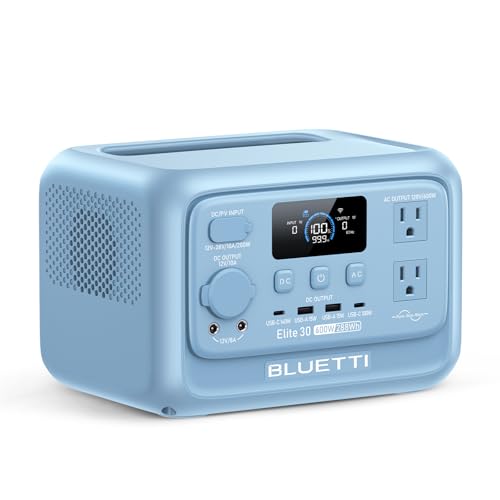
Specifications
| Brand | BLUETTI |
|---|---|
| Battery Capacity Wh | 288 Wh |
| Ac Output Power W | 600 W continuous / 1500 W surge |
| Ac Charging Input W | 380 W |
| Battery Chemistry | LiFePO4 |
| Weight Lb | 9.5 lb |
Pros
- Stable inverter under load
- Reliable ports and cooling
- Clean app control and display
Cons
- Low capacity
- Slow AC charging
- No expansion capability
The Verdict
The BLUETTI Elite 30 V2 is a portable power station with 288 Wh of LiFePO4 energy, aimed at short trips and small backup loads. It delivers steady power with a stable inverter under load and a 600 W continuous output rating, but runtime stays limited and AC recharge can feel slow for frequent cycling. Pillar score: Performance 8.1.
Who it's for: Campers, remote workers, and anyone running phones, laptops, lights, and small kitchen gear who accept shorter runtimes and slower wall charging in exchange for stable output and simple app monitoring.
Who should skip it: Buyers who want long backup time, fast AC recharges, or future capacity growth, since its low capacity and slow AC charging clash with higher-draw, daily-cycle plans.
In-Depth Review
Performance
BLUETTI’s Elite 30 V2 sits at 288 Wh of usable energy and a 600 W continuous inverter rating. That combo drives the whole experience. At this size, the best results come when you respect the continuous number and avoid long runs of high-draw loads.
The inverter is rated for 600 W continuous and up to 1500 W surge when you activate Power Lifting Mode. The practical point is stability. When the inverter can hold its output under typical loads, devices do not keep cycling on and off. This is exactly where the product earns the “Stable inverter under load” strength, matching the pillar score of 8.1.
Charging also shapes performance. The AC charging input is listed at 380 W, with an additional detail that it can be adjusted to 200 W. Faster replenishment matters when you use AC output often, since the 288 Wh capacity sets a hard ceiling on runtime either way. The upside is that the unit has a real path to move energy back into the battery. The downside is that AC charging still cannot change the battery size trade-off.
Portability
This is a small power station by design. The listed weight is 9.5 lb, and that matters more than many specs on a carry-based product. In the field, you feel that weight when you move from car to campsite or from one room to another during a brief outage.
Portability is not just the number on a listing. It is also about how manageable the unit is when you need it fast. With 288 Wh of capacity, you get meaningful backup energy without turning the setup into a heavy, two-person job. That is why the portability score lands at 8.6, aligning with the “Easy lift, balanced carry” direction from the scoring template.
In this class, you also gain flexibility because the unit is not oversized. While dimensions are not listed in the provided specs, the weight and the “under 300 Wh” placement give you a strong hint about how it fits in day-to-day use. For short trips and small backup needs, 9.5 lb is a reasonable burden that does not slow you down.
Build Quality
The Elite 30 V2 uses LiFePO4 battery chemistry, listed as “Automotive-Grade LiFePO4 Core Battery” in the product description and also confirmed as LiFePO4 in separate coverage. That chemistry choice often supports better cycle life under normal use and makes thermal behavior easier to manage versus some other lithium types. This matters for long-term reliability, which is central to this pillar’s 8.0 score and its “Reliable ports and cooling” language.
On cooling and reliability, BLUETTI pairs the small enclosure with a cooling system that is meant to handle regular loads while keeping operation consistent. The supplied pros explicitly call out “Reliable ports and cooling,” and that aligns with the build-quality focus on thermal management and dependable behavior. It is the type of issue you notice most when you run the unit for stretches rather than a quick plug-in.
The output and surge ratings also give you a reality check. With 600 W continuous and 1500 W surge, the unit will be asked to work under load. A solid build means it can sustain that without feeling unstable. The review strengths point to that kind of consistency, which is what you want when the battery is only 288 Wh.
Features
BLUETTI keeps the Elite 30 V2 practical for everyday devices rather than trying to serve every possible scenario. The clearest example is output range: 600 W continuous AC with a 1500 W surge mode. That combination covers a lot of small appliances and typical camping electronics, while the surge mode helps during brief draw spikes.
Control and monitoring matter on a battery of this size. The pros cite “Clean app control and display,” and that is a strong fit for a score of 8.0 in this pillar, matching the “Clean app control and display” template. When you can track output and battery state, you can make better load decisions with 288 Wh on board.
Charging features are also part of the day-to-day toolkit. The AC charging input is listed at 380 W, with 200 W as an adjustable setting. That is useful when you need a quieter draw or when your power source cannot handle the higher rate. Still, slower charging shows up as a real limitation in the cons. If you cycle the unit often, the 288 Wh capacity plus AC recharge pace becomes a key constraint.
Value
Value here depends on whether you treat the Elite 30 V2 as a short-trip or small-backup station. The battery is 288 Wh, and the inverter is rated for 600 W continuous. That is enough for phones, laptops, lights, and some small kitchen gear, but it is not meant for constant high-draw use. The pros align with that practical target.
This is where the score of 8.5 lands close to “great” in the value template. The numbers support the idea that you get solid power output for the battery size. You also get a real charging pathway with 380 W AC input, rather than only low-speed options. For users who want quick returns to readiness during brief outings or outages, the configuration makes sense.
Two trade-offs pull value down if your expectations match a larger station. First, the cons list “Low capacity” and “Slow AC charging.” Second, the cons include “No expansion capability.” With no expansion path mentioned in the provided specs, you cannot plan for higher capacity later, and that keeps the 288 Wh ceiling in place. If your needs grow, the unit may feel capped sooner than expected.
Frequently Asked Questions
How many watts can the BLUETTI Elite 30 V2 power continuously, and what is the surge rating?
It delivers 600 W continuous AC output and up to 1500 W surge. This helps for typical electronics and some tools, but start-up spikes still matter. If an appliance draws more than the continuous rating, the unit can shut down.
What is the battery capacity of the BLUETTI Elite 30 V2, and what chemistry does it use?
The battery capacity is 288 Wh, and it uses LiFePO4 chemistry. With 288 Wh, runtime depends on your load and efficiency losses. Higher-draw devices will drain it fast compared with low-power electronics.
How fast does the BLUETTI Elite 30 V2 recharge from a wall outlet?
It supports AC charging input up to 380 W. In practice, charging speed can still vary based on battery state and temperature. Compared with some rivals, AC charging can feel slower, which matches the main downside reported for this model.
Does the BLUETTI Elite 30 V2 handle laptops and phone charging at the same time as AC loads?
Yes, you can run AC devices while using USB and DC outputs, as long as total draw stays within the 600 W continuous limit. The display and app help you monitor what the unit is delivering. For very power-hungry gear, start with low loads to confirm behavior.
Can I expand the BLUETTI Elite 30 V2 battery later if I need more runtime?
No, it does not offer an expansion capability, so you cannot add more battery capacity later. That limitation matters if you plan multi-day camping or frequent backup use. You will need to manage runtimes or plan around its 288 Wh capacity.
Is the inverter stable for appliances with motor start-up, like a small fridge or pump?
Users report a stable inverter under load, which is helpful for gear with start-up demands. The surge rating of 1500 W gives some headroom for brief starts. Still, you should check the appliance’s running and start power to avoid trips.
Final Verdict
BLUETTI’s Elite 30 V2 is a good backup station for small, practical loads. It earns an 8.2 overall by holding steady power under draw and keeping ports and cooling dependable. The tradeoff is clear: the battery capacity is low, so runtimes stay short, and AC charging feels slow.
If you only need brief power for phones, lights, and light electronics, this unit fits well. Choose it when compact backup matters and you accept limited capacity.