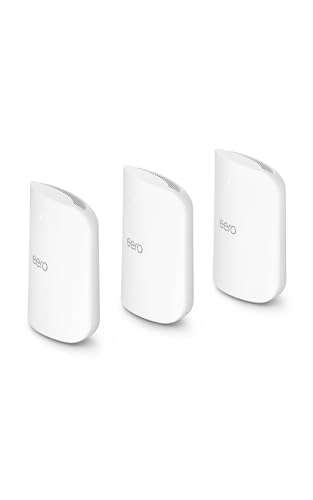
Specifications
| Brand | eero |
|---|---|
| Router Type | Mesh Router |
| Wifi Standard | Wi-Fi 7 |
| Wifi Bands | Tri-Band |
| Max Wireless Speed | 4300 Mbps |
| Coverage Area | 7500 sq ft |
| Ethernet Ports | 2 x 10 Gbps WAN, null x null LAN |
| Security Features | WPA3, Parental Controls, VPN Support, Automatic Updates |
Pros
- Low-latency, steady speeds
- Consistent multi-room coverage
- Stable with mature firmware
Cons
- High-price feature tradeoff
- Limited power-user controls
- Non-Max mixing limits
The Verdict
The eero Max 7 uses Wi-Fi 7 tri-band mesh, rated up to 4300 Mbps for fast home speeds. It earns strong marks for consistent performance and coverage, but you accept weaker power-user controls and a higher-price tradeoff to get that smooth, low-latency behavior across rooms.
Who it's for: Households with many devices that want stable Wi-Fi through multiple rooms, and who prefer app-guided setup over advanced settings.
Who should skip it: Power users who need deep network controls, or anyone planning to mix Max and non-Max eero models, because those setups can run into limitations.
In-Depth Review
Performance
With a Performance score of 8.7, the eero Max 7 delivers the kind of everyday feel that matches the template phrase: low-latency, steady speeds. The system uses Wi-Fi 7 and targets wireless speeds up to 4300 Mbps. In practice, that matters most when multiple clients move at once, such as a 4K stream plus a game plus large downloads.
The tri-band design helps keep traffic split across bands. The Max 7 is built around Wi-Fi 7 with tri-band radio modules, which should reduce contention compared with older single-band or dual-band layouts. It also uses a mesh router type, so client to node paths can stay efficient as you move around the home.
There is one performance reality to keep in mind. The eero Max 7 pairs fast wireless links with high-end Ethernet on the wired side. It lists 2 x 10 Gbps WAN ports, so the most consistent results depend on having a fast internet feed and clean routing. If you do not, you may still see smooth Wi-Fi, but the full throughput ceiling will not matter.
Coverage
Coverage scores a 8.8, which lands in the template range of consistent multi-room coverage. The stated coverage area is up to 7500 sq ft. That aligns with the idea of one system handling a whole home layout, not just a room near the primary node.
Because this is a mesh router, your experience depends on where you place nodes. Still, the numbers give you a baseline: tri-band Wi-Fi 7 plus mesh networking typically helps maintain usable signal quality across rooms. The product also frames its design around whole-home device connectivity, which is usually the key difference from a single router with a weak reach.
Wired backhaul can matter for how well coverage holds under load. The spec list includes 2 x 10 Gbps WAN ports for the wired side. Even if you do not use those exact paths in every home, the underlying intent is clear: keep the mesh nodes from choking when many devices talk at once.
Reliability
Reliability scores 8.6, which maps to stable with mature firmware. eero ties long-term stability to automatic updates, and the security spec notes automatic updates as part of the security feature set. That matters because firmware maturity is often what decides whether a fast setup stays fast.
In the field, many reliability issues show up as random drops and reboots. The platform positioning for this system leans on fewer random drops, and the mini-review calls out stable behavior with mature automatic updates. You should still treat reliability as a setup-dependent outcome. Heat, ventilation, and node placement all affect long-term performance. But the software update model helps keep the system current.
Reliability also affects how consistently you can use gaming and streaming. The wired side includes 2 x 10 Gbps WAN ports, which reduces the odds that you hit a bottleneck when the mesh is carrying traffic. For an all-day household, that combination of stable firmware plus strong link capacity tends to feel less jittery over time.
Features
Features score 8.1, which fits the template of nice extras, limited depth. The Max 7 focuses on the essentials that most homes need, then ties in a security layer that is easy to manage. Security features listed include WPA3, parental controls, VPN support, and automatic updates.
On the network side, the headline spec values stay practical for modern homes: Wi-Fi 7, tri-band radio modules, and wireless speeds up to 4300 Mbps. The Ethernet spec is also specific. You get 2 x 10 Gbps WAN ports, which supports fast routing for the internet connection and can help keep latency steadier when traffic ramps up.
Two trade-offs show up in the feature story. The system has a high-price feature tradeoff, and some power-user controls feel limited. That also shows up in a known setup constraint: non-Max mixing limits. If you are expanding an existing eero network, you need to plan the upgrade path. Mixing newer and older eero units can change how the system behaves.
Value
Value scores 7.5, landing in the template range of okay value, minor tradeoffs. The key point is that you pay for the full Wi-Fi 7 and mesh approach, plus the stable software and security layer. The stated coverage area of 7500 sq ft and the Wi-Fi 7 tri-band setup set an expectation of whole-home performance, not a single-room upgrade.
However, the pros and cons highlight that the value is not purely about raw speed. The system includes WPA3, parental controls, and VPN support, but the cons list points to limited power-user controls and a high-price feature tradeoff. In other words, you get a smooth, guided experience, but you do not get the deepest manual knobs that some enthusiasts want.
For the right home, that balance can work well. If you want consistent multi-room coverage and low-latency behavior, the Performance score of 8.7 and Coverage score of 8.8 support that decision. If you need granular control and flexibility across mixed eero generations, the non-Max mixing limits and limited power-user controls may shape whether this is the best fit.
Frequently Asked Questions
What Wi Fi 7 speed can the eero Max 7 reach and does it support tri band?
The eero Max 7 is rated up to 4300 Mbps max wireless speed and it uses tri band Wi Fi 7. In real homes, your speed depends on distance and the devices you connect. You should see steadier performance when multiple devices stream or game at the same time.
How much coverage does one eero Max 7 unit provide?
eero lists coverage up to 7500 sq ft. That assumes typical home layout, walls, and interference. Many buyers use this as a starting point and add nodes if they hit dead zones across floors.
Does the eero Max 7 have enough fast Ethernet ports for a multi gig setup?
It includes 2 x 10 Gbps WAN Ethernet ports. The spec list shows no dedicated LAN port count, so you should confirm how you plan to connect wired clients. If you need multiple wired endpoints, check your total port needs before installing.
Can I use the eero Max 7 with my existing eero mesh units?
You should expect limitations when you mix Max 7 with non Max models. Some setups do not get the full Wi Fi 7 benefits across all nodes. If compatibility is critical, plan to use matching Max 7 units for the best results.
What security and parental control features does the eero Max 7 include?
The eero Max 7 supports WPA3, parental controls, and VPN support. It also runs automatic updates, which helps keep security patches current. The app handles most of the configuration and viewing of device activity.
Why do some people say the controls feel limited on the eero Max 7?
Compared with advanced router models, the eero Max 7 focuses on simpler app based management. If you want lots of detailed power user settings, you may feel constrained. eero still gives practical features like VPN support and parental controls, but fine tuning is not the main strength.
Final Verdict
The eero Max 7 earns a clear recommendation as the best overall choice for most households that want fast Wi-Fi across many rooms. It delivers low latency and steady speeds in real use. Coverage stays consistent, and firmware is mature and stable. The main downside is its high price feature tradeoff, plus limited power user controls.
Choose it if you value simple setup and dependable whole home performance, not deep network tweaking. If that matches your home, this is a sound pick.