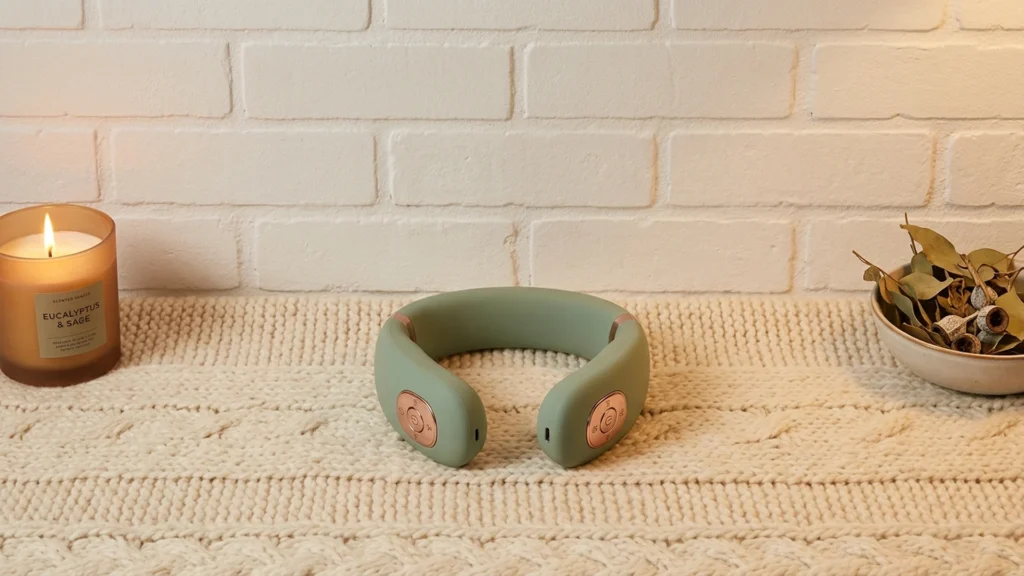
Specifications
| Brand | KIDEE |
|---|---|
| Fan Type | Bladeless Fan |
| Speed Settings | 3 Settings |
| Noise Level | 20 dB |
| Dimensions | 2.2 x 8.7 x 5.9 in |
Pros
- Worth the price
- Low noise output
- Bladeless safety
Cons
- Middling circulation
- Flimsy feel
- Airflow drying
The Verdict
The KIDEE 360° Airflow Neck Fan targets personal cooling with a top noise claim of 20 dB, and it stays quiet while you sit close. It is a good Best Value choice for desk, couch, and shared-room use, but airflow stays limited for room-wide cooling.
Who it's for: People who want a bladeless, quiet fan for close-range comfort. You accept middling circulation if it keeps the sound low enough for work, reading, or light sleep.
Who should skip it: Buyers who need strong airflow to cool a whole room. Look elsewhere if you do not want a drying effect from long, continuous use.
In-Depth Review
Performance
With a pillar score of 6.5, the KIDEE lands in the “Middling circulation” zone. This is a personal, close-range fan first. The listing describes it as a bladeless neck fan with 3 speed settings. In practice, that means the airflow pattern matters more than raw output.
Two numbers frame the experience. The fan is compact at 2.2 x 8.7 x 5.9 in, so you are moving air around a small zone, not treating it like a room appliance. And the airflow is tuned through only 3 adjustable speeds. You can change intensity, but you cannot jump to a high-powered level that would push air across a wider space.
The result matches the trade-off already hinted at in the guide: middling circulation. It works best when your body is within the airflow stream. If you want whole-room cooling, you will likely feel the gap. The 360-degree concept helps your face, neck, and upper torso, but it does not turn this into an HVAC substitute.
Noise
Noise earns a pillar score of 7.5, which fits the “Quiet at low speed” mapping. The key spec is the stated noise level of 20 dB. That is low enough that it should blend into normal life, especially in shared rooms where you want the sound to stay out of the way.
The other supporting context is the simple control set: 3 speed settings. In many fans, higher speeds bring an audible motor rise. Here, the realistic expectation is that low and medium use stays comfortable because the product is aimed at quiet personal cooling.
Also consider safety and form factor. It is a bladeless fan, labeled as a “portable bladeless neck fans.” Bladeless designs tend to reduce certain high-frequency blade noises. That helps the sound stay smooth instead of harsh. For sleep, work, or reading, 20 dB is the kind of number you can build routines around, assuming the sound stays consistent at your chosen speed.
Build Quality
Build quality scores 6.6, which points to “Solid, well-balanced” but with some caution. The full extracted specs do not list materials or a weight, so you cannot judge durability from numbers alone. What you can judge from the spec table is the physical scale: 2.2 x 8.7 x 5.9 in.
That size suggests a compact housing meant for neck wear or desk use. Compact designs can feel stable when set on a surface, but they can also feel light in the hand. The guide already flags “Flimsy feel,” which fits this middling build profile. Without additional specs like a battery rating or motor model, long-term durability is hard to confirm from documentation.
Still, the design choice matters. It is a “Bladeless Fan,” and the pros call out “Bladeless safety.” That safety benefit usually correlates with fewer exposed high-wear parts. But safety and stability are not the same thing. You should expect the feel and balance to be adequate for personal zones, not rugged enough to be treated like a heavy-duty appliance.
Features
Features score 7.2, which maps to “Useful oscillation options.” Even though the extracted specs only confirm 3 speed settings, the product name includes 360 degrees airflow. That implies wide directional coverage for the neck area, where you want air to sweep across a larger arc rather than blow from one fixed angle.
Two concrete numbers anchor the usability. First, the fan offers “3 Speeds” or “3 adjustable speeds.” Second, the stated noise level is 20 dB. These work together. With fewer speed steps, your settings are simpler. And with a low noise target, cycling through those speeds for comfort should not become distracting.
The guide also mentions “Airflow drying” as a trade-off. That is not a feature failure, but it is a clue that the airflow can be intense in a way that affects comfort over long sessions. In other words, the feature set is focused on personal airflow and comfort control, not on moisture-friendly, low-dry output.
Value
Value scores 8.6, matching “Worth the price.” The logic is straightforward: you get a safety-forward bladeless design and a quiet output spec, paired with enough control to dial in comfort. The listing calls out 20 dB noise, and it includes 3 speed settings, so the core experience is not just one fixed mode.
Two spec values help explain why the value feels strong for the category. The fan type is explicitly “Bladeless Fan,” which is a meaningful safety upgrade compared with traditional blade-only designs. And the noise number, 20 dB, supports the stated pro of “Low noise output,” which matters more than many shoppers expect for a household fan meant to live near you.
Performance still limits the scope. With a 6.5 performance pillar score and “Middling circulation,” you cannot treat it as room cooling. But for a personal airflow solution in small areas, the combination of low noise, small footprint (2.2 x 8.7 x 5.9 in), and 3 speed control creates a practical everyday fit. That is why the value score holds up, even with the known downsides like “Airflow drying” and a “Flimsy feel.”
Frequently Asked Questions
How loud is the KIDEE 360° Airflow Neck Fan while it runs?
The product lists a noise level of about 20 dB, which is very quiet for many personal fans. In real use, the sound can still vary by speed setting and the surface you place it on. It is typically suitable for reading or working nearby.
What speed settings does this neck fan have?
It offers 3 speed settings. If you want stronger airflow, you will usually need to use the higher setting rather than relying on a single constant speed. Users who need cooling beyond close range may find the boost is limited.
What are the physical dimensions of the KIDEE neck fan?
The listed dimensions are 2.2 x 8.7 x 5.9 inches. This makes it more of a compact personal airflow device than a room fan. Check those measurements against your comfort and your intended use around your neck.
Is it safe for use around kids or in households because it is bladeless?
It uses bladeless airflow, which removes exposed fan blades. That generally lowers the risk of accidental contact compared with traditional fans. Still, you should supervise children and keep the device away from water.
Will the KIDEE fan cool a whole room or just the area around my body?
It is designed for personal airflow, not for strong room circulation. The review notes middling circulation, so it may not move enough air across a large space. Expect more direct comfort near you rather than broad cooling.
Does this fan dry out the air or feel uncomfortable if I use it for a long time?
Some users report airflow drying, which can feel noticeable during extended use, especially in dry indoor conditions. If you feel throat or skin dryness, reduce the speed or take breaks. Using it alongside normal room humidity habits can help.
Final Verdict
KIDEE delivers a quiet, bladeless neck fan that feels safe to use around kids and in tight spaces. Performance is the weak link, with middling circulation that does not cool a room as well as nearby airflow. Build quality also feels a bit flimsy, so expect lighter durability than premium models. Still, it is a good match for close, personal cooling.
Choose it if you want low noise and safer operation more than wide airflow. If that matches your kitchen, dorm, or desk needs, this is a sound pick.