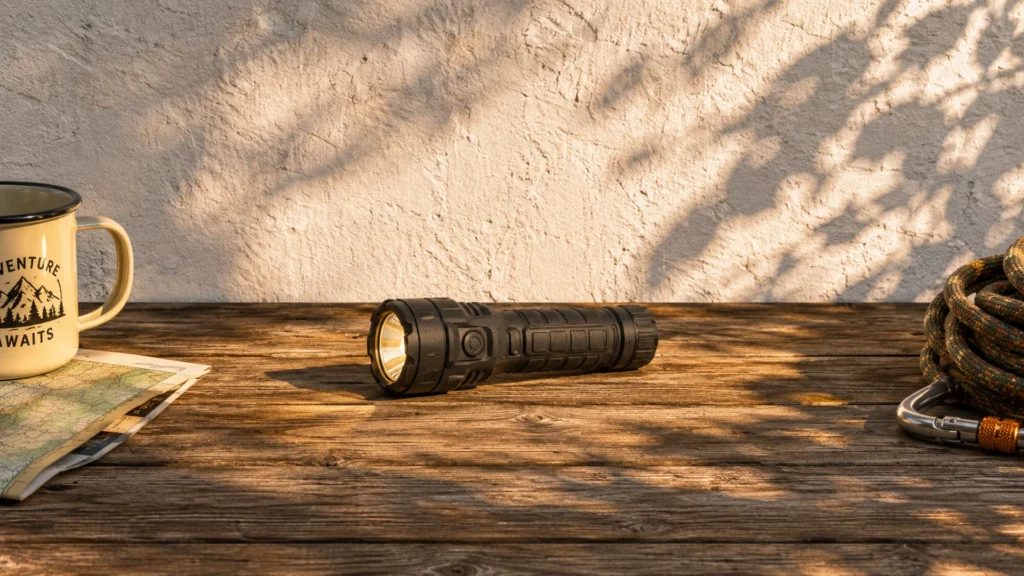
Flashlights are compact lights for home, work, and outdoor use. In this category, you are buying light output, beam reach, and practical runtime, not just a bright spec number.
Picking one is hard because specs can mislead. “Max lumens” often appear briefly, then the light steps down as it heats. Mode counts can be filler, and battery claims can hide real runtime drops. Fit and finish also matters, especially for switches, seals, and lens clarity.
This guide compares top options across real-world criteria like sustained brightness, beam distance, and power convenience. You will also find clear buying tips for battery type, charging port, waterproof rating, and weight so you can match the light to your use.
Quick Overview
Top Picks
Best Overall

Specifications
| Brand | Fenix |
|---|---|
| Brightness Lumens | 2800 lm |
| Beam Distance Ft | 415 yd |
| Runtime Hr | 42 hr |
| Mode Count | 6 Modes |
| Battery Type | 1 x 21700 Li-ion |
| Charging Port | USB-C |
| Waterproof Rating | IP68 |
| Weight Oz | 6.4 oz |
Pros
- Laser-like throw
- Tight fit, dependable switch
- One-hand easy controls
Cons
- Heavy and bulky
- Mode spacing tradeoff
For a Best Overall pick, this flashlight stands out for its tight, laser-like throw. It is the kind of light that reaches far while still having practical modes for everyday use. If you want one beam style that performs at distance, this fits the role well.
Real-world performance is strong, with a 415 yd beam distance and up to 2800 lm. It also runs smoothly, with a long 42 hr rating and careful heat handling that helps keep output usable. The build feels dependable, the switch is easy to use with one hand, and the IP68 seal adds confidence outdoors. Power is also convenient, since it uses a 1 x 21700 Li-ion cell and USB-C charging.
The main drawback is carry, it is heavy and bulky at 6.4 oz. You also get 6 modes, but the spacing between them can be a bit of a compromise. If you want a throw-focused, durable everyday light that is simple to operate one-handed, this is the one to get.
Also ranked #1 in: USB-C Rechargeable Flashlights · Dual Switch Flashlights
Best with AA Batteries

Specifications
| Brand | ACEBEAM |
|---|---|
| Brightness Lumens | 1400 lm |
| Beam Distance Ft | 997.2 ft |
| Runtime Hr | 94 hr |
| Mode Count | 2 Modes |
| Battery Type | 2x AA |
| Charging Port | USB-C |
| Waterproof Rating | IP68 |
| Weight Oz | 2.6 oz |
Pros
- Laser-like throw
- High output brightness
- Highly water resistant
Cons
- Driver quality critique
- Inconsistent tailstanding
This Acebeam model fits the Best with AA Batteries slot for one main reason, it turns two AAs into a very long reach beam. You get 1400 lm and a reported distance of 997.2 ft, in a compact light that still uses common cells.
In day to day use, the throw feels sharp and far. It also stays bright for a long stretch, with a rated runtime of 94 hr across its two modes. Build and protection are strong too, with an IP68 water rating and a rugged feel for real outdoor handling. USB-C charging adds convenience when you want to recharge compatible AA setups.
The trade off is driver quality, which can be uneven, and the light does not tailstand reliably. If you want maximum throw from AA cells and you do not need perfect tailstanding, this is the one to get.
Best Magnetic Charging

Specifications
| Brand | Nitecore |
|---|---|
| Brightness Lumens | 6500 lm |
| Beam Distance Ft | 1214.8 ft |
| Runtime Hr | 61 hr |
| Mode Count | 6 Modes |
| Battery Type | Built-in Lithium-Ion |
| Charging Port | USB-C |
| Waterproof Rating | IPX8 |
| Weight Oz | 6.4 oz |
Pros
- Laser-like throw
- High output brightness
- USB-C or magnetic charging
Cons
- Emitter non-independence
This is a strong pick for Best Magnetic Charging thanks to its built-in lithium-ion setup that uses USB-C or a magnetic charge approach. That means you can top up quickly at a desk or dock, without pulling the light apart.
In real use, the beam profile stands out. It reaches out with laser-like throw, hitting a rated 1214.8 ft, while still staying bright at 6500 lm. Heat control keeps output usable, and the light runs up to 61 hr across its 6 modes. Build quality feels dependable too, with an IPX8 waterproof rating and a compact 6.4 oz carry weight.
The main drawback is emitter non-independence, which can limit how evenly the light changes across modes. If you want a small, daily-carry flashlight that is easy to recharge magnetically or via USB-C, this one fits.
Best for Long Runtime

Specifications
| Brand | ACEBEAM |
|---|---|
| Brightness Lumens | 4500 lm |
| Beam Distance Ft | 853.5 ft |
| Runtime Hr | 624 hr |
| Mode Count | 6 Modes |
| Battery Type | 1x 21700 Li-ion |
| Charging Port | USB-C |
| Waterproof Rating | IP68 |
| Weight Oz | 7.65 oz |
Pros
- Laser-like throw
- Tight fit, dependable switch
- Easy charging, clear indicators
Cons
- Heavy and bulky
- Turbo access inconsistency
- Floody distance limitation
If you want long runtime without giving up reach, the Acebeam E75 is a strong match. Its standout trait is laser-like throw, so you can keep seeing far objects while still using steady modes for hours. With a 1x 21700 cell and a long rated runtime, it fits the long-haul, get-to-work-and-stay-ready style.
In day to day use, the beam reach stands out, and the output feels useful beyond the first burst. The switch is tight and dependable, which matters when you are toggling modes often. Charging is also easy, with USB-C support and clear indicators to reduce guesswork.
The trade-off is size and weight, so it is not ideal for light pocket carry. Also, turbo access can be inconsistent, and the beam stays more floody than you might expect at distance. If you need a long-running flashlight with serious throw, and you do not mind carrying a bigger light, this is the one to get.
Best for Twist Focus

Specifications
| Brand | Coast |
|---|---|
| Brightness Lumens | 500 lm |
| Beam Distance Ft | 360 ft |
| Runtime Hr | 2.25 hr |
| Mode Count | 2 Modes |
| Battery Type | COAST ZITHION-X™ lithium polymer rechargeable battery OR alkaline batteries |
| Charging Port | USB-C |
| Waterproof Rating | IP54 |
| Weight Oz | 4.8 oz |
Pros
- Laser-like throw
- Tight fit, dependable switch
- USB-C or magnetic charging
Cons
- Short runtime
- Poor waterproofing
- Limited light modes
If you want the beam to go far at the turn of a dial, the Coast HP3R is a strong fit for Best for Twist Focus. Its focus control keeps the hotspot tight, so the light stays focused out at long range instead of spreading out too fast.
On the ground, it delivers laser-like throw around 360 ft and manages the light well for the size. The switch feels dependable, and the body uses a tight fit that makes the light feel reliable for daily carrying. Charging is also practical with USB-C or magnetic charging, so you can top it up without digging for a special cradle.
The main downside is short runtime, and the IP54 rating means you should avoid heavy rain and wet conditions. It also has limited light modes, so it is not the best pick for people who want lots of beam options. If you need a simple, twist-to-tighten thrower for tasks like walking trails or fixing things outdoors, this is the one to get.
Best Flat EDC

Specifications
| Brand | OLIGHT |
|---|---|
| Brightness Lumens | 1700 lm |
| Beam Distance Ft | 224 ft |
| Runtime Hr | 14 days |
| Mode Count | 7 Modes |
| Battery Type | Built-in Lithium-Ion |
| Charging Port | Magnetic |
| Waterproof Rating | IPX7 |
| Weight Oz | 4.8 oz |
Pros
- High output brightness
- Laser-like throw
- USB-C or magnetic charging
Cons
- Built-in battery tradeoff
This flat EDC pick stands out because it pairs pocket-friendly carry with laser-like throw. With 1700 lm and a 224 ft beam distance, it is built for quick checks, outdoor walks, and lighting up far objects without taking up much space.
It earns strong marks for build and everyday grip. The controls feel dependable, it is rated IPX7 for water resistance, and the beam stays useful thanks to solid sustained output. Charging is also convenient, using magnetic charging that is simple to line up and top off when you are on the move.
The main trade-off is the built-in lithium-ion battery, so you cannot swap cells if one day the pack ages out. If you want a slim, throw-capable flashlight you can charge in seconds and carry daily, this is a smart choice, as long as you are fine with a non-replaceable battery.
Best with Micro USB

Specifications
| Brand | Streamlight |
|---|---|
| Brightness Lumens | 600 lm |
| Beam Distance Ft | 673 ft |
| Runtime Hr | 3.5 hr |
| Mode Count | 3 Modes |
| Battery Type | 1x SL-B26 Lithium-Ion USB Rechargeable Battery Pack (or 2x CR123A Lithium Batteries) |
| Charging Port | Micro-USB |
| Waterproof Rating | IPX7 |
| Weight Oz | 4.8 oz |
Pros
- Laser-like throw
- Easy charging, clear indicators
- Highly water resistant
Cons
- Short runtime
- annoying spring mechanism
This Streamlight fits the Best with Micro USB role because it uses a simple Micro-USB charging port, and it stands out with a very long-reaching beam. At 600 lm and 673 ft of beam distance, it is built for finding things far away, not just lighting up what is nearby.
You get practical power and solid everyday durability. It runs for about 3.5 hr, has three modes, and the charging setup includes clear indicators. It also carries an IPX7 water resistance rating, so it handles rain and submersion surprises better than most pocket lights.
The main downside is runtime. With a 3.5 hr figure, you will recharge sooner than some rivals, and the spring mechanism can feel annoying during use. If you want a throw-focused flashlight that charges with Micro-USB and you do not need all-day runtime, this is a strong choice.
Best for Right-Angle Lighting

Specifications
| Brand | Wurkkos |
|---|---|
| Brightness Lumens | 1200 lm |
| Beam Distance Ft | 423 ft |
| Mode Count | 2 Modes |
| Battery Type | 1x 14500 Li-ion Battery |
| Charging Port | USB-C |
| Waterproof Rating | IP68 |
| Weight Oz | 1.6 oz |
Pros
- High output brightness
- Laser-like throw
- USB-C or magnetic charging
Cons
- Early release bugs
- Firmware ceiling variability
- Headband discomfort
This right-angle flashlight fits the Best for Right-Angle Lighting role because it keeps the beam steady where you need it, near ceilings, under hoods, and in tight spots. The standout is its laser-like throw, with a rated beam distance of 423 ft, plus a bright 1200 lm output that lights up far targets in a way flat lantern-style lights often do not.
It scores well in real-world performance and power handling for a compact setup. You get only 2 modes, but they are practical for switching between quick task lighting and a longer reach setting. Charging is simple thanks to USB-C, and the light is built for wet and rough use with an IP68 rating.
The main catch is early release bugs and some firmware ceiling variability, so updates and behavior can differ between units. The headband can also be uncomfortable for long sessions. If you want a right-angle light with strong throw and easy USB-C charging for car work, repairs, or search tasks, this is the one to get.
Best Value

Specifications
| Brand | ThruNite |
|---|---|
| Brightness Lumens | 405 lm |
| Beam Distance Ft | 285 ft |
| Runtime Hr | 7.5 hr |
| Mode Count | 3 Modes |
| Battery Type | Built-in Lithium-Ion |
| Charging Port | USB-C |
| Waterproof Rating | IPX8 |
| Weight Oz | 1.2 oz |
Pros
- Tight fit, dependable switch
- USB-C or magnetic charging
- Highly water resistant
Cons
- Low brightness output
- Weak beam focus
- Non-serviceable battery
This ThruNite Archer Mini fits the Best Value role because it balances everyday use with simple charging. The standout trait is the USB-C or magnetic charging, so you can top it up without hunting for special cells.
In daily carry, the light feels reliable, with a tight fit and a dependable switch. It is also rated IPX8, which helps when it gets splashed or briefly submerged. Runtime and step-down look practical for a compact light, and it has 3 modes to cover quick tasks and longer sessions.
The main downside is the low brightness output, and the beam focus is not very tight. That means it is better for close to mid-range than for spotting far objects. If you want a small, rugged USB-C rechargeable flashlight for near-field use, this one is a solid match.
What to Look For
Performance: Look for strong usable output, not just a high peak. Favor flashlights that keep brightness steady for the time you actually need, with heat control that prevents harsh step-down.
Build: Check materials and machining, especially the lens and switch area. A good flashlight seals well against dust and water, holds up to drops, and avoids wobbly controls.
Ergonomics: Choose a size and grip you can use one-handed. Weight matters for carry comfort, and balance matters for sustained use. A good clip and an easy switch layout reduce fumbling.
Power: Match the battery type to your habits. Common cells are simpler to replace, while built-in packs can be easier for charging. Also check for consistent runtime, so the light does not fall off quickly.
Brightness: Use the listed brightness as a starting point. More useful is how the flashlight performs across modes, especially at the brightness level you will use most.
Beam Distance: Beam distance tells you how well the light reaches. If you need to see far, prioritize beam reach over raw maximum brightness.
Charging Port and Waterproof Rating: A convenient charging port saves time. USB-C and magnetic charging tend to be practical. For protection, verify an IP rating when available, and avoid vague “water resistant” claims.
How We Selected These Products
We started with broad web research across review sites, buyer forums, and best-of lists for flashlights in this price class. That gave us a wide pool and helped identify patterns that show up repeatedly in real use, like premature step-down, finicky switches, and confusing charging.
Next, we read a large volume of customer reviews to understand the issues buyers actually ran into, along with the features they relied on most. We then verified availability and key specs directly on Amazon listings, so the details matched what you can buy today.
Each flashlight was scored across the same pillar set, Performance, Build, Ergonomics, Power, and Value, using an objective framework tied to the criteria above. Final selection favored models that stand out for distinct roles, not just the highest overall score.
Frequently Asked Questions
Which flashlight is best for daily carry on a budget?
If you want strong light for the money, pick a flashlight with simple modes and a common battery setup. ThruNite Archer Mini Flashlight stands out for value in this set. It is bright for its AAA size, and it includes USB-C charging convenience. Just expect limited sustained high output because the body is so small.
What is the main difference between AA flashlights and 21700 or 18650 flashlights?
AA lights use very common, easy-to-find batteries, but they usually give shorter high-mode runtimes. 21700 and 18650 flashlights typically feel brighter and last longer on turbo, because they store more energy. They also often offer better throw or more usable heat control during long sessions. Your choice depends on whether you value quick battery swaps or maximum light per charge.
Why do more expensive flashlights sometimes cost more but do not feel brighter for long?
Many lights hit a high advertised brightness, then step down to avoid overheating. That means you can see great max numbers, but your usable brightness may drop after a few minutes. Fenix PD36R Pro Flashlight scores well here because it aims to stay usable rather than only chasing peak output. Still, always compare real runtime at normal modes, not only the max spec.
Is a higher price always better for Flashlights?
No. Some of the best value comes from budget-friendly lights with efficient drivers and simple mode ramps. ThruNite Archer Mini Flashlight has the top value score here. Premium lights often win on build quality, sustained output, and battery convenience, but the best deal still depends on your battery and charging preference.
Why do many flashlights struggle with low-mode brightness?
Low modes matter for walking, tasks, and saving battery, but they get harder when manufacturers push high max output. Some lights set the lowest mode too bright, so you cannot get that true low-glow comfort. Nitecore EDC29 Flashlight shows this idea, with users wanting fewer lumens at its lowest setting. The fix is choosing a light with a properly low mode ladder and good regulation.
How should I maintain and charge my flashlight for best battery life?
Use the recommended battery type and avoid mixing fresh and old cells in multi-battery lights. Store the flashlight in a cool, dry place, and do not leave it fully drained for long. For USB charging lights, charge regularly and avoid overheating from using turbo continuously. If the light has an on-board pack, follow the manufacturer guidance for charging and power management.


