Transparency Note: This post contains affiliate links. As an Amazon Associate, we earn from qualifying purchases at no extra cost to you.
Fish finders with transducers pair a display unit with sonar hardware in the same package. For buyers, the key check is whether the selected listing names an included transducer and whether its sonar modes suit the fishing information they want.
Packages can differ in transducer model, imaging support, screen size, mapping, and connections. A named transducer makes the included hardware clearer, but buyers should still compare the unit’s sonar modes and confirm the package fits their setup.
Choose this comparison to focus on included sonar hardware rather than screen size alone. For a display-size focus, see our 7-Inch Fish Finders guide. Looking for all types? See our Best Fish Finders.
C-MAP Discover onboard; preloaded U.S. and Canadian inland and coastal charts
Networking
Ethernet; NMEA 2000; wireless; Bluetooth
Pros
Advanced sonar imaging
Large, high-resolution touchscreen
Cons
For a fish finder sold with a transducer, the Lowrance HDS PRO 9 stands out for including an Active Imaging HD 3-in-1 transducer. That gives buyers a named sonar unit in the package, alongside CHIRP, SideScan, and DownScan Imaging. Its 9-inch touchscreen and onboard C-MAP Discover charts for U.S. and Canadian inland and coastal waters make it a broad setup for anglers who also want chartplotting.
Choose it if the included transducer and multiple sonar views matter more than a smaller screen. Ethernet, NMEA 2000, wireless, and Bluetooth support can help it connect with compatible gear, though exact accessory compatibility depends on the equipment. If screen size is your main concern, compare 7-inch models; if package completeness is the priority, check that each listing names its included transducer.
Built-in GPS; Humminbird Basemap covering more than 10,000 lakes; includes LakeMaster and CoastMaster VX map card for US and Canada regions; compatible with Navionics charts
Networking
Ethernet; Bluetooth; NMEA 2000
Pros
Large, easy-view screen
Advanced sonar imaging
Built-in GPS mapping
Cons
For a fish finder with a transducer, the Humminbird XPLORE 10 Fish Finder stands out for pairing an included transducer with MEGA Side Imaging+ and MEGA Down Imaging+, plus Dual Spectrum CHIRP. The supplied specifications do not identify the transducer model, so check the exact package if matching its hardware to your boat matters. Its 10-inch, 1280 x 720 display gives these sonar views room on screen, while built-in GPS and included LakeMaster and CoastMaster VX map cards for US and Canada support chart use.
This is a good fit for anglers who want imaging, mapping, and a transducer in one package, rather than choosing a control head and sonar hardware separately. It also supports Ethernet, Bluetooth, and NMEA 2000 for compatible connections. Choose a 7-inch fish finder if a smaller display is your priority; compare the wider Fish Finders range if you want to weigh other screen sizes and included transducers.
For a fish finder package with a transducer, the Garmin ECHOMAP UHD2 9" 93sv stands out by including the GT56-TM. Its listed sonar modes are Traditional CHIRP, ClearVü, and SideVü, giving anglers several views of fish and underwater structure. The 9-inch screen pairs with built-in GPS and Garmin Navionics+ U.S. Inland maps.
Choose this configuration if you want the GT56-TM included rather than selecting a control head and transducer separately. The listing identifies Wi-Fi for sharing sonar, waypoints, and routes with another ECHOMAP UHD2 chartplotter, and for connecting wirelessly to a Force trolling motor. Its sonar modes and maps are documented capabilities; real-world performance and ease of use are not established by the available evidence.
150 m (fish) and 250 m (structure), realistic in saltwater
Included Transducer
Included: Active Imaging 3-in-1
Networking
Wireless; NMEA 2000; Ethernet
Pros
Large, sharp, easy-view display
Advanced sonar imaging
Transducer included
Cons
One owner reported snowy DownScan despite resets, updates, and adjustments
cause and representativeness unclear
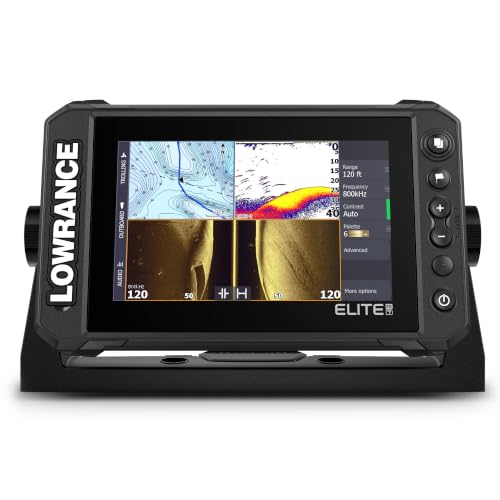
For a transducer-included setup, the Lowrance Elite FS 9 Fish Finder stands out by pairing a 9-inch display with an Active Imaging 3-in-1 transducer in this configuration. Its listed sonar modes include CHIRP, SideScan, DownScan Imaging, and FishReveal, giving anglers several ways to view fish and underwater structure without sourcing a transducer separately. The listing also identifies preloaded C-MAP Contour+ charts, useful for buyers who want charting in the same package.
Choose it if you want that included transducer and a larger screen for viewing sonar and charts. The display resolution is 800 x 480 pixels, and one owner reported snowy DownScan that persisted after adjustments, resets, and updates; the cause and how typical the issue is remain unclear. If your main priority is a 7-inch screen, compare models in the 7-Inch Fish Finders category instead.
Broadband: 50, 83, and 200 kHz (depending on Broadband transducer); Active Imaging: 455 and 800 kHz; DownScan: 700 kHz CHIRP and 1200 kHz CHIRP; SideScan: 455 kHz CHIRP and 1075 kHz CHIRP
Included Transducer
Included: Active Imaging 3-in-1
Networking
Wireless; NMEA 2000; Ethernet
Pros
Advanced sonar imaging
Flexible frequency options
Transducer included
Cons
One owner couldn’t connect an older VHF radio requiring NMEA 0183
For anglers comparing fish finders that include a transducer, this Elite FS 7 package pairs the display with an Active Imaging 3-in-1 transducer. That makes the included sonar hardware clear, rather than leaving the transducer unspecified. Its listed sonar modes include CHIRP, SideScan, DownScan Imaging, and FishReveal, with 455 and 800 kHz Active Imaging frequencies. The listing also names preloaded C-MAP Contour+ charts, so this configuration combines imaging hardware and charting in one package.
Choose it if those imaging modes and the included transducer suit your boat setup. One reported owner could not connect an older VHF radio that required NMEA 0183, so check equipment compatibility before relying on that connection. If your main priority is comparing screens of the same size, rather than confirming included sonar hardware, consider the 7-Inch Fish Finders category.
CHIRP traditional sonar; CHIRP ClearVü; CHIRP SideVü
Included Transducer
GT52HW-TM
Gps Chartplotter
Built-in GPS; Quickdraw Contours mapping
Networking
Wi-Fi
Pros
Clear returns and advanced sonar imaging
Built-in GPS mapping
Transducer included
Cons
For shoppers comparing fish finders with transducers, the Garmin Striker Vivid 7" 7sv stands out for including the GT52HW-TM, identified in the supplied specifications. Its sonar modes are CHIRP traditional sonar, CHIRP ClearVü, and CHIRP SideVü, so the package combines traditional and scanning views without leaving the transducer model unspecified. A 7-inch, 800 x 480-pixel display and built-in GPS with Quickdraw Contours mapping round out the listed capabilities.
Choose this model if you want the named transducer and several sonar views in one package. The specifications do not settle its maximum sonar depth, so check that requirement against your fishing conditions rather than assuming a range. If your main priority is comparing screen sizes, the 7-Inch Fish Finders group is the closer fit; this sub-category puts the included sonar hardware first.
CHIRP traditional sonar; CHIRP ClearVü scanning sonar
Sonar Frequencies
Traditional: 50/77/200 kHz; CHIRP (mid and high); ClearVü: 260/455/800 kHz
Included Transducer
GT20-TM
Gps Chartplotter
Built-in GPS; Quickdraw Contours mapping software
Networking
Wi-Fi
Pros
Advanced sonar imaging
Sharp, detailed display
Built-in GPS mapping
Cons
For a fish finder with a transducer, this Garmin Striker Vivid 7" 7cv Fish Finder stands out because the specified package includes the GT20-TM. Its 7-inch, 800 x 480 display pairs CHIRP traditional sonar with CHIRP ClearVü scanning sonar, so one included transducer supports both listed sonar modes. That makes the package a clear choice for shoppers who want the transducer model identified before buying.
Built-in GPS and Quickdraw Contours mapping software add basic mapping tools, while Wi-Fi is listed for connectivity. Choose this model if the GT20-TM and its sonar modes suit your setup; compare the main Fish Finders group if you want to weigh packages across a broader range of equipment and performance needs. For a comparison centered on screen size, see 7-Inch Fish Finders.
What to Look For
Included transducer: Check the selected listing for an explicit inclusion. When a model is named, compare that identifier with the sonar modes and frequencies listed for the fish finder.
Sonar modes: Match supported traditional sonar and imaging modes to the views you need. Do not assume that models with similar names support the same modes.
Screen size and resolution: Consider whether the display gives you enough room to read sonar information while fitting your boat’s available space. Compare resolution when it is stated.
GPS and charts: If you need position marking or maps, check whether the specific model has built-in GPS and identify which chart products are included or supported.
Connections and setup: Check documented wired and wireless connections against the equipment you plan to use. A connection name alone does not confirm compatibility with every device.
We identified fish finders through broad research across review sites and buyer forums, then filtered the comparison to models whose supplied product information explicitly confirms an included transducer. We used the selected listing and checked specifications to describe each package without assuming that similar model names have identical contents.
We scored the products with the same research-based pillar framework used in the main Fish Finders comparison. This supports direct comparison within the sub-category, while keeping the focus here on package completeness and included sonar hardware. Scores are assessments based on available research, not physical test results.
Frequently Asked Questions
How can I tell whether a fish finder package includes a transducer?
Check the exact listing and model variant for an included transducer and its model number. These options include named transducers such as Garmin's GT56-TM, GT52HW-TM, and GT20-TM, or Lowrance's Active Imaging 3-in-1. If a listing only says included without a model, confirm the box contents before buying.
What should I match between an included transducer and my boat?
Check that the transducer's mounting style and sonar modes suit your boat and fishing needs. The listed packages include different hardware, such as GT-series models and Active Imaging 3-in-1 units, so do not assume they are interchangeable. Confirm fit and compatibility for your setup with the manufacturer or seller.
Do these fish finders need extra setup after I install the transducer?
Yes. Mount and connect the transducer, then select the sonar modes your unit supports and check that it returns clear readings on the water. GPS and chart setup also varies: some listed models include built-in GPS and mapping, while the Lowrance HDS PRO includes C-MAP Discover charts.
When should I choose a fish finder without a transducer instead?
Choose a control-head-only package if you already own a compatible transducer or need a specific transducer that the included package does not provide. Check exact model compatibility before buying, since the included hardware differs across these listings. If you do not have a transducer, choose a package that names one or clearly confirms it is included.
How do fish finders with included transducers compare with other fish finders?
Their main advantage is package completeness: a confirmed transducer can save you from sourcing sonar hardware separately. They still vary in screen size, sonar modes, GPS, and connectivity, so compare those features with your needs. If screen size is your main concern, browse 7-inch fish finders; that group is defined by display size, not included equipment.