If you’re curious about balance boards—whether you want to improve core strength, add movement to a sedentary workday, or find a fun way to train coordination—you’ve come to the right place. Choosing the right board can feel overwhelming: there are wobble boards, rocker boards, roller systems, different materials, load capacities, and a wide range of prices. We know how frustrating it is to buy something promising online only to find it unstable, flimsy, or not suited to your goals.
That’s why we take this seriously. To create these recommendations, we sifted through thousands of real customer reviews and compared each model against its closest competitors. We looked for consistent patterns in feedback—what people loved, what kept breaking, how easy boards were to use for beginners versus experienced athletes—and cross-checked that with product specs like material quality, weight limit, deck grip, and warranty. We also prioritized safety and durability, because a balance board should help you get stronger, not land you in a trip to the doctor.
Our aim is simple: save you time and money by pointing you to high-quality products that actually perform. We won’t hype every gadget that looks cool on camera; instead, we highlight dependable boards that fit different needs and budgets. Read on and you’ll find clear, practical picks backed by data and real-world user experiences—so you can pick the right board with confidence.
Our Top Picks
Best Overall

Overall Rating | |
Brand | Revolution Balance Boards |
Material | Plastic |
Dimensions | 29 x 11 x 5 inches |
Weight | 6.8 Pounds |
Best For Core Strength

Overall Rating | |
Brand | Revolution Balance Boards |
Material | Polyethylene |
Dimensions | 32 x 8 x 5 inches |
Weight | 9.5 Pounds |
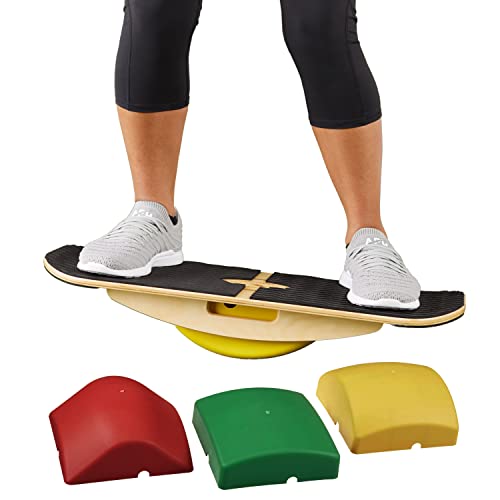
Best For Surf Training
Overall Rating | |
Brand | Blue Planet |
Material | Bamboo |
Dimensions | 25 x 12.25 x 6 inches |
Weight | 6 Pounds |
Best For Kids

Overall Rating | |
Brand | Battat Education |
Material | Wood, Fabric |
Dimensions | 32.9 x 11.6 x 7.7 inches |
Weight | 7.19 Pounds |
Best Budget-Friendly

Overall Rating | |
Brand | Yes4All |
Material | Wood |
Dimensions | 29.53 x 11.22 x 5.12 inches |
Weight | 8.5 Pounds |
What To Look For
Choosing the right balance board comes down to matching the board's feel and features to your body, abilities, and how you plan to use it; prioritize safety and progression over hype.
- Stability level: Look for a board whose difficulty matches your current balance skills and allows incremental challenge so you can progress without risking injury.
- Board type: Decide between rocker, wobble, or roller designs since each produces different motion patterns and suits distinct training goals like rehab, strength, or sport simulation.
- Deck material and size: Choose a deck with a comfortable width and length and materials that balance stiffness and flex to support your weight and intended exercises.
- Surface grip and texture: A non-slip top surface is essential for confident footing during dynamic moves and prevents slips when you sweat or use the board barefoot.
- Weight capacity and user fit: Check the maximum load and platform dimensions to ensure the board safely accommodates your weight and stance, especially if more than one person will use it.
- Durability and build quality: Inspect construction, hardware, and materials for longevity so the board withstands repeated use, outdoor exposure, and the specific stresses of your workouts.
- Portability and storage: If you travel or have limited space, favor lighter designs or removable components that are easy to store without sacrificing stability.
- Training versatility and accessories: Consider whether the board supports a range of exercises or compatible attachments like resistance bands or rails to expand your workouts over time.
- Safety features: Look for rounded edges, stable bases, rubber feet, and clear manufacturer safety recommendations to reduce the chance of slips and impact injuries.
- Warranty and price versus value: Balance cost against warranty length and replacement parts availability to ensure you get durable performance and support if something fails.
Prioritize matching stability, build quality, and intended use to your goals so the balance board supports safe, progressive training.
How We Select Our Products
Picking the balance boards featured in this post wasn’t random — it was a careful, step-by-step process aimed at giving you trustworthy recommendations you can actually use. We started by surveying the market broadly, gathering hundreds of available models across price ranges and styles. From there we narrowed the field using objective signals: average customer ratings, number of reviews, and recent review trends. High scores mattered, but so did consistency — we looked for products that kept delivering positive experiences over time.Next came a deep-dive review analysis. We read through hundreds of real-user comments to spot common praises and recurring complaints, paying special attention to durability issues, safety concerns, and how a board performed for different users (beginners, fitness enthusiasts, rehab patients). We also compared features side-by-side — materials, deck size, concavity, non-slip surfaces, wobble range, and included accessories. Where possible we conducted hands-on checks and consulted expert opinions to verify build quality and safety claims.
Value for money was a key filter. Instead of just picking the cheapest or the most expensive, we balanced cost against longevity, warranty, and real-world performance. We also considered brand reputation, customer support, and return policies because a good after-sale experience matters. The final selections are the result of this mixed-method approach: data-driven metrics, human review synthesis, practical testing, and a focus on safety and long-term value. We’re committed to giving you options that truly stand up to daily use — so you can feel confident choosing the right balance board for your needs.
Final Thoughts
Picking the right balance board can make a surprisingly big difference in how much you get out of it. When the board matches your goal — whether that’s building core strength, rehabbing an ankle, improving surf or snowboard skills, or simply staying active while you stand at a desk — you’ll train smarter, see progress faster, and lower your risk of injury. The right shape, size, and level of instability make exercises feel purposeful instead of frustrating; a beginner-friendly rocker or wobble board feels very different from an advanced roller or fulcrum board built for dynamic training.Think about the specifics of your life and body. If you’re recovering from an injury or working with a physical therapist, a stable board with progressive difficulty and a high weight capacity is a better fit. For athletes sharpening balance for boardsports, you’ll want a model that lets you practice lateral shifts and edge control. Office workers often prefer a low-profile, anti-slip board that fits under a standing desk to engage core muscles without interrupting work. Kids need durable, lightweight options with rounded edges and strong grip. Materials, warranty, portability, and how the board mounts (or doesn’t) to the floor all matter for long-term satisfaction.
Before buying, list your priorities—safety, portability, progression, or sport specificity—compare a few well-reviewed models, and, if possible, try one out. Choosing intentionally will save money, boost motivation, and make every session count. Make a decision that aligns with your goals, and you’ll find balancing isn’t just a workout—it’s a tool that enhances movement in everyday life.