





How to Wash and Dry Heated Socks Safely
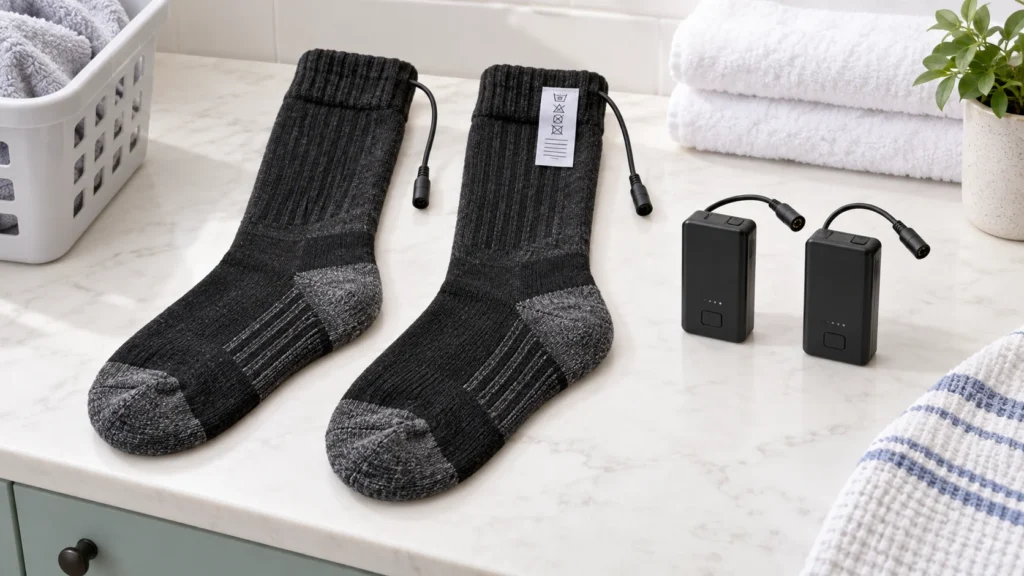
Heated socks need gentler care than ordinary laundry because they include electrical parts as well as fabric. The safest method is not one universal wash cycle: the care label and instructions for your exact pair should decide whether the socks can be machine-washed, how to protect their connectors and how they should be dried. If instructions are missing or unclear, contact the manufacturer rather than guessing.
Use this guide as a cautious process for routine cleaning—not as permission to wash every model. For help choosing a pair with care instructions that suit you, see TheTopZone’s heated socks Top Picks.
Start with the exact care instructions
Before washing, find the care label and the manual for your exact model. Look for whether hand washing or machine washing is allowed, any water-temperature or cycle limits, how the battery must be disconnected, and the approved drying method. Fieldsheer’s care article describes battery removal, a protective laundry bag and a gentle cold-water machine cycle for its guidance, while iHood recommends following the specific manufacturer instructions and describes air drying. Those recommendations are not a substitute for your own pair’s label: models can differ. See Fieldsheer’s heated-sock care guidance and iHood’s washing guide.
If the label is absent, unreadable or does not say whether machine washing is permitted, don’t infer permission from a product listing or another brand’s advice. Ask the manufacturer. Until you have an answer, avoid putting the socks in a washing machine or dryer. If the socks or electrical connections appear damaged, don’t wash or use them until the manufacturer advises you what to do.
Prepare the socks and connections
Switch the socks off and disconnect the batteries before cleaning. If a battery is removable, detach it using the method in the manual; don’t pull on its cable or connector. Keep batteries and chargers away from the wash area. iHood and Fieldsheer both describe removing the battery before washing in their care guidance (iHood; Fieldsheer).
Follow the manual’s directions for any exposed connector: it may specify how to secure, tuck away or protect it. Don’t assume that wrapping it in plastic, sealing a pocket or wetting a connector is safe unless the instructions explicitly say so. Check the sock and accessible wiring for visible damage before washing. If you find damage, stop and ask the manufacturer rather than trying to repair wiring yourself.
Close or secure any battery pocket as directed, and check the care label again before choosing a washing method. Use only a mild detergent if the manufacturer permits it; avoid bleach and fabric softener unless the instructions expressly allow them. Fieldsheer advises against bleach and fabric softener in its article, but the exact product instructions take priority.
Choose hand washing or machine washing
Hand washing
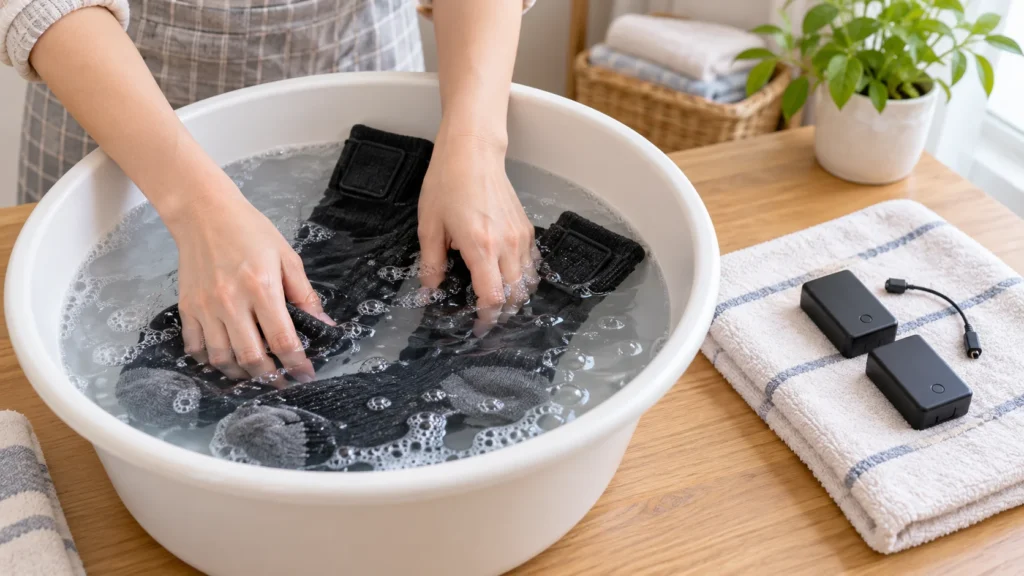
If the label permits hand washing, use the specified water temperature and detergent. Gently move the socks through the water; avoid hard scrubbing, twisting or wringing, especially around the heating areas and connectors. Rinse as directed until detergent is removed. Press the socks gently between your hands or in a clean towel to take up excess water, without twisting them. This follows the low-agitation approach described in iHood’s hand-washing instructions.
Machine washing
Machine-wash only if the exact model’s instructions allow it. Follow the specified cycle, temperature and detergent directions; use a laundry bag only if the manufacturer recommends or permits one. A mesh bag and gentle cycle appear in some general care advice, but they do not make an otherwise prohibited wash safe. Do not add a dryer step just because the washing machine is approved.
Illustrative decision: Your pair’s care label says “hand wash only,” while a general article says some heated socks can go in a machine. The label for your pair answers the decision: hand-wash it. If the label does not give a water temperature or explain connector protection, pause and ask the manufacturer rather than borrowing those details from another model.
Dry completely before reconnecting
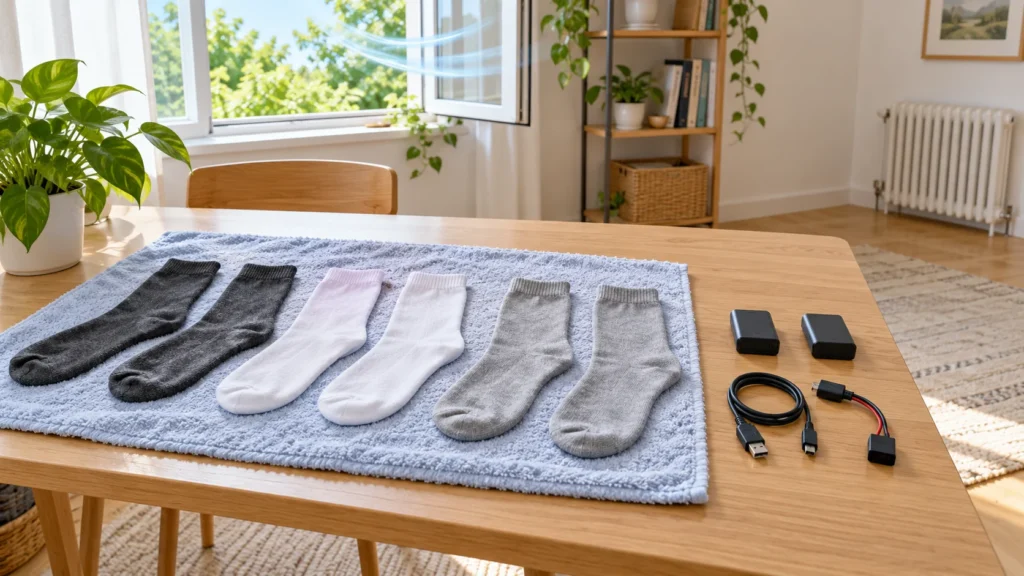
Drying is part of electrical care, not just laundry. Unless the exact manufacturer instructions clearly approve a different method, air-dry the socks. iHood recommends laying them flat on a towel in a ventilated area and avoiding direct heat; Fieldsheer also describes air drying, while its separate dryer advice should not be taken as permission for another model. See iHood’s drying advice and Fieldsheer’s drying guidance.
Keep the socks away from radiators, heaters and other direct heat sources. Don’t wring or twist them to speed drying. If the manual specifies how to position or turn them during drying, follow that method. Otherwise, allow them to dry naturally in a well-ventilated place. Don’t reconnect a battery, charge a battery through a damp connection or use the socks while any part of the sock or connector is still wet. Wait until they are fully dry; if you cannot tell whether a connection is dry, wait longer or ask the manufacturer.
Avoid a tumble dryer unless the instructions for your exact model explicitly permit it and state the required setting. General advice conflicts: Fieldsheer discusses low-heat or air-dry dryer settings, while iHood says to avoid traditional dryers. Because dryer heat and tumbling can affect delicate components, the cautious choice is air drying unless the model-specific instructions say otherwise. Never treat another brand’s dryer setting as a specification for your socks.
Store the socks and batteries
Once the socks are completely dry, disconnect the battery for storage if the manufacturer’s instructions call for it. Keep the socks in a cool, dry place, as recommended in Fieldsheer’s storage guidance. Follow the battery manufacturer’s instructions for storing or charging the battery; do not guess at a storage charge level or charging schedule. Keep damp laundry and wet connectors out of the storage area.
Before wearing the socks again, check that they are dry and that the accessible wiring and connectors show no visible damage. Reconnect the battery only as instructed. If a connector looks damaged, the socks behave unusually or you are uncertain about moisture inside a connection, do not use them until you have obtained model-specific advice.
The safe rule to remember
Remove the batteries, follow the exact care label, wash only by an approved method, and let the socks dry fully before reconnecting or storing them. When instructions are missing, conflicting or unclear, ask the manufacturer. That cautious pause is better than applying a general heated-sock tip to a model it was never written for.