





How to Apply Perfume Without Overdoing It
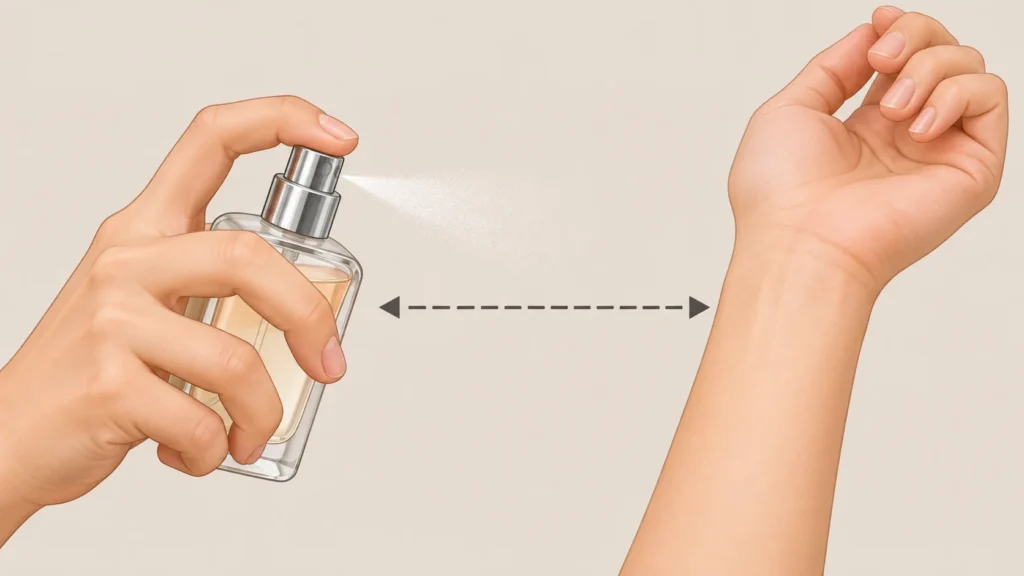
Wearing fragrance lightly is less about finding a universal number of sprays and more about controlling the first application, giving it time to settle, and checking how it wears in your actual setting. A scent that seems subtle to you may be more noticeable to someone nearby, and the same fragrance can smell different from one person to another. Start small; add only when you have a clear reason.
This guide offers a practical method for applying perfume, adjusting for fragrance strength and context, and deciding whether a top-up makes sense. For help choosing a scent in the first place, see TheTopZone’s fragrance Top Picks.
Start with a small application
Begin with one spray on skin, then pause before adding more. The point is not that one spray is right for everyone: sprayers, formulas, personal perception, and the place you are going all differ. It is a cautious starting point that lets you assess the scent before committing to a larger application.
Apply to clean, dry skin if that suits your routine, and avoid spraying into the air and walking through it. The general application advice in The Trend Spotter’s cologne guide recommends spraying directly onto skin rather than using an air-cloud method, and advises against rubbing fragrance into the skin after application. Treat this as a practical technique, not a promise that scent will last a particular length of time; results can vary by fragrance and wearer.
Choose one spot to start, rather than covering several areas at once. Pulse points, such as the wrist or neck, are commonly suggested application areas; however, the retailer’s listing for Baccarat Rouge 540 Extrait de Parfum specifically says to spritz it on pulse points. That is guidance for that exact product, not proof that every perfume should be applied identically. See the retailer’s listing and application note for that fragrance.
Give the first application time to settle before deciding it is too faint. Smell it at a normal conversational distance, rather than repeatedly pressing your nose against the application spot. If you can clearly detect it without trying, adding more may not be necessary. If you cannot smell it yourself, that alone is not a reliable reason to spray again: your own perception can change as you wear a scent, and other people may experience it differently.
Adjust for strength and setting
Think of strength as a reason to be more cautious, not as a formula for calculating sprays. The Trend Spotter describes fragrance categories such as eau de toilette and eau de parfum as differing in aromatic concentration, but that general distinction does not establish how strongly a particular bottle will project on your skin or how much you should apply. Follow any directions on your own product, and begin with less when you do not know how it will wear.
Then consider the setting. In a small room, a quiet workplace, public transport, or any situation where people will be close to you, keep the application particularly restrained. For a brief outing or a spacious outdoor setting, you may have more room to judge your preference, but there is still no need to add fragrance automatically. What matters is the people and space around you, not a rule that one occasion always calls for a certain number of sprays.
If you are trying a fragrance for the first time, avoid testing a generous application just before an important event. Apply a small amount at a time when you can observe how it smells on you and whether it feels comfortable. The supplied Vera Wang Princess listing notes that natural smell can affect how fragrance smells on skin. This is a product-page observation, not a general measurement of how every fragrance develops.
Illustrative example: a close-quarters day
Imagine you are wearing an unfamiliar perfume to a meeting in a small room. Your goal is to avoid an intrusive scent, not to make it noticeable across the room. Apply one spray to one chosen spot, wait, and check whether you can detect it comfortably at ordinary distance. If you can, stop there. If you cannot, consider the possibility that you have simply become less aware of it; do not add more just to satisfy your own nose. This example is a cautious decision process, not a guaranteed spray count or a claim about how long the fragrance lasts.

Decide whether to reapply
Do not schedule a top-up just because a certain number of hours has passed. How long a scent remains noticeable varies, and the supplied sources do not establish a reliable universal reapplication interval. Instead, pause and consider why you think you need more. Is the fragrance genuinely no longer noticeable to you at a normal distance, or have you been smelling it continuously? Are you about to enter a setting where a fresh application could be too strong?
If you choose to reapply, use a small amount and reassess. Avoid stacking repeated sprays because you are uncertain whether the first one worked. A second application is a choice, not a requirement; if people will be close by, or if you are unsure, stopping is the more conservative option. The Trend Spotter suggests reapplication in its cologne guide, but its advice should not be treated as a mandatory schedule for every perfume or wearer.
Also consider where you apply it. A spray on clothing may behave differently from one on skin, and the fragrance’s own label or product instructions should take priority. Do not assume a technique documented for one bottle applies to all fabrics or formulas. If you prefer not to apply fragrance to skin, check the product directions and choose an appropriate alternative rather than improvising.

Notice discomfort and stop
If a fragrance feels unpleasantly strong to you, stop adding it. Move away from the immediate application area if practical, and follow the product label for any relevant use or removal instructions. If the product causes irritation or another unwanted reaction, discontinue use; do not try to cover the sensation with additional fragrance. This is a general caution, not a diagnosis or medical treatment recommendation.
Comfort is personal, and preferences can change by day, place, and company. There is no need to wear fragrance every day, reach a particular level of projection, or reapply to meet a fixed rule. A useful routine is simple: start with a small amount, give it time, consider the setting, and add more only when you have a good reason. If you are still deciding what to wear, explore TheTopZone’s fragrance Top Picks; choosing a fragrance and deciding how lightly to apply it are separate decisions.