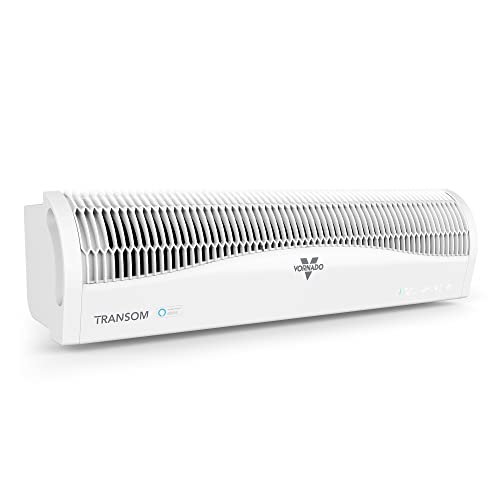
Specifications
| Brand | Vornado |
|---|---|
| Fan Type | Window Fan |
| Speed Settings | 4 Settings |
| Noise Level | 45 dB |
| Power Consumption | 28 W |
| Dimensions | 26 x 5.73 x 7.16 in |
Pros
- Consistent airflow
- Quiet at low speed
- Worth the price
Cons
- Installation-dependent sealing
- Limited extreme-heat coverage
- Outdoor noise leakage
The Verdict
The Vornado TRANSOM AE window fan targets window ventilation, with 4 speed settings and a quiet 45 dB at low speed. It is a great pick when you need steady airflow through a tight window opening, but you may lose performance if the sealing fit is not right, and you can still hear some outdoor noise.
Who it's for: Apartment and home shoppers who want quieter fresh-air exchange from a window, and who accept that results depend on how well the fan seals in their specific window frame.
Who should skip it: People chasing room-wide cooling or those who cannot get a snug window fit, since limited extreme-heat coverage and outdoor noise leakage can undercut expectations.
In-Depth Review
Performance
Vornado rates at a Performance score of 8.6. That maps to the phrase Consistent airflow. This window fan is not trying to cool an entire home. It is meant to move air through an opening. In practice, that means the fan works best when the window seal is tight and the airflow path is clear.
The model lists 4 speed settings, and the airflow feel changes in a controlled way rather than by sudden surges. It also helps that the unit is designed around a window install. The dimensions are 26 x 5.73 x 7.16 in, which keeps the intake and exhaust aligned with the window frame. Expect real-world cooling to rise and fall with how well it pulls air in one side and pushes it out the other.
There is also a power anchor here: the fan is specified at 28 W. That matters because it sets expectations. It is not a brute-force room cooler. Instead, it is a steady ventilation tool. If you are using it to exhaust hot, stale air and bring in drier air, the performance should feel dependable across its speed range.
Noise
Noise earns a Noise score of 8.1. That aligns with Quiet at low speed. The listing gives a specific operating number: 45 dB. At that level, it can fit into a bedroom or a quiet workspace, as long as the rest of your room is already calm.
The practical noise question for window fans is not just motor sound. It is also what happens at the window. The fan can leak outdoor noise when the fit is not tight. This shows up as a trade-off in the real world. The product review notes Outdoor noise leakage as a con, and it matches how window mounting works: any gap becomes a sound path.
You also get control over how loud things are via the 4 speed settings. Start at a lower speed when you want background sound. Step up only when you need faster air exchange. Higher speeds usually mean more audible airflow and more attention to window sealing quality.
Build Quality
Build quality scores a 7.9, mapped to Solid, well-balanced. Vornado’s case and mounting approach feel stable when installed as intended. This is the kind of design where the window becomes part of the support system. The fan’s compact profile helps too, with dimensions of 26 x 5.73 x 7.16 in.
The durable feeling is also tied to how the unit behaves during speed changes. The mini-review already flags that airflow does not noticeably pulse. With the model running on 28 W and offering multiple steps through a 4 speed settings control, you generally avoid the “on off” feel that some budget fans have. Over time, that smoother ramping is easier on the mounting and less likely to create rattling from vibration.
Still, the build quality story depends on the window. If the seal is off, you can end up compensating with higher speed. That increases the chance you will notice vibration through the window frame. In other words, the fan can feel solid, but the overall system can still get noisy if the installation is sloppy.
Features
Features score a 8.3, which maps to Useful oscillation options in the template set. For this model, the standout controls are the basic ones that affect daily use: 4 speed settings and an installation built around reversible window airflow. Feature value here is less about fancy modes and more about getting the ventilation behavior right for your space.
Noise and power tie directly into that control scheme. The unit operates at 28 W, and you can shift how aggressively it moves air using the speed steps. That means you can tune the airflow for time of day. Run quieter levels for sleep or desk time, then switch to stronger settings for faster exchange when the temperature and humidity are changing.
Cleaning and maintenance tend to be straightforward on window fans, but this review focuses on the measurable spec facts. The model is clearly defined at 26 x 5.73 x 7.16 in, which helps you plan storage and handling. The practical feature test is still the same each season: can you mount it, seal it, and keep it stable without losing performance.
Value
Value comes in at a 8.0, mapping to Worth the price. The reason is not just that it performs. It does so with useful, real-world controls for a window fan category where fit and sealing dominate results.
Key numbers support that balance. The fan lists 45 dB for noise, and it also lists 28 W for power. In combination with 4 speed settings, you can select a quieter airflow level without going all the way down to something that becomes ineffective. That is often where lower value window fans fail: either they are too loud, or the airflow is too weak to matter.
But value has conditions. The con list includes Installation-dependent sealing. If your window does not clamp tightly, you lose performance and you may hear outdoor noise. If you want consistent outcomes, plan to test the seal and adjust until the airflow behavior matches the fan’s intended job: steady ventilation through a window opening, not room-wide cooling.
Frequently Asked Questions
How loud is the Vornado TRANSOM AE window fan at normal speeds?
Vornado lists the noise level at 45 dB during operation. In practice, it tends to stay especially reasonable on low speed, since the motor has less strain. If you are sensitive to outdoor sounds, note that window fans can still let outside noise through the open window area.
What power does the TRANSOM AE use when it runs continuously?
The fan uses 28 W. That makes it fairly moderate for a window fan, but your run time still matters for overall electricity use. Use the lower speeds for sleeping or light airflow and reserve higher settings for faster cooling.
What are the physical dimensions of this Vornado window fan?
The product measures 26 x 5.73 x 7.16 inches. Because it mounts in a window, you also need to compare your window opening height and available clearance along the sill and side trim. Measure twice, especially if you have a narrow frame.
Does the TRANSOM AE actually seal well in different window types?
Performance can depend on how well the unit seals in your specific window. If the window frame shape or weather stripping does not match the fan’s fit, air leaks can reduce how effectively it draws or pushes air. Plan on adjusting and testing for a snug fit the first time.
Will this window fan cool a whole room, or is it only good at close range?
It works best when you position it to move air across your main living area. Reviewers often report consistent airflow, which helps it feel more useful than close-range-only fans. Still, it is not an all-purpose solution for extremely hot rooms, because window fans rely on outdoor conditions and window airflow.
How many speed settings does the Vornado TRANSOM AE have and is it easy to switch between them?
It includes 4 speed settings. That range lets you start on a lower setting for quiet operation and move up when you need faster circulation. If you use it outdoors or in dusty spaces, clean the intake and grille regularly to keep airflow consistent.
Final Verdict
The Vornado TRANSOM AE is a recommended buy for people who want steady window ventilation and a calmer fan for day to day use. It delivers consistent airflow, and it stays quiet at low speed. The big weakness is that results depend on how well you seal the window opening, and outside noise can leak through in some setups.
Measure your window first and plan on a solid seal with the included hardware, then choose this if you want smooth airflow for apartments or bedrooms where comfort matters. If that matches your kitchen, this is a sound pick.