If you’ve been hunting for a grip strengthener that actually delivers — one that’s comfortable, durable, and worth the money — you’re in the right place. Buying fitness gear online can feel overwhelming: dozens of models, wild claims, and a flood of reviews that aren’t always helpful. That’s why we take a different approach. We dig through thousands of real customer reviews, compare product features side-by-side, and filter out the noise so you don’t have to. Our goal is simple: help you pick a high-quality tool that matches your needs, whether you’re rehabbing an injury, improving rock-climbing performance, or just tired of weak handshakes.
We don’t rely on a single metric or the loudest marketing. Instead, we examine build materials, adjustability, grip comfort, long-term reliability, and value for money — and we contrast each model against similar options to highlight what you’re truly getting. We also pay attention to common complaints and praise trends across reviews so recurring issues don’t surprise you after purchase. The result is a curated list of grip strengtheners chosen for real-world usefulness, not just flashy specs. Read on: we’ll walk you through the best picks for different goals and budgets, explain why each one made the cut, and give straightforward buying advice so you can make a confident decision.
Quick Overview
Top Picks
Best Overall

Specifications
| Brand | IronMind |
|---|---|
| Material | Billet aluminum handles; Spring |
| Adjustability | Fixed |
| Dimensions | 0.8 x 4.5 x 1 in |
| Weight | 195 lb |
Pros
Cons
If you want the single best gripper for steady, long-term progress, the Captains of Crush No. 2 is hard to beat. What really sets it apart is the GR8 spring — it gives a smooth, consistent resistance that doesn’t wobble or wear out, so every rep feels the same. The knurled, aircraft-grade billet aluminum handles are both comfortable and grippy; they stay planted in your palm even when your hands are sweaty, and the whole assembly has that precision-machined, “this will last forever” feel. Built by IronMind in the USA with a reputation stretching back to 1988, it’s the kind of tool that feels as serious as the results it delivers.
It’s also refreshingly simple: no adjustable tension, no padded gimmicks — just a rugged, effective tool. That straightforwardness is an average feature for purists but precisely why it earns Best Overall: dependable performance without frills.
Best for Hand Rehab

Specifications
| Brand | Expand-Your-Hand Bands |
|---|---|
| Material | Latex-free bands |
| Adjustability | 5 levels (bands) |
| Dimensions | 1 x 5 x 4 in |
Pros
Cons
The Expand-Your-Hand Bands Exerciser Pack earns its spot in the “Best for Hand Rehab” category largely on practicality. It’s a genuine U.S.-origin product packed into a compact, lightweight box (9" x 7" x 5", 1 lb), which makes it incredibly easy to take to appointments, toss in a gym bag, or keep on a clinic shelf. That portability and straightforward packaging mean patients and therapists can keep rehab consistent outside the clinic. Clear part-number and country-of-origin labeling is a small but meaningful detail for clinics that manage inventory or need reliable reorder information.
On the flip side, the supplied description doesn’t include specifics about materials, resistance levels, or how many bands are included, so it reads as a reliably convenient, baseline solution rather than a highly specialized tool. If you want a simple, travel-friendly option for everyday grip work and early-stage rehab, this pack feels well suited. For progressive strengthening or clinical protocols that require precise resistance increments, you may need to confirm those missing specs first.
Best Adjustable Hand Trainer

Specifications
| Brand | GD Iron Grip |
|---|---|
| Material | Aluminum handles; Springs; 4T iron |
| Adjustability | 6 levels (55-176 lb); width 3 |
| Dimensions | 8.4 x 5.2 x 2 in |
| Weight | 1.5 lb |
Pros
Cons
This gripper earns its spot in the Best Adjustable Hand Trainer category because it blends serious build quality with real adjustability. The 55–176 lb range in six steps and three grip-width settings let you progress cleanly from rehab or beginner work up to heavy strength training, and the handle extensions plus pinch set are thoughtful extras for climbers and anyone wanting more targeted finger work. The aluminum handles, heavy-duty springs and 4T iron feel solid in hand — it’s the kind of tool that inspires confidence you won’t outgrow it quickly.
A couple of things are more middle-of-the-road: the steps between resistance levels aren’t as fine as a digital unit’s micro-loading, and it’s not the most pocketable trainer if you want something ultra-compact. Still, for durability, versatility and straightforward mechanical performance, the GD Iron Grip EXT 90 is an excellent, no-nonsense choice for serious grip development.
Best Grip Balls Set

Specifications
| Brand | Peradix |
|---|---|
| Material | TPR (thermoplastic elastomers) |
| Adjustability | 3 levels (soft, medium, firm) |
| Dimensions | 6.7 x 3.4 x 2 in |
| Weight | 4.5 oz |
Pros
Cons
Peradix's three-pack of egg-shaped grip balls is a handy, no-fuss option for anyone looking to build finger and forearm strength or simply relieve tension. The graded resistances—soft, medium and firm—make it easy to progress or share among different users, so musicians, climbers and office workers can each find a level that works. The small, pocketable design is a real plus: toss one in a scrub pocket, bag or carry-on and you’ve got a discreet exercise tool wherever you go.
They make a thoughtful, budget-friendly gift and shine for everyday convenience and variety. On the downside, these are basic stress-ball-style trainers: the materials and longevity feel about average, and their compact size means they won’t replace heavy-duty grip trainers for serious strength athletes. For most people, though, the set delivers excellent versatility, portability and value in the Best Grip Balls Set category.
Best Finger Isolation Exerciser

Specifications
| Brand | Prohands |
|---|---|
| Material | ABS; Stainless steel springs; Santoprene |
| Adjustability | 7 lb (medium tension) |
| Dimensions | 2.9 x 3.6 x 0.9 in |
Pros
Cons
The Gripmaster stands out in the finger-isolation category because it actually lets you work each digit on its own, which is huge for correcting imbalances and building true dexterity. It’s built from solid materials—sturdy plastic, stainless steel springs and santoprene—so it feels reliable and lasts through heavy use. Musicians, athletes and therapists use it for a reason: the focused resistance helps with strength, endurance and rehab goals (arthritis, carpal tunnel and neuropathy are commonly cited benefits). The graduated tension range up to about 9 lb also makes it easy to track progress as you get stronger.
That said, the signature Gripmaster is a straightforward device rather than a luxury one. It doesn’t have the palm cushion found on the Rehab model, and very advanced users might want higher maximum resistance. Overall, its precise finger-by-finger training, durable build and proven versatility are why it ranks highly for isolated finger work.
Best All-in-One Kit
Specifications
| Brand | IMENSEAS |
|---|---|
| Material | Flexible silicone |
| Adjustability | Adjustable (22-88 lb) |
| Dimensions | 9 x 2.2 x 0 in |
| Weight | 0.8 lb |
Pros
Cons
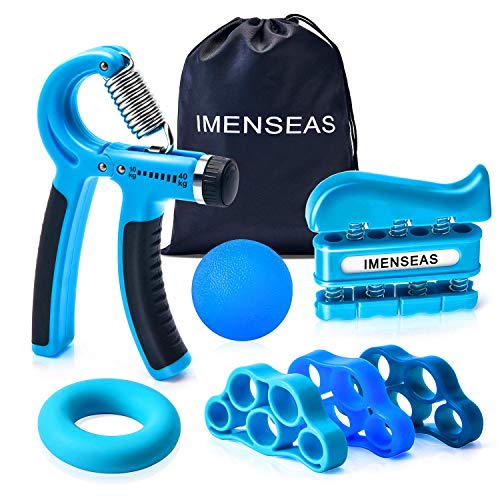
What makes the IMENSEAS 7-Piece Grip Training Kit stand out as an all-in-one option is its sheer versatility. You get an adjustable hand gripper (22–88 lbs) plus progressive finger stretchers, a four-finger exerciser, a 50-lb grip ring and a stress ball — so it covers strengthening, extension and stress relief in one kit. The range of resistances and silicone construction make it approachable for beginners, musicians, climbers and people rehabbing from tendon or wrist issues, while the different pieces let you easily target specific muscles and track progress without buying separate tools.
It’s not perfect for elite athletes who need very high loads or metal-grade grippers, and some components are simpler in feel compared with premium single-purpose devices. Still, for most users this kit delivers excellent value: well-thought-out resistance variety, compact portability and practical rehab uses make it a smart pick if you want a complete, ready-to-go hand and finger training setup.
Best Grip Strength Tester

Specifications
| Brand | CAMRY |
|---|---|
| Material | ABS |
| Adjustability | Adjustable (hand-size gear) |
| Weight | 0.9 lb |
Pros
Cons
The CAMRY digital hand dynamometer feels like a reliable, no-nonsense choice for anyone wanting accurate grip numbers. Its high-precision strain gauge and fine resolution (up to 198 lbs / 90 kg with 0.2 lb / 0.1 kg steps) give confidence in single-attempt readings, while the automatic peak-hold and an intuitive status bar (weak/normal/strong based on age and gender) make results easy to interpret. I also appreciate the adjustable grip for different hand sizes and the large LCD that shows user code, age, gender, units and status all at once. Storing up to 19 users with automatic comparison to prior tests is handy for tracking progress in a household or small clinic.
That said, it’s fairly straightforward rather than high-tech: there’s no Bluetooth or app syncing and analytics are basic. The included AAA batteries and five-year warranty are nice touches. For most home athletes, therapists, or coaches wanting dependable, easy-to-read measurements, this unit punches above its price.
Best for Wrist Rehab

Specifications
| Brand | DMoose Fitness |
|---|---|
| Material | Rubber; Steel; Nylon rope |
| Adjustability | Fixed |
| Dimensions | 16.3 x 4.1 x 0.1 in |
Pros
Cons
For wrist rehab, the DMoose forearm and wrist roller checks a lot of the right boxes. Its dual-function design lets you target wrist flexion/extension and forearm grip in controlled, repeatable reps—exactly what you want when rebuilding strength slowly. The anti-slip textured handles feel secure even when your palms get sweaty, and the solid steel rod (rated up to 240 lbs) gives peace of mind that it won’t bend under heavier loading as you progress.
The real rehab-friendly detail is the grooved finger roller: that textured surface helps finger dexterity and gentle tendon work, useful for conditions like tennis elbow, carpal tunnel, or wrist tendonitis. It’s compact and simple to use at home, which helps with consistency in a recovery program. On the downside, it’s a basic mechanical tool—no adjustable resistance settings or digital feedback—so progression depends on how you load and use it, ideally under guidance. Overall, it’s a practical, durable choice for focused wrist rehab.
What To Look For
Picking the right grip strengthener comes down to matching the tool to your goals, hand size and how often you plan to train, so you actually use it long-term. Think about progression, comfort and durability up front to avoid buying something you outgrow or stop using quickly.
- Resistance range and progression: Choose a device with a resistance span that matches your current strength and offers clear incremental increases so you can keep getting stronger without replacing equipment.
- Adjustability: Adjustable tension or interchangeable springs lets multiple users or changing strength levels get consistent, measurable workouts from one tool.
- Ergonomics and handle shape: Handles should fit your hand comfortably, align with your natural grip and reduce wrist strain to encourage proper form and longer sessions.
- Material and durability: Look for high-quality metal, reinforced plastics or solid rubber that resist cracking, corrosion and wear if you plan to train frequently.
- Size, weight and portability: Compact, lightweight options are easy to carry and use anywhere, while larger, heavier units may offer higher resistance for advanced lifters.
- Comfort and grip surface: Non-slip coatings, textured grips or cushioned handles improve control during intense reps and protect skin from blisters or pressure points.
- Measurement and feedback: Built-in counters, adjustable dials or companion apps help track progress, set targets and stay motivated with objective feedback.
- Intended use and safety: Different tools suit rehabilitation, climbing, general fitness or powerlifting, so pick one designed for your specific needs and follow safety recommendations.
- Price, warranty and value: Balance upfront cost with expected lifespan and warranty coverage to ensure you get reliable performance without overspending on unneeded features.
- Versatility and additional exercises: Some grip trainers allow pinch, crush and finger-specific work or attach to other equipment, giving more training variety from a single purchase.
Prioritize a comfortable, durable tool with appropriate resistance and clear progression so it matches your goals and keeps you training consistently.
How We Select Our Products
Picking the handful of grip strengtheners you see highlighted here wasn’t random — it was the result of a methodical, multi-step process designed to give you recommendations you can trust. We started broad, compiling dozens of contenders from major retailers, specialty fitness brands, and active community recommendations. From there we applied a consistent scoring system that balanced objective data (like resistance range and materials) with real-world feedback (customer ratings and long-form reviews). Products that lacked enough reliable information or had safety complaints were filtered out early.
When evaluating candidates we looked at several key criteria. Build quality and durability were non-negotiable — stainless springs, reinforced housings, and replaceable parts scored higher. Ergonomics and comfort mattered just as much: grip diameter, texture, and how the device feels over repeated reps influence whether you’ll actually use it. Resistance range and adjustability were critical for different fitness levels, from rehab to rock climbing. We also compared value for money by weighing price against lifespan, warranty, and how much training progression the device supports. Brand reputation, transparent specs, and availability of spare parts were considered too.
Beyond specs and star counts, we analyzed hundreds of user reviews and tested a selection ourselves. That meant squeezing, timing sets, noting noise and hand fatigue, and testing adjusters and locking mechanisms over weeks. We paid attention to consistent patterns in complaints or praise rather than isolated opinions. Finally, the results were aggregated into a clear ranking, with pros and cons for each pick to help you choose based on your goals.
We update the list periodically, re-checking recalls, new models, and long-term user feedback. Our aim is simple: give you thoughtfully researched, practical choices so you can build grip strength without guessing.
Final Thoughts
Picking the right grip strengthener can make a surprisingly big difference—because not all tools meet the same needs. If you’re rehabbing an injury, you’ll want something with gentle, adjustable resistance and a comfortable grip so you can progress without flaring pain. Athletes and climbers, on the other hand, benefit from models that let you precisely increase tension and train different grip types (crush, pinch, support) to build functional strength and endurance. Musicians and people whose work involves fine motor skills should look for devices that improve finger isolation and dexterity rather than brute force. For older adults or those with arthritis, soft, ergonomic designs that reduce joint stress and offer predictable resistance are key.
Beyond the physical benefits—better grip strength reduces injury risk, improves daily tasks, and supports stronger lifts in the gym—choosing the right tool improves consistency. You’re more likely to stick with a tool that feels good in your hand, fits your routine, and shows measurable progress. Consider materials, adjustability, size, and portability: a compact trainer is great for travel, while a heavy-duty steel trainer may suit those focused on maximal strength. Don’t forget safety and quality—cheap spring devices can fail or strain your joints.
Make an informed choice by matching a trainer’s features to your specific goal, reading user feedback, and, when applicable, consulting a physical therapist or coach. That way you’ll pick a grip strengthener that helps you progress steadily, stays comfortable to use, and actually keeps you coming back.